工程选型指南 高温安全阀选型指南 应根据实际泄放工况进行选择,而非仅依据笼统的温度标签。需将泄放温度、泄放量、压力-温度额定值、部件暴露条件、背压、高温管道、试验及文件资料作为一个完整的压力保护系统一并审查。 泄放温度 泄放量基准 材料与密封面 背压 询价资料 本页内容 快速…

工程选型指南
高温安全阀选型指南
应根据适用的泄放工况进行选型,而非仅依据通用温度标签。 应将泄放温度、泄放量、压力-温度额定值、部件暴露条件、 背压、热管道、测试及文件资料作为一个完整的压力保护系统进行综合审查。
快速解答:高温安全阀应如何选型?
应根据主导泄放工况而非通用温度标签来选择高温安全阀。确认受保护设备、介质及相态、工作压力、MAWP或设计压力、整定压力、所需泄放量及其依据、泄放温度、叠加背压和排放背压,以及入口和出口管道布置。
然后校核阀体和法兰的压力-温度额定值、所选流道面积、有记录或经认证的排量,以及每个受限部件的温度暴露情况,包括阀座、弹簧、波纹管、垫片、密封件、先导阀和感测系统(如配备)。连接尺寸、压力等级、阀体材料、金属阀座或开放式阀盖本身并不能证明适用性。如果工况、排量、泄放温度或背压数据缺失,最终选型仍需根据制造商数据、项目规范和所采用的规范版本进行确认。
产品系列说明: 高温安全阀.
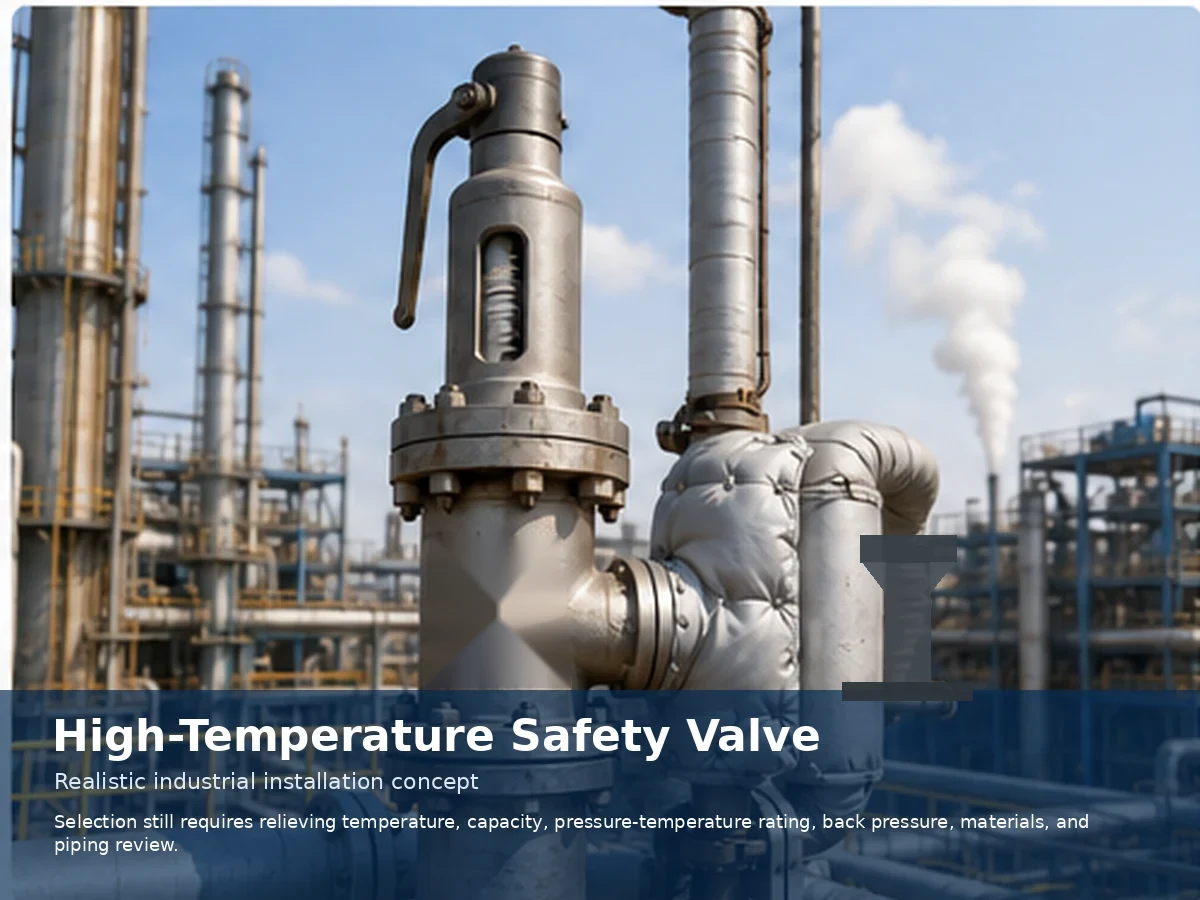
贴近工业实际的可视化效果。最终阀门配置、材料、压力等级及安装方式须根据所选型号和项目要求予以确认。
什么工况属于安全阀的高温工况?
There is no universal temperature cutoff for every safety valve. The service becomes temperature-critical when heat changes the capacity calculation, pressure rating, component suitability, set-pressure behavior, leakage risk, piping loads, or maintenance method. Continuous exposure and short relieving exposure must be reviewed separately because the highest fluid temperature may not be the longest component exposure.
| 高温复核触发条件 | 变更内容 | 需要证据 |
|---|---|---|
| 压力-温度额定值降低取决于材料 | 阀体、法兰、螺栓连接或相连管道的允许压力可能降低。 | 材料组、金属温度、额定值表及采用版本。 |
| 泄放特性与正常运行不同 | 密度、可压缩性、黏度、闪蒸或两相行为可能改变所需面积。 | 工况相关的泄放压力、温度、相态及物性参数。 |
| 内部零部件成为限制因素 | 阀座、导向件、弹簧、波纹管、垫片、密封件、先导阀或传感管线可能决定整体性能。 | 所选型号的零部件材料及制造商温度限值。 |
| 热循环或热浸影响显著 | 间隙、对中、垫片载荷、弹簧受热情况以及外部管道载荷均可能发生变化。 | 运行周期、暴露持续时间、保温边界及安装布置。 |
| 排放管道会产生热-机械载荷 | 膨胀、反作用力、冷凝水、背压及支撑均可能影响运行。 | 出口计算、支撑方案、疏水及公用集管数据。 |
持续工况与泄放工况对比
A valve on a hot header may remain heat-soaked during normal operation without lifting. Another valve may stay relatively cool until a short upset sends a hotter fluid through the nozzle and outlet. The RFQ should identify both conditions, their duration, and expected cycling.
当笼统的“高温”标签不够用时
- 不要仅依据产品目录中的最高温度进行选型,而应确认具体的系列和配置。
- Do not infer spring temperature from inlet-fluid temperature.
- Do not assume the highest-temperature scenario also controls relieving capacity.
- Do not use body material as proof that seats, gaskets, bellows, pilots, or seals are suitable.
- Do not approve a replacement from size, class, and appearance alone.
选型时应采用哪个温度值?
Use a temperature map rather than one undefined “maximum temperature.” The map should connect each relief scenario to the fluid temperature at the valve inlet, the expected body and flange metal temperature, and the probable spring-chamber or pilot-component exposure.
| Temperature Input | 工程用途 | 常见错误 |
|---|---|---|
| Operating temperature | Continuous heat exposure during normal service. | Using it as the only temperature in the RFQ. |
| 设计温度 | Equipment or piping design boundary and rating review. | Substituting it automatically for relieving temperature. |
| 泄放温度 | Fluid properties, sizing, internal exposure, and discharge behavior for a named relief case. | Providing a value without identifying the scenario. |
| Body / flange metal temperature | Pressure-temperature rating of pressure-containing parts and connections. | Checking pressure class without material group and metal temperature. |
| Spring-chamber / bonnet temperature | Spring material, set-pressure correction, seals, guides, and long-term stability. | Assuming it equals the inlet-fluid temperature. |
| Ambient / external heat exposure | Fire case, radiant heat, weather, insulation, or local thermal environment where applicable. | Ignoring external heat or blocked ventilation. |
Minimum Temperature Map for the Datasheet
- Name each credible relief scenario and identify which case controls capacity.
- State operating, design, and relieving temperature as separate fields.
- Identify whether the fluid is steam, gas, vapor, liquid, or two-phase at relief conditions.
- State expected exposure duration and thermal-cycle frequency.
- Mark body-metal and spring-chamber temperature as measured, calculated, estimated, or to be confirmed.
- Identify insulation, heat tracing, jackets, fire exposure, and hot common headers.
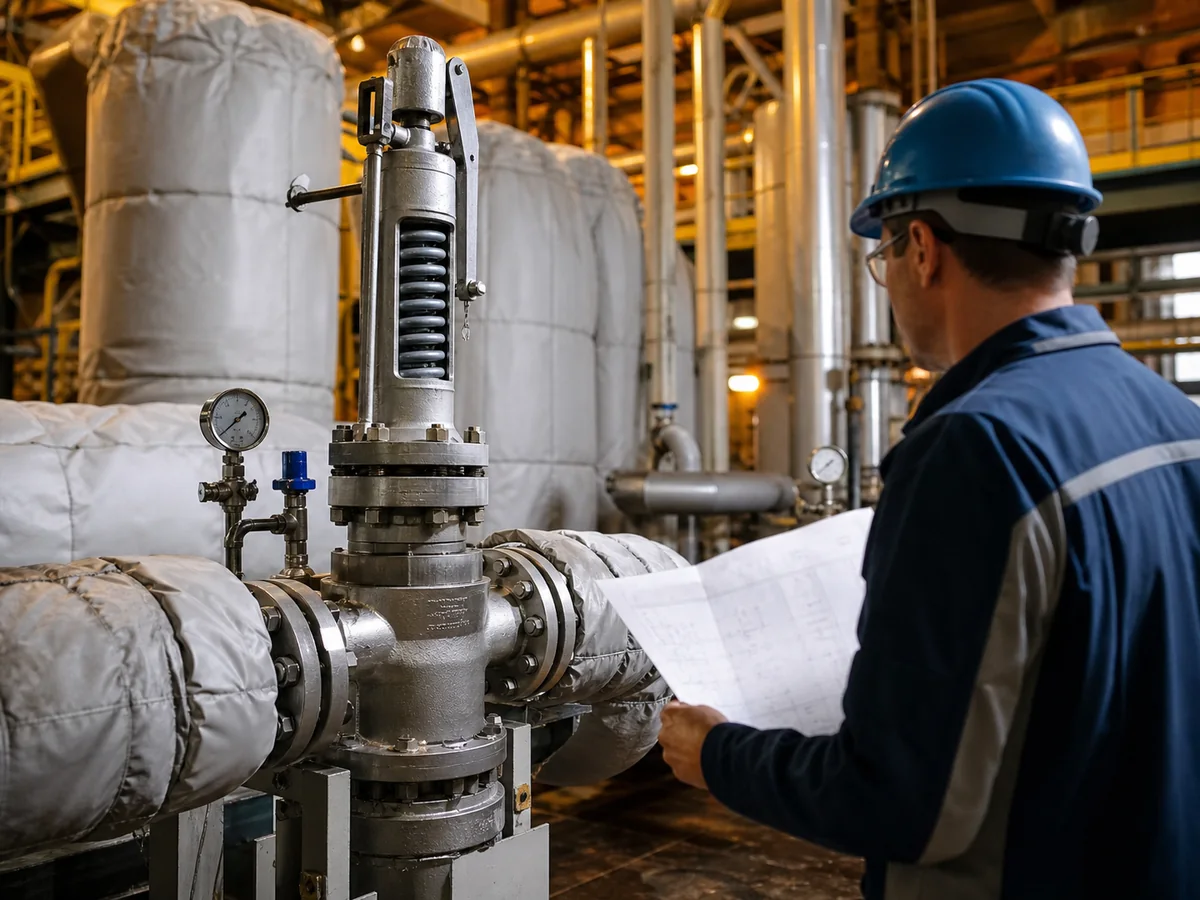
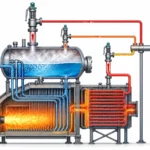
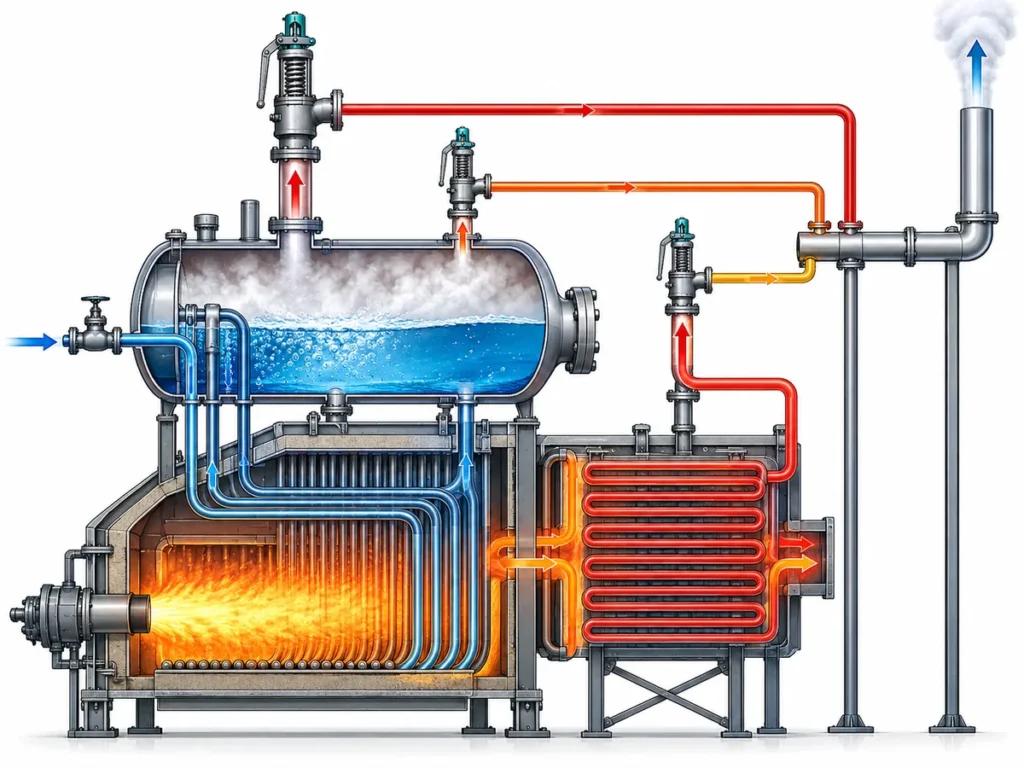
Simplified engineering illustration. Actual component temperatures depend on the valve design, installation, insulation, relief scenario, and manufacturer data.
高温安全阀选型工作流程
The workflow is sequential. A supplier can offer a preliminary configuration with incomplete information, but the result must remain clearly marked as provisional until the missing inputs are confirmed. Use the API 521 压力泄放系统 guide when defining relief scenarios, disposal systems, flare or vent context, and depressuring interfaces within its applicable scope.
| 步骤 | 决策 | Minimum Input | Stop / Confirm Condition |
|---|---|---|---|
| 1 | Define protected equipment and relief scenario | P&ID, protected boundary, scenario description | Boundary or credible case unclear |
| 2 | Confirm medium and phase | Composition and relief-state phase | Two-phase, reactive, coking, or corrosive behavior undefined |
| 3 | Confirm pressure and capacity basis | Operating pressure, MAWP/design pressure, set pressure, required rate | No approved capacity calculation |
| 4 | 确定控制泄放温度 | 特定工况下的压力、温度和物性参数 | 仅提供了正常工作温度 |
| 5 | 校核压力-温度额定值 | 材料组别、Class/PN、金属温度、额定值标准 | 无法证明额定值 |
| 6 | 筛选阀体部件与结构配置 | 阀体、内件、阀座、弹簧、阀盖、波纹管/先导/密封件 | 任何受限部件未经验证 |
| 7 | 复核进口、出口及背压 | 压力损失、背压、支撑、排放、热膨胀数据 | 未评估稳定性或机械载荷 |
| 8 | 确认试验与文件 | 试验依据、排量证明、图纸、材质记录、批准文件 | 未约定所需证明文件 |
初步选型矩阵
| 观察到的工况 | 可考虑的审查方向 | 不能证明的内容 |
|---|---|---|
| 出口背压高或波动 | 在型号限值允许时,审查波纹管平衡式或先导式方案。 | 即认为任一结构在所需温度下均自动适用。 |
| 高温蒸汽且存在弹簧受热风险 | 审查阀盖形式、弹簧腔温度、疏水排放及适用的锅炉/压力容器规范。 | 即认为必须采用开放式阀盖。 |
| 黏稠、结焦或凝固性液体 | 复核液体排量、沉积物、排液、伴热或夹套需求。 | 认为所有导热油安全阀都必须带夹套。 |
| 严格泄漏要求 | 确定阀座结构及所需的阀座密封性试验。 | 认为金属阀座可实现零泄漏。 |
| 记录有限的更换 | 在选型替换前,先还原原设计依据。 | 认为尺寸或压力等级一致即可视为等效。 |
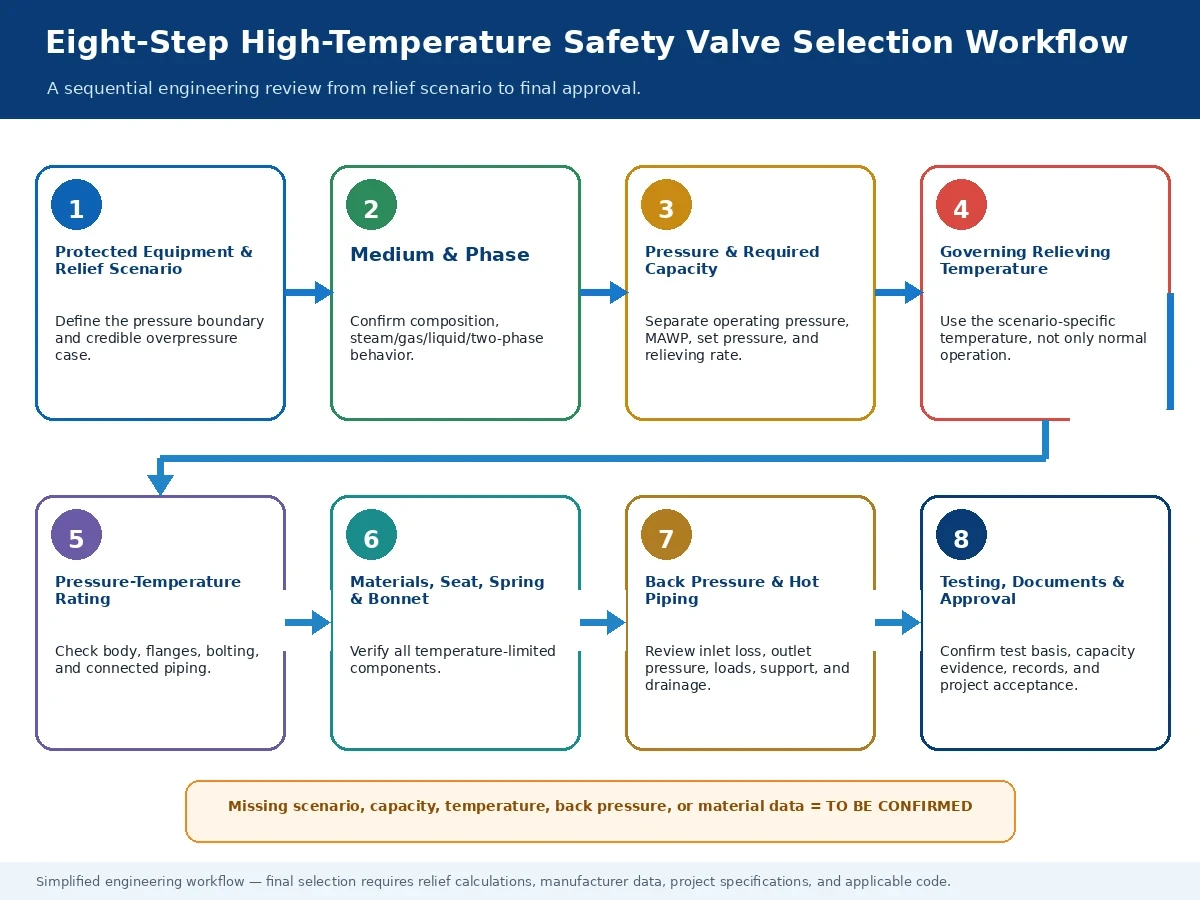
简化选型流程。最终选型仍需依据实际泄放计算、制造商数据、项目规格书、适用标准版本及当地要求。
校核压力-温度额定值和所需泄放量
压力等级参考: 压力-温度额定值.
Capacity reference: 安全阀定径与认证泄放能力.
Sizing-method context: API 520 sizing workflow for translating the applicable sizing and selection basis into RFQ inputs; the project must still confirm the adopted edition, scope, and exact valve data.
Rating and capacity are separate checks. Use the applicable flange standard to verify flanges and flanged fittings within that standard’s stated scope. Verify the valve-body and complete assembly pressure-temperature limits from the selected valve design basis and manufacturer data. Relieving capacity is a separate question: it concerns the amount of fluid the exact valve configuration can discharge under the approved scenario basis.
Pressure Terms That Must Remain Separate
| 术语 | 工程含义 | 选型边界 |
|---|---|---|
| 工作压力 | Normal system pressure during intended operation. | Does not establish set pressure, MAWP, or relieving capacity. |
| 设计压力 | Pressure used as part of the equipment or piping design basis. | Must not be treated automatically as MAWP or relieving pressure. |
| MAWP | Maximum allowable working pressure of the protected equipment at the governing temperature, as defined by the applicable design basis. | Belongs to the protected equipment; it is not a valve-capacity value. |
| 整定压力 | Specified inlet pressure at which the safety valve is set to begin opening under the applicable test or service basis. | Does not prove the required or documented relieving capacity. |
| 超压 | Pressure increase above set pressure while the valve is relieving. | Use the applicable project and code basis; do not assume a universal percentage. |
| 泄放压力 | Valve-inlet pressure used with the approved relief scenario for sizing and capacity verification. | Must be tied to the medium, phase, relieving temperature, and scenario assumptions. |
| 压力积聚 | Pressure increase above the protected equipment’s MAWP during an overpressure event. | Relates to the protected system and is not interchangeable with valve overpressure. |
| Blowdown / reseat pressure | Difference between set pressure and reseating pressure, or the pressure at which the valve closes after opening. | Depends on valve design, service, adjustment limits, and the applicable acceptance basis. |
| 项目 | Required Engineering Question | Evidence to Accept |
|---|---|---|
| 所需泄放量 | What mass or volumetric flow must the system relieve in the controlling case? | Approved relief calculation and physical-property basis. |
| 所需面积 | What area follows from the applicable sizing method and scenario inputs? | Calculation sheet with pressure, temperature, medium, phase, and correction basis. |
| 所选流道 | Does the chosen orifice meet or exceed the required area without relying on connection size? | Manufacturer orifice data for the exact model. |
| Documented / certified capacity | Does the selected valve configuration provide the required capacity at the stated conditions? | Applicable manufacturer capacity documentation and project-required certification basis. |
| 压力-温度额定值 | Can the body, inlet/outlet flanges, bolting, gasket, and connected piping carry pressure at metal temperature? | Material group and adopted pressure-temperature rating source. |
| Back-pressure effect | Does outlet pressure alter capacity, opening, stability, or blowdown? | System calculation and selected-model back-pressure limits. |
DN/NPS, inlet size, outlet size, Class, PN, body material, and external dimensions do not by themselves establish relieving capacity.
Capacity Review Before Replacement
Compare the original required capacity, selected orifice, set pressure, allowed overpressure, medium, relieving temperature, and back pressure with the proposed replacement. Where original calculations or capacity records are unavailable, the replacement remains an engineering reassessment—not a like-for-like purchase.
选择阀体、内件、阀座、弹簧、波纹管及密封材料
Treat the valve as an assembly. The lowest verified component limit can govern even when the body material and pressure class appear acceptable.
| 部件 | High-Temperature Screening | Confirmation Required |
|---|---|---|
| Body / bonnet / flanges | Allowable stress, oxidation, corrosion, thermal cycling, and pressure-temperature rating. | Exact material specification, metal temperature, class/PN, and model limit. |
| Nozzle / disc / spindle / guide | Distortion, erosion, corrosion, deposits, differential expansion, and galling. | Trim combination, hardness or surface treatment where applicable, and fluid compatibility. |
| 阀座 | Actual seat temperature, leakage requirement, contamination, cycling, and fire/upset exposure. | Metal or soft-seat construction, test medium, test pressure, and acceptance criterion. |
| 弹簧 | Actual spring-chamber temperature, relaxation risk, adjustment range, and set-pressure correction. | Spring material, manufacturer temperature basis, and test procedure. |
| Bellows — if fitted | Temperature, pressure, corrosion, fatigue, venting, and back-pressure duty. | Bellows material, cycle basis, vent arrangement, and model limits. |
| Pilot / seals / sensing line — if fitted | Seal, diaphragm, piston, tubing, condensation, plugging, or heat-tracing limits. | Exact pilot system and all temperature-limited components. |
| Gaskets / packing / seals | Thermal degradation, extrusion, leakage, and medium compatibility. | Actual component temperature and approved material. |
金属密封与软密封
A metal seat is often reviewed for elevated temperature, but it does not mean zero leakage. A soft seat may be acceptable only where the exact material, seat temperature, pressure, medium, cycling, and manufacturer limit are verified. The purchase specification should define the required API 527 阀座密封性试验 or other project-approved test method, test medium, pressure, and acceptance basis rather than relying on a generic seat description.
Material Selection Stop Conditions
- The composition or phase at relief conditions is unknown.
- The selected model’s spring, seal, bellows, or pilot limits are unavailable.
- The fluid can coke, polymerize, crystallize, corrode, or deposit solids and no cleaning strategy is defined.
- Body/flange rating is checked, but trim and gasket materials remain unspecified.
- A product-family temperature range is being applied to an unconfirmed individual model.
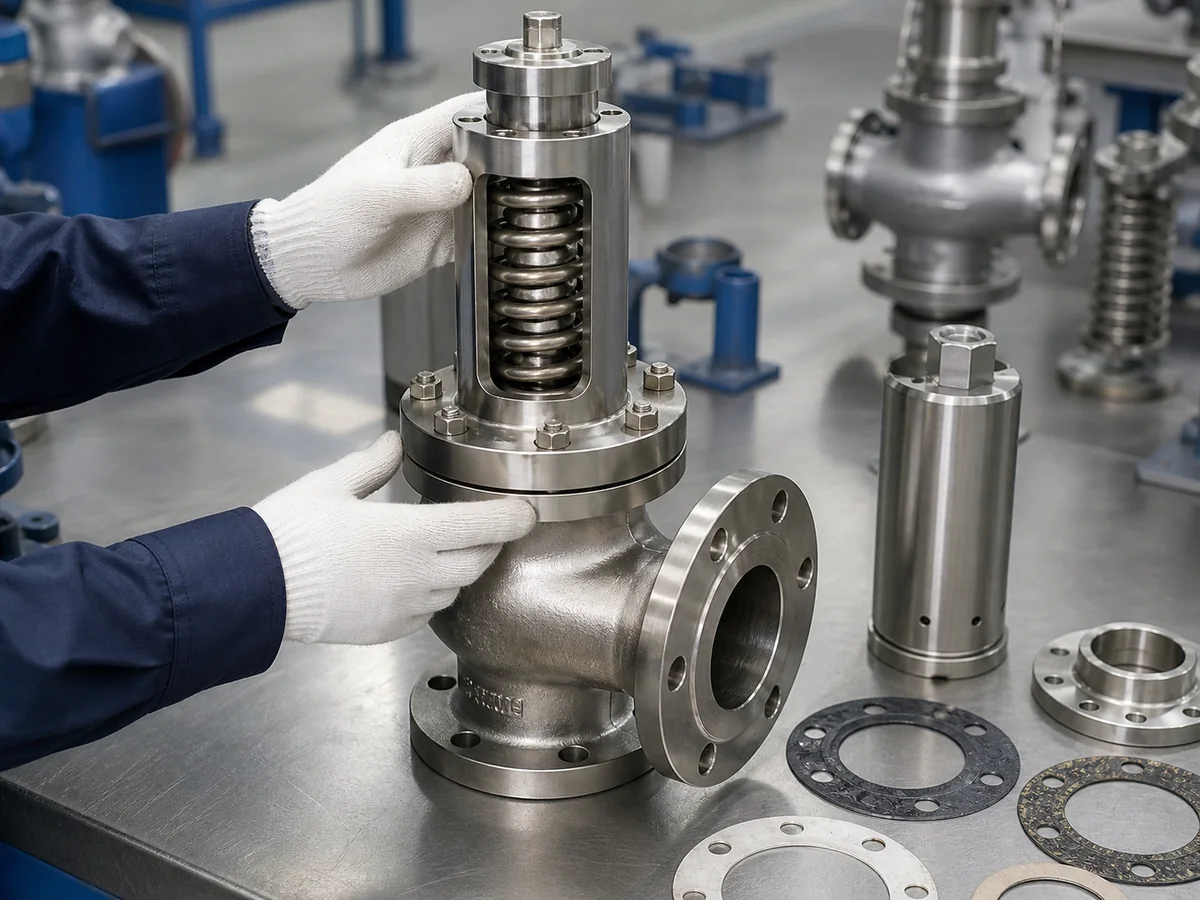
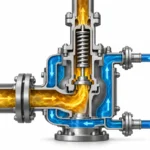
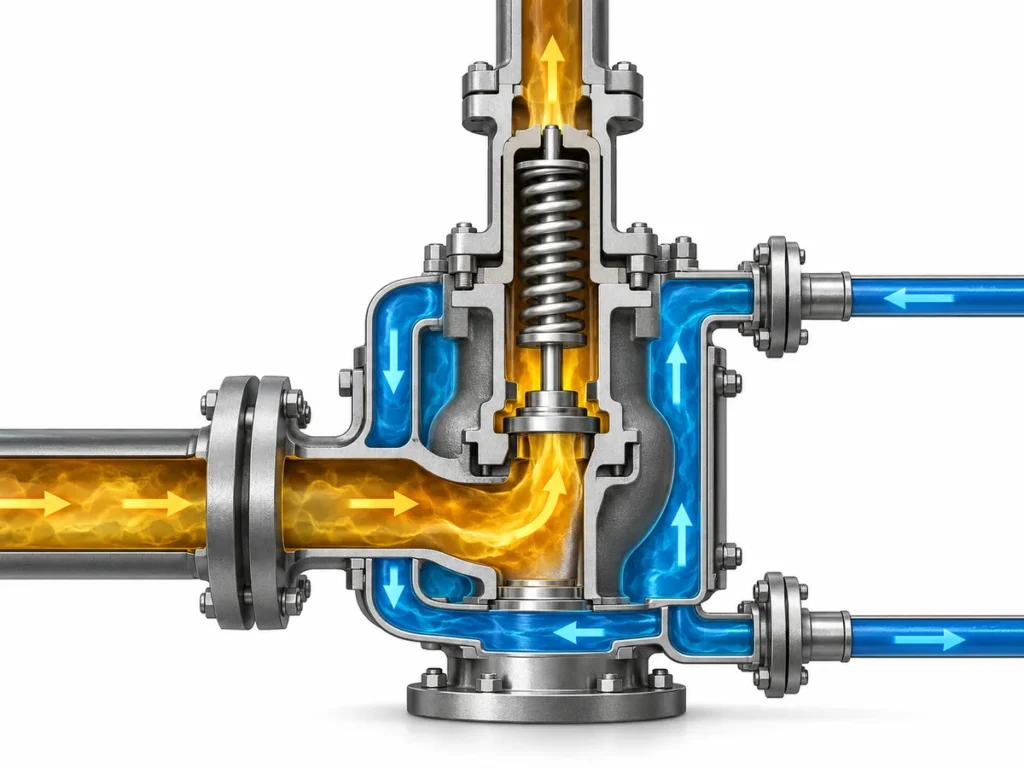
Simplified engineering illustration, not a certified manufacturing drawing. Component arrangement varies by valve design.
根据介质和工作条件选择阀门配置
Temperature narrows the acceptable designs, but the medium, phase, operating margin, back pressure, leakage requirement, maintenance method, and code scope determine the configuration review.
For saturated or superheated steam product-family context, review 蒸汽安全阀; the final bonnet, lever, trim, spring, capacity, and test basis remain model- and project-specific.
| 工况 | Primary Selection Inputs | Configuration Questions | 切勿假设 |
|---|---|---|---|
| Saturated / superheated steam | Steam capacity, relieving temperature, code scope, drainage, spring exposure, reaction force. | Bonnet, lever, trim, discharge arrangement, and test basis. | Open bonnet or one steam-valve design is mandatory for every case. |
| Hot gas / vapor | Composition, compressibility, relieving temperature, flare/header back pressure, toxicity and disposal. | Conventional, balanced, or pilot-operated design within model limits. | Pilot-operated automatically means better high-temperature performance. |
| Thermal oil / hot liquid | Liquid capacity, viscosity, flashing, coking/deposits, blocked-in thermal expansion, drainage. | Liquid trim, seat, collection system, tracing or jacket only where justified. | Every hot liquid requires a jacketed valve. |
| Two-phase / reactive service | Approved scenario method, phase split, reaction heat, deposits, discharge system. | Model-specific stability, materials, and disposal-system review. | A generic gas or liquid selection method is sufficient. |
When Not to Select by Temperature Alone
- Variable back pressure may govern the choice between conventional, balanced, and pilot-operated designs.
- Toxic or flammable media may govern bonnet, vent, packing, and discharge containment.
- Viscous or deposit-forming liquids may govern drainage, tracing, cleaning, and inlet layout.
- Boiler, vessel, or piping jurisdiction may govern construction, lever, testing, and documentation.
- Frequent cycling may govern guides, springs, gaskets, bellows, and inspection intervals.
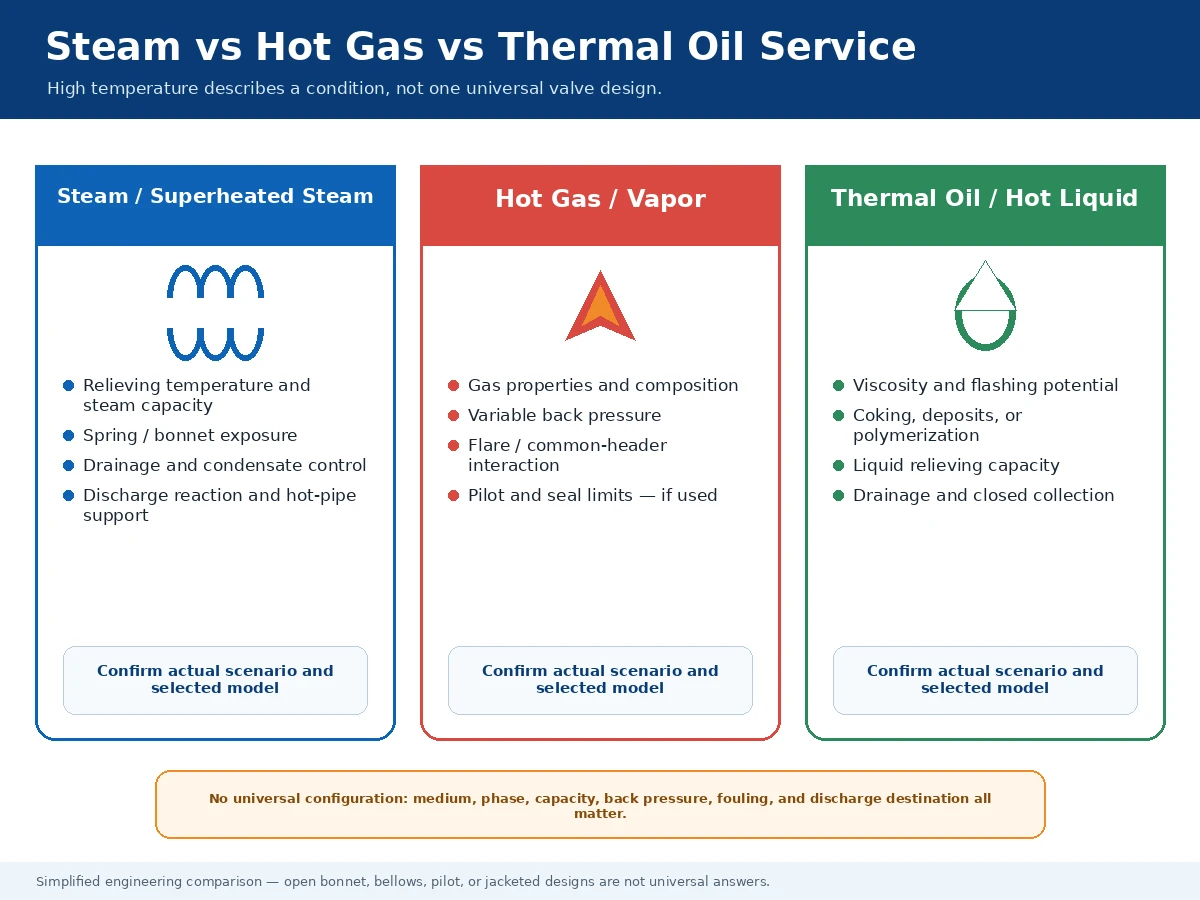
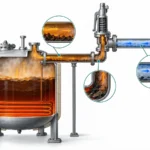
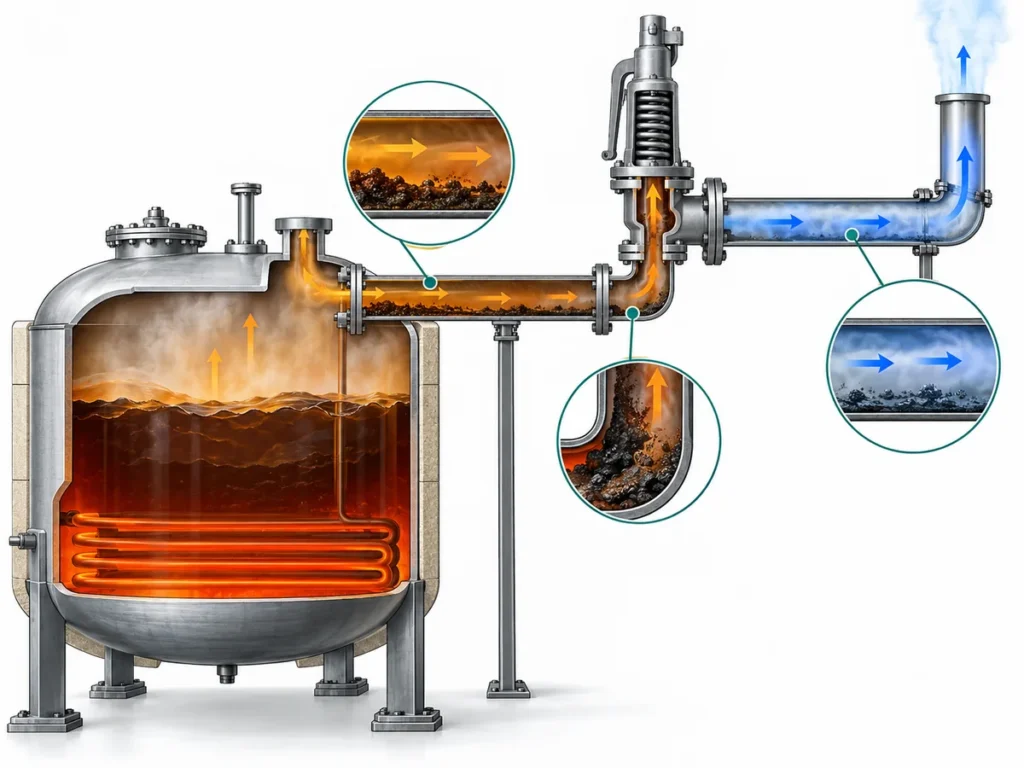
Simplified engineering comparison. Final configuration depends on the actual medium, relief scenario, project code, and manufacturer model limits.
审查背压、入口损失和热排放管道
Related engineering guide: 背压与波纹管.
A thermally suitable valve can still be unstable, undersized, or mechanically overloaded when the inlet and outlet systems are not reviewed as part of the relief path.
For inlet routing, outlet support, drainage, orientation, vents, and safe discharge review, use the 安全阀安装指南.
| 观察到的工况 | 工程影响 | 所需措施 |
|---|---|---|
| Superimposed back pressure before opening | Can change effective opening conditions and conventional-valve suitability. | State normal and maximum values and whether they are constant or variable. |
| Built-up back pressure during discharge | Can affect capacity, stability, blowdown, and outlet loading. | Calculate at required flow and compare with exact model limits. |
| 共用排放总管 | Other devices can create variable pressure and interaction. | Provide simultaneous-relief assumptions and header calculation. |
| 入口压力损失过大 | Can reduce valve-inlet pressure during flow and promote instability or chatter. | Calculate the inlet loss for the required flow using the applicable project basis. |
| Hot outlet thermal growth | Can impose bending, flange, and nozzle loads on the valve. | Provide independent support, flexibility, and reaction-force review. |
| Condensate or trapped liquid | Can add back pressure, corrosion, water hammer, freezing, or unsafe discharge. | Define drainage, low points, venting, and safe collection. |
| Insulation around bonnet, vents, or pilot | Can raise component temperature or block required openings. | Confirm the manufacturer-approved insulation boundary. |
Installation Do / Do Not
| 应做 | 不宜做 |
|---|---|
| Keep the inlet direct and sized from the pressure-loss calculation. | Reduce or lengthen the inlet without checking stability and capacity. |
| Support heavy outlet piping independently. | Use the valve body as a pipe anchor. |
| Provide thermal flexibility and discharge-reaction support. | Force flange alignment or transfer expansion loads into the valve. |
| Provide drainage and protect required vents. | Trap condensate or cover bonnet/bellows vents with insulation. |
| Confirm safe discharge and personnel protection. | Route hot discharge toward walkways, platforms, or maintenance areas. |
高温工况下可能出现哪些问题?
Failure symptoms should be traced back to the relief scenario, capacity, temperature map, materials, back pressure, and installation—not treated as isolated valve defects.
| 症状或风险 | 可能原因 | 首要工程检查 |
|---|---|---|
| Valve chatters or cycles during relief | Inlet pressure loss, excessive/variable back pressure, oversized valve, or unsuitable operating margin. | Inlet/outlet calculations, required capacity, selected orifice, and model stability limits. |
| Seat leakage increases after hot service | Thermal distortion, deposits, erosion, contamination, or test requirement mismatch. | Seat condition, fluid cleanliness, actual seat temperature, and specified tightness basis. |
| Set pressure shifts | Spring-chamber temperature, spring relaxation, incorrect correction, friction, or poor calibration. | Spring temperature, manufacturer correction method, test records, and guide condition. |
| Bonnet, pilot, or seals overheat | Insulation boundary, heat conduction, hot ambient, leakage, or sensing-line exposure. | Component temperature map and manufacturer limits. |
| Flange leakage or body distortion | Pressure-temperature rating mismatch, gasket/bolting issue, forced alignment, or thermal pipe load. | Rating, bolting, gasket, supports, and piping stress. |
| Replacement does not match capacity | Selection based on size, class, or appearance rather than relief basis. | Required capacity, original orifice, documented capacity, medium, and relief conditions. |
| Bellows or pilot reliability concern | Temperature, corrosion, fouling, vent blockage, fatigue, or unsuitable back-pressure duty. | Exact component materials, cycle, vent/sensing arrangement, and model limitations. |
综合工程场景培训
These are hypothetical combinations used to explain the decision logic. They are not customer projects, field results, capacity evidence, certification records, or proof that a particular ZOBAI model is suitable.
| Composite Training Scenario | Controlling Questions | 所需依据 |
|---|---|---|
| 过热蒸汽母管 | Which code scope applies? Which case controls capacity? What relieving and spring-chamber temperatures apply? What drainage, reaction, and support are required? | Steam relief calculation, set/overpressure basis, temperature map, material/rating review, discharge layout, and test requirements. |
| Thermal-oil loop | Is the case thermal expansion, blocked outlet, or another upset? What are viscosity, flashing, coking, seat-leakage, and collection requirements? | Liquid relief basis, properties at relief conditions, material compatibility, drainage, tracing/jacket justification, and outlet-system data. |
| Hot process gas or reactor | Is the relief gas, vapor, or two-phase? Is the fluid reactive, polymerizing, corrosive, or connected to a variable-back-pressure flare header? | Approved process calculation, composition/phase, relieving pressure and temperature, back-pressure profile, selected-model limits, and disposal-system data. |
Scenario Review Template
- Define the protected equipment and pressure boundary.
- Name the credible overpressure case and identify the controlling case.
- Confirm medium, phase, composition, relieving pressure, and relieving temperature.
- Verify required capacity and selected-valve capacity basis.
- Screen component materials and valve configuration.
- Review inlet loss, back pressure, discharge loads, drainage, and safe disposal.
- Define testing, documents, approval, and installation responsibilities.
高温安全阀询价清单
A complete RFQ allows the supplier to distinguish preliminary screening from a final engineering selection and reduces the risk of hidden assumptions.
| 数据组 | 最低资料要求 | 为什么需要这些信息 |
|---|---|---|
| 被保护设备及工况 | Equipment tag, protected boundary, scenario description, P&ID. | Defines what the valve protects and what drives flow. |
| 介质及相态 | Composition, steam/gas/vapor/liquid/two-phase state, corrosive or deposit-forming behavior. | Controls sizing, materials, seat, drainage, and discharge. |
| Pressure and capacity | Operating pressure, MAWP/design pressure, set pressure, allowed overpressure, required capacity and basis. | Separates pressure settings from required flow. |
| 温度 | Operating, design, relieving, body-metal, spring-chamber, ambient/fire exposure where applicable. | Supports sizing, rating, and component review. |
| 背压与管道 | Superimposed/built-up back pressure, inlet/outlet connections, pressure loss, support, drainage, discharge destination. | Supports stability, capacity, and mechanical integration. |
| Materials and configuration | Body, trim, seat, spring, bellows/pilot, gasket/seal, bonnet, lever, insulation boundary. | Identifies temperature- and medium-limited components. |
| 试验与文件 | Set-pressure test, temperature correction, seat test, material records, capacity basis, drawings, nameplate, ITP, code/edition. | Defines acceptance evidence before release. |
Testing and Documentation Matrix
| Document / Test | 用途 | Buyer Should Confirm |
|---|---|---|
| 泄放计算 | Defines required rate, area, pressure, temperature, phase, and assumptions. | Approved scenario and capacity basis. |
| 排量证明文件 | Shows selected-valve performance basis. | Exact model, orifice, medium, pressure, temperature, and required certification scope. |
| 整定压力 / CDTP 记录 | Connects workshop calibration to service conditions where correction is required. | Manufacturer method, test medium, and acceptance. |
| 密封性试验 | Defines leakage test method and acceptance. | Applicable standard, test pressure, medium, seat type, and project criterion. |
| 材质记录 | Verifies pressure-containing and specified internal materials. | Required document type, heat/lot traceability, and scope. |
| Drawing / BOM / nameplate | Verifies configuration, dimensions, materials, markings, and installation interfaces. | Consistency with datasheet and purchase order. |
| 安装及维护说明 | Defines orientation, support, vents, drainage, adjustment, inspection, and retest. | Exact selected series and revision. |
更换核实流程
- Collect the existing nameplate, datasheet, model, serial number, test records, and installation photographs.
- Recover the protected equipment, relief scenario, required capacity, and original code basis.
- Compare set pressure, orifice, documented capacity, relieving temperature, back pressure, materials, seat, bonnet, bellows/pilot, and connections.
- Check dimensional and piping compatibility without treating it as proof of hydraulic equivalence.
- Document all differences and obtain engineering approval before purchase or installation.

Conceptual checklist. Final data fields depend on the project, applicable code, selected valve design, and local regulatory requirements.
技术参考资料
These official sources support the engineering framework. The edition check below was completed on 3 August 2026. The project must still verify the adopted edition, scope, jurisdiction and acceptance criteria. A standard name does not prove that a specific ZOBAI valve is certified or approved for a particular service.
- API 520 第 I 部分 API identifies Part I, 10th edition, as the published sizing and selection standard for pressure-relieving devices within its stated scope; verify the project-adopted edition.
- API 标准 521 API’s current standards plan lists API 521, 7th edition, for pressure-relieving and depressuring systems; verify the adopted edition and project scope.
- ASME BPVC 第 XIII 卷 Official ASME page for the 2025 edition covering overpressure protection of boilers, pressure vessels and piping systems within its stated scope.
- ASME B16.5 Official ASME page for the 2025 edition covering pressure-temperature ratings, materials, dimensions and testing for flanges and flanged fittings within its scope—not the complete safety-valve assembly.
- ISO 4126-1 ISO 4126-1:2013 was reviewed and confirmed in 2025 and remains current; it is a safety-valve product standard, not an application code for the protected system.
- API 527 API’s current standards plan lists API 527, 5th edition, for seat tightness of pressure relief valves; verify the adopted edition, test medium, pressure and acceptance basis.
- 美国国家锅炉与压力容器检验师委员会:温度注意事项 National Board technical guidance explains that manufacturer literature is required for design temperature limits and correction factors, and that capacity must be evaluated at actual service conditions.
常见问题
01 安全阀在什么温度下被视为高温?
并非所有安全阀都存在统一的适用温度上限。当温度改变介质特性、压力-温度额定值、零部件限值、整定压力特性、泄漏风险、管道载荷或维护条件时,即需进行高温工况审查。请确认实际泄放工况及所选型号。
02 安全阀选型时应使用工作温度还是泄放温度?
两者可能均需考虑。工作温度描述的是持续暴露条件,而泄放温度描述的是特定超压工况下的介质状态,是定径与选型的关键输入参数。阀体金属及弹簧腔温度也可能需要单独评估。
03 高温工况是否必须使用金属密封面?
序号 在高温工况下常会考虑金属密封面,但具体选择取决于实际密封面温度、介质、压力、泄漏要求、沉积物、循环工况以及制造商数据。金属密封面并不代表零泄漏。
04 是否每台高温安全阀都必须采用开放式阀盖?
阀盖形式(开放式、封闭式、填料式或加长式)取决于弹簧是否外露、介质密封要求、排放方式、适用规范范围、环境条件及制造商设计。仅凭温度条件并不强制要求采用开放式阀盖。
05 温度升高时,还能使用相同的压力等级吗?
并非自动适用。压力-温度额定值取决于材料组、金属温度、适用标准及其版本。请按主导工况核对阀体、进出口法兰、螺栓、垫片及相连管道。
06 背压如何影响高温安全阀?
背压会影响开启、排量、稳定性、启闭压差及出口载荷。请确认叠加背压与排放背压的数值、其为恒定还是变化、公共排放总管的影响,以及所选型号的标定限值。
07 高温安全阀报价需要提供哪些信息?
提供受保护设备、泄放工况、介质及相态、操作压力与温度、MAWP/设计压力、整定压力、所需泄放量及依据、泄放温度、背压、连接形式、材质、阀座、弹簧/阀盖/波纹管或先导阀要求、管道数据、规范/版本、试验及文件。
工程评审
Send Your Operating Conditions for Engineering Review
Send the relief calculation, datasheet, P&ID, medium and phase, pressure definitions, required capacity, relieving temperature, back pressure, connections, materials, testing, and documentation requirements. Missing critical inputs will be returned as to be confirmed.