获取安全阀报价

请提供您的介质、整定压力、温度、口径、标准或数据表,我们的团队将审核您的需求并回复相应的后续步骤。.

压力真空泄放阀与安全阀:不同职责与定径基准

压力真空泄放阀(PVRV)与安全阀都能响应压力工况,但二者解决的保护问题不同。本文中,PVRV指用于常压或低压储罐压力及真空保护装置中的设备。安全阀指用于承压设备上的超压保护装置……

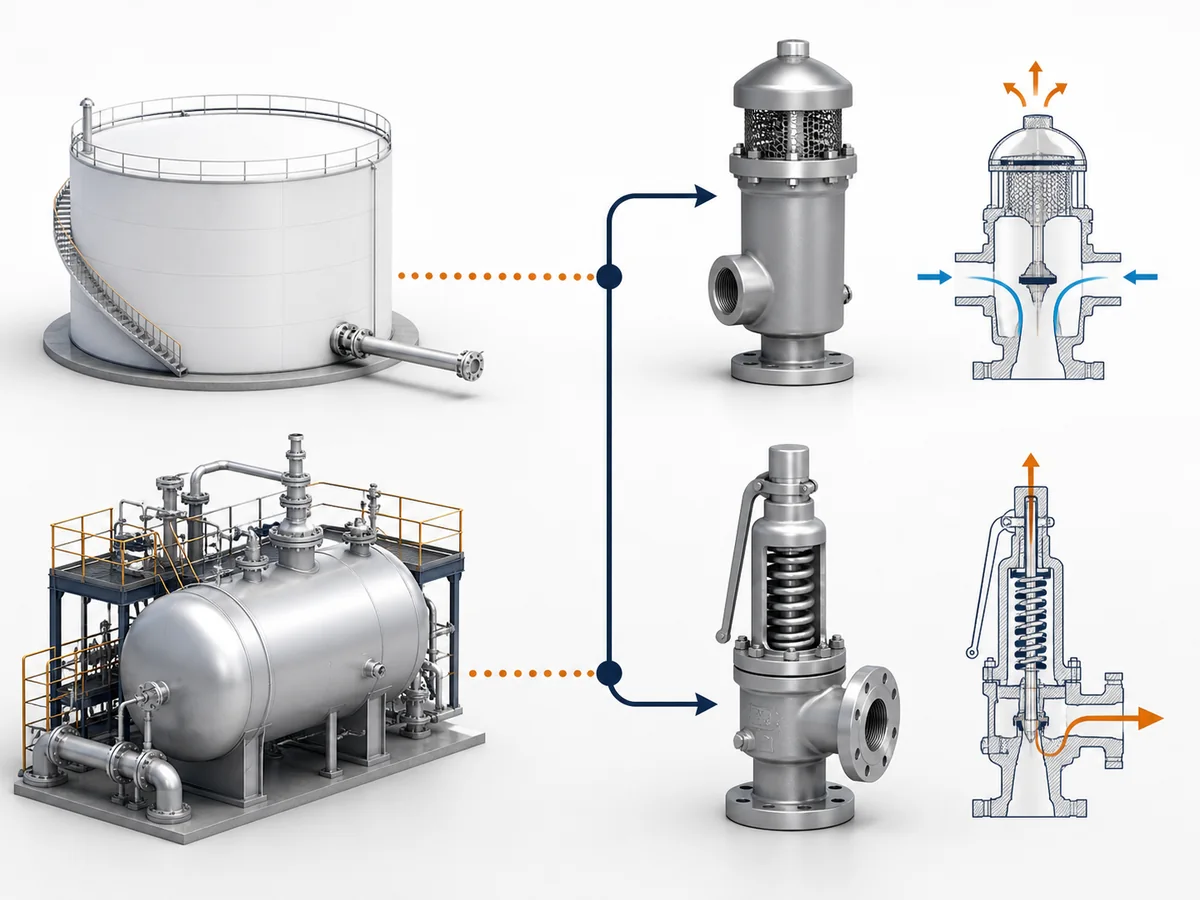
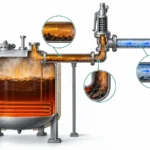
区分储罐压力真空保护与压力设备超压保护的决策图。.

泄压-真空安全阀(PVRV)和安全阀都能响应压力工况,但它们解决不同的保护问题。在本文中, PVRV 指用于常压或低压储罐的压力-真空保护装置。 安全阀 指在适用的设计和保护基准下,应用于承压设备上的超压保护装置。.

实际区别不仅仅在于阀门结构,而在于以下因素的组合: 受保护设备、所需工况、主导场景和定径基准.

储罐 PVRV 审查可能需要向外压力侧排放和向内真空侧流动,而正常和紧急储罐通风仍作为单独的检查。安全阀审查则从适用的超压泄放工况开始,确定所需泄放量,然后验证合适的装置容量以及主导基准所要求的支持性容量证据。.

由于这些工程路径始于不同的问题,匹配的连接、相似的压力等级或物理适配并不足以证明一种装置可以替代另一种装置。.

从受保护设备和泄放工况入手

在比较阀门尺寸、整定值或连接方式之前,先确定受保护的设备以及需要保护的压力边界。仅知道设备名称是不够的:实际的设计基础和所需的保护工况决定了应采用哪种工程路径。.

常压或低压储罐保护

对于常压或低压储罐,保护问题可能涉及 两个方向.

正压可能需要蒸汽或气体从储罐排出。过大的真空可能需要气体进入储罐,以使内部压力不低于储罐允许的真空条件。因此,PVRV 可以同时具备泄压和真空泄放功能。.

诸如 API 2000 和 ISO 28300 等储罐通气标准同时涵盖了所覆盖的常压储罐应用中的超压和真空工况。在本文范围内,这使得储罐保护成为一个压力与真空问题,而非仅正压问题。.

因此,选择 PVRV 并不仅仅因为储罐具有特定尺寸的管口。所需的保护取决于储罐的设计基础以及产生压力侧和真空侧通气需求的工况。.

承压设备超压保护

对于本比较中的安全阀侧,核心问题不同: 适用的承压设备需要防止超压工况的保护。.

工程审查首先确定产生泄放需求的适用超压工况。该需求确定了所选泄压装置必须满足的所需泄放能力。.

ASME超压保护规则和API泄压指南将此类问题视为承压设备的泄压装置问题。这与确定常压或低压储罐在运行期间如何呼吸的工程基础不同。.

为超压保护而选用的安全阀,不能因为安装在同一设备上或具有相似的连接方式,就认为其同时满足了独立的真空或吸气要求。.

因此,采购决策的首要问题是: 未解决的需求是储罐压力/真空泄放,还是承压设备的超压泄放?

在比较替换尺寸、压力标记或产品目录系列之前,应先确定这一分类。.

区分储罐压力真空保护与压力设备超压保护的决策图。.
保护路径始于受保护设备和所需工况,而非连接尺寸或外观相似性。.

PVRV工况如何由压力、真空、吸气和呼气构成

PVRV工况不能仅用一个正压要求来代表。对于此处涉及的储罐应用,审查必须区分压力侧和真空侧,并确定每个方向的所需泄放量。.

压力侧呼气

呼气 指当条件导致内部压力升高时,气体或蒸汽必须离开储罐。.

储罐充装或其他操作条件可能产生向外呼气的需求。工程任务是确定在适用的储罐泄放基准下所需的压力侧泄放能力,并确认所提议的装置能在相关条件下提供该能力。.

这是关于储罐系统容量的问题。仅凭连接口径无法确定所需的呼吸量,也无法确定设备的可用呼吸量。.

真空侧吸入

吸入 是指当条件倾向于将储罐压力降低到可接受的真空状态以下时,向内流动的需求。.

储罐排空或泵出可能产生向内气体需求,在适用的储罐呼吸基准下,可能还需要考虑热效应。.

因此,组合式阻火呼吸阀(PVRV)具有两个不同的功能方向:

  • 压力侧在需要正压保护时允许向外流动;;
  • 真空侧在需要真空保护时允许向内流动。.

仅压力侧的充分性并不能说明真空侧的充分性。仅针对超压工况选择的正压泄压装置,同样不能自动提供所需的向内流动功能。.

为什么双向职责不能简化为一个压力数值

常见的规格错误是将现有的阻火呼吸阀(PVRV)简化为其连接尺寸和一个压力设定值。这可能会忽略整个真空侧的保护要求。.

适当的储罐侧审查可能需要分别提供以下信息:

  • 罐体设计压力;;
  • 罐体设计真空度;;
  • 压力侧整定;;
  • 真空侧整定;;
  • 所需呼气量;;
  • 所需吸气量;;
  • 产生这些要求的操作工况。.

确切的项目输入取决于适用的储罐设计和通气基准,但决策规则是稳定的: 不应根据单向规格批准双向保护任务。.

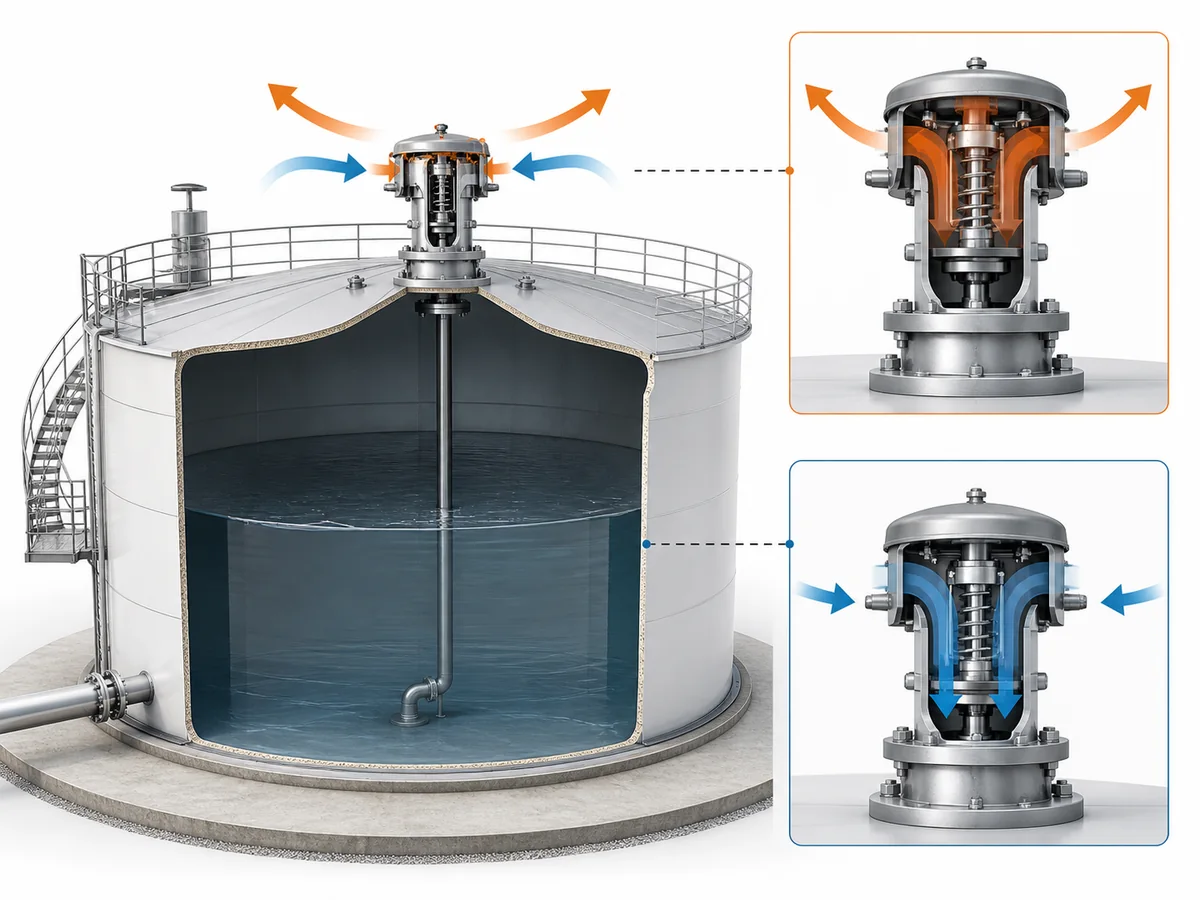
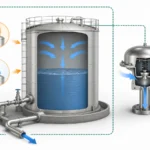
Tank showing outward pressure-side flow and inward vacuum-side flow for separate venting duties.
储罐压力-真空保护包含必须独立评估的向外和向内两种任务。.

正常通气、紧急通气和惰化是独立的储罐系统检查

PVRV并不能免除识别储罐保护系统必须评估的工况的需要。特别是,, 正常通气和紧急通气是两项独立的要求.

正常通气与紧急通气

正常通气针对适用储罐通气基准所涵盖的操作和热力条件引起的压力和真空变化。.

紧急通气针对单独的紧急要求。.

API 2000 和 ISO 28300 在其储罐通气范围内区分正常通气和紧急通气。采购后果是直接的:足够的正常压力侧和真空侧通气能力并不能证明紧急通气要求也已满足。.

相反,确定紧急通气路径并不能消除确定操作期间适用的正常压力侧和真空侧呼吸负荷的需要。.

这一区别并 规定一个通用的数值或物理设备的布置。所需的保护布置取决于适用的储罐设计、项目要求和所选设备。.

因此,正确的工程问题不仅仅是是否存在 PVRV。而是完整的保护布置必须满足哪些正常和紧急通气负荷,以及哪个设备或设备组合负责每项负荷。.

详细的紧急通气尺寸计算不在本比较范围内。.

氮封在储罐侧审查中的位置

储罐也可能配备惰性气体密封系统。当存在该系统时,密封系统成为储罐气体平衡和保护审查的一部分。.

本文的冷冻应用证据将密封信息与储罐的充装、排空、压力、真空和呼吸要求一并处理。这支持将密封视为储罐侧工程输入,而非无关的附件。.

然而,密封调节阀和PVRV执行不同的功能。.

这两种功能不能相互替代:密封不能替代所需的压力-真空保护,而PVRV的存在也不能证明所有与密封相关或紧急情况都已得到处理。.

就采购而言,有用的规则是: 如果存在密封系统,应将其作为储罐侧工程输入的一部分予以披露,而不是孤立地审查呼吸阀。.

详细的密封系统设计属于储罐系统工程路径,不属于本文比较范围。.

安全阀定径如何从主导超压工况开始

安全阀定径遵循不同的逻辑,因为工程问题不是储罐如何呼吸,而是受保护的承压设备必须针对哪种适用的超压工况进行泄放。.

API泄压指南和ASME超压保护要求将安全阀问题置于与常压或低压储罐通风不同的泄压装置框架中。.

在确定阀门尺寸之前,先确定主导泄放工况

安全阀不应从期望的连接直径开始定径。.

首先必须评估受保护系统适用的超压工况。确定控制性泄放需求的工况为所需泄放能力提供依据。.

此顺序很重要,因为阀门可能在物理上适配可用连接,但不具备适用泄放工况所需的能力。.

工程路径在概念上是: 超压工况 → 所需泄放能力 → 设备能力验证.

本文有意止步于该决策边界。计算泄放负荷、选择流道面积以及应用详细的定径方法属于专门的安全阀定径流程。.

所需泄放能力不等于连接尺寸

所需泄放能力是 系统侧要求. 。连接尺寸是物理接口。.

因此,它们是不可互换的工程量。.

入口和出口连接对安装很重要,并可能影响最终阀门配置,但仅凭连接尺寸并不能证明特定安全阀能够满足泄放需求。.

更换审查应保留实际的定径依据或建立新的有效依据,而不是将公称尺寸视为泄放能力的证据。.

适用时提供排量认证或支持性文件

安全阀侧还需区分 capacity the protected system requires and the capacity evidence available for the selected valve.

Where capacity certification is required by the governing basis, certified relieving capacity or corresponding supporting documentation can provide device-side evidence. Where a different documentation basis applies, the project should use the evidence required for that case.

Certification terminology therefore cannot be treated as universal.

A generic catalog flow value should not automatically be described as certified relieving capacity, and a PVRV vent-capacity rating should not simply be renamed as safety-valve certified relieving capacity unless the governing basis actually supports that terminology.

The procurement decision is consequently two-part: first establish the required system capacity; then verify that the proposed device has the appropriate supporting capacity evidence.

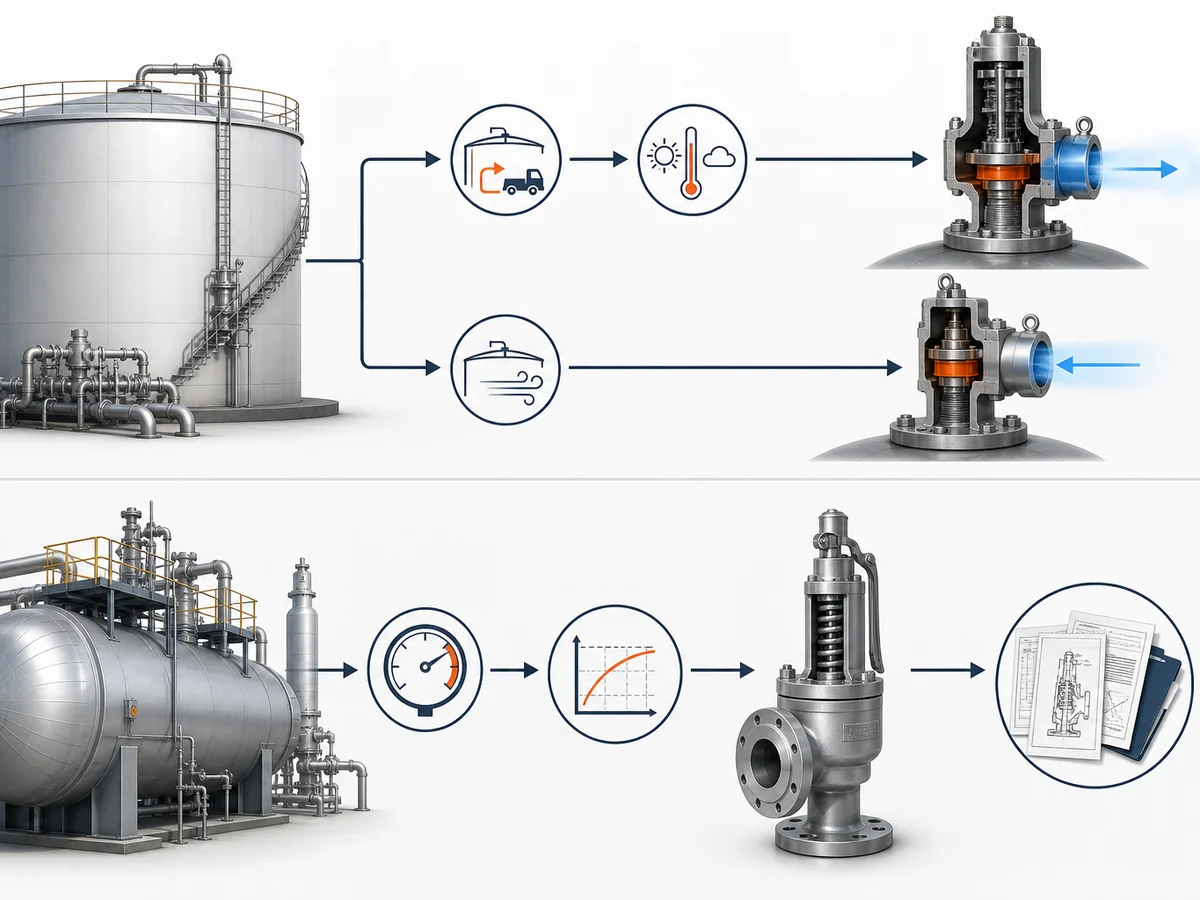
Two engineering routes comparing tank pressure-vacuum venting with overpressure-case and capacity-verification logic.
Both routes may involve capacity checks, but they begin from different engineering problems and are not interchangeable.

Why PVRV and Safety-Valve Sizing Bases Are Not Interchangeable

The strongest reason not to substitute these devices from a catalog comparison is that they answer different engineering questions.

A PVRV review begins with the pressure and vacuum limits of a tank and the conditions that create outward and inward venting demand. A safety-valve review begins with the applicable overpressure scenario and the required relieving capacity of pressurized equipment.

Those paths can both end with a valve and a capacity check, but their upstream sizing bases are different.

Different Inputs Produce Different Capacity Checks

PVRV tank-venting route versus safety-valve overpressure route
Decision area PVRV / tank-venting route Safety-valve / overpressure route
受保护设备 Atmospheric or low-pressure tank within the article scope Applicable pressurized equipment
Primary duty Pressure-side outbreathing and vacuum-side inbreathing Protection against an applicable overpressure relieving case
Sizing basis Tank pressure-vacuum limits and scenarios creating outward and inward venting demand Applicable overpressure scenario and required relieving capacity
Capacity verification Pressure-side and vacuum-side venting requirements, with emergency venting separately checked as applicable Required relieving capacity compared with suitable device capacity evidence under the governing basis

On the tank/PVRV side, relevant information can include:

  • tank design pressure and vacuum;
  • pressure and vacuum settings;
  • filling and emptying basis;
  • normal outbreathing and inbreathing requirements;
  • thermal venting considerations where applicable;
  • blanketing information where present;
  • separate emergency venting requirements.

On the safety-valve side, relevant information can include:

  • protected pressurized equipment;
  • applicable overpressure scenario;
  • required relieving capacity;
  • set-pressure requirement;
  • relieving conditions;
  • fluid phase and required properties;
  • back pressure and discharge-system conditions;
  • valve capacity evidence and documentation required by the governing basis.

Because the input sets are different, a device selected through one path should not be treated as suitable for the other merely because both devices have a pressure-related function.

Mechanical Fit or a Similar Setting Does Not Establish Equivalence

Superficial similarities can be useful for identifying a candidate replacement, but they are not sufficient for approving protection equivalence.

  • Connection match: the replacement appears to fit the same inlet, outlet or flange arrangement.
  • Setting match: a pressure designation appears similar to the existing device.
  • Physical similarity: the device appears capable of mounting in the same location.

Those observations may address mechanical compatibility, but they do not establish protection equivalence.

Before approving substitution, the review should answer these engineering questions:

  1. Is the replacement being evaluated for the same protected equipment and the same design basis?
  2. Does it preserve the required function: pressure-and-vacuum tank protection or pressurized-equipment overpressure relief?
  3. Are the governing operating, emergency or overpressure scenarios still represented in the sizing basis?
  4. Does the proposed device have suitable capacity evidence and installed-condition information for the relevant protection path?

If any of those questions remains unresolved, matching dimensions or one similar pressure value should not be used to close the equivalence decision.

Replacement Must Preserve the Actual Protection Duty

A sound replacement review should reconstruct the original protection requirement before approving the substitute.

If the existing device protects a tank against both excessive pressure and excessive vacuum, the replacement review should retain both functions and the relevant pressure-side and vacuum-side capacity requirements.

If the existing device protects pressurized equipment against an applicable overpressure case, the replacement should be checked against that relieving requirement rather than only against the old valve’s nominal connection.

If the original engineering inputs are unavailable, treat them as unresolved project data rather than inferring them from appearance, catalog dimensions or a single pressure designation.

The central substitution rule is: matching hardware does not establish matching duty, and matching one pressure value does not establish matching sizing basis.

What to Send in an RFQ for Each Protection Route

A useful RFQ should make the protection problem visible to the supplier or engineering reviewer. Valve size, pressure and material alone are often not enough to distinguish a tank PVRV requirement from a pressurized-equipment safety-valve requirement.

The required project data can vary, but the following two branches provide a practical starting point. Missing governing data should be marked as unresolved rather than filled from an unrelated catalog value.

PVRV / Tank-Venting Input Branch

For an atmospheric or low-pressure tank pressure-vacuum enquiry, provide the applicable information available for the project:

  • protected tank type and design basis;
  • 罐体设计压力;;
  • 罐体设计真空度;;
  • required pressure-side setting;
  • required vacuum-side setting;
  • filling or inflow basis;
  • emptying or pump-out basis;
  • thermal venting basis where relevant;
  • blanketing-system information where present;
  • required pressure-side venting capacity;
  • required vacuum-side venting capacity;
  • emergency venting basis;
  • vent or discharge arrangement and relevant restrictions;
  • process medium or vapor and material-compatibility requirements;
  • existing valve data sheet or identification information for replacement work.

The purpose of this branch is not to perform PVRV sizing inside the RFQ. It is to make sure the enquiry shows that pressure-side, vacuum-side and emergency requirements are separate questions that may each need verification.

Safety-Valve / Overpressure Input Branch

For a safety-valve enquiry on applicable pressurized equipment, provide the applicable project information available for the relief review:

  • protected equipment;
  • applicable overpressure scenario;
  • applicable equipment or project design basis;
  • operating pressure;
  • required set pressure;
  • required relieving capacity;
  • relieving pressure and temperature conditions;
  • fluid phase and required fluid-property information;
  • candidate orifice or available capacity information, if already established;
  • back pressure and discharge-system conditions;
  • required capacity certification or supporting documentation where applicable;
  • existing valve nameplate, data sheet or sizing calculation for replacement work.

This branch is built around the overpressure relieving requirement and the evidence needed to verify the proposed device against it, not around tank inbreathing and outbreathing.

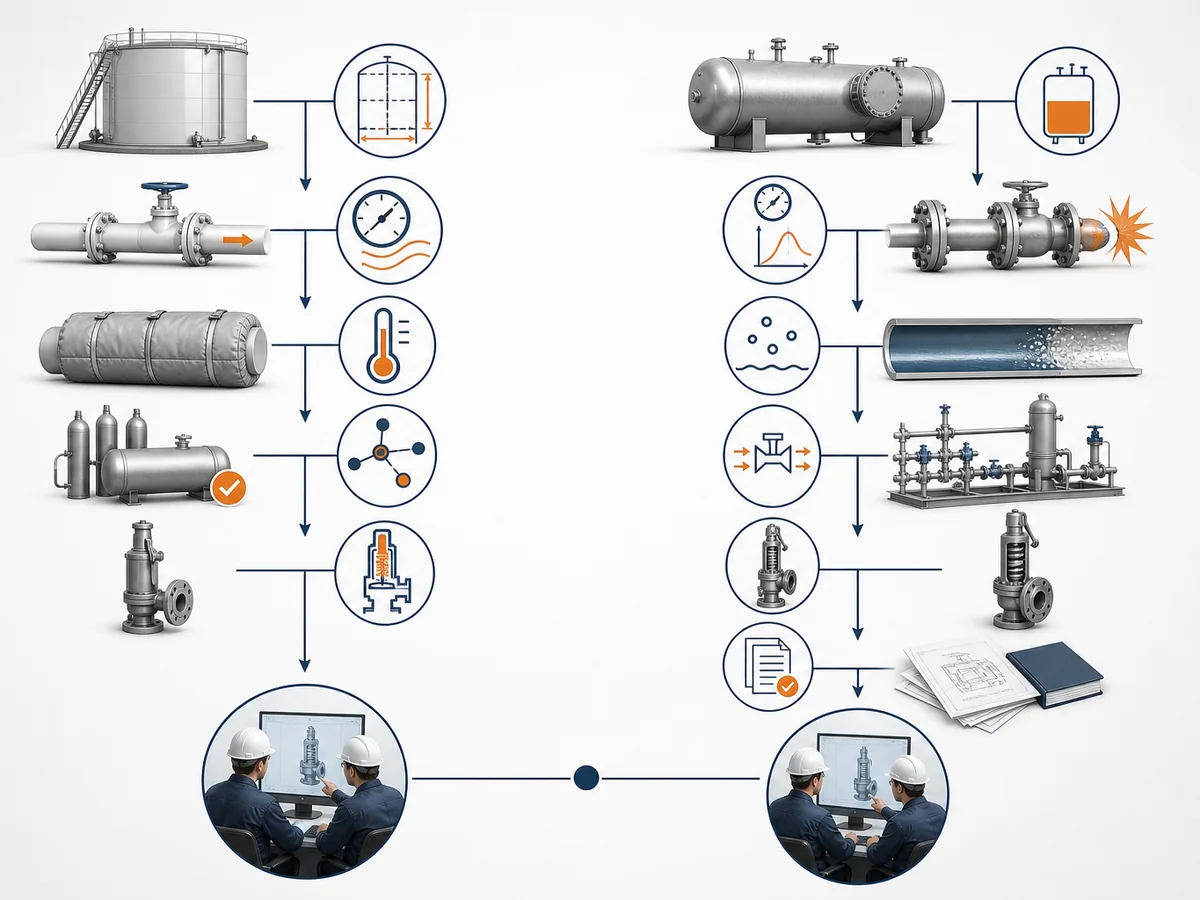
Two-branch RFQ checklist separating tank pressure-vacuum inputs from safety-valve overpressure inputs.
A useful RFQ identifies the protection route and supplies the engineering data required for that route.

When to Route the Question to a Dedicated Technical Owner

This comparison should stop once the correct protection path is identified.

A tank question that requires detailed normal venting, emergency venting or blanketing analysis belongs in the tank-venting engineering path.

A safety-valve question that requires relieving-load calculation, orifice selection or detailed capacity verification belongs in the dedicated safety-valve sizing path.

A general safety-valve construction or selection question belongs in the safety-valve selection topic.