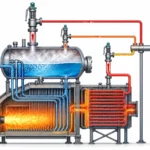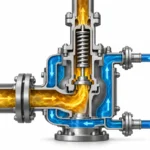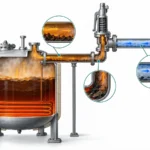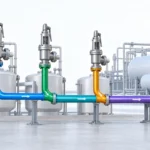
Compare as funções da válvula de alívio térmico e da válvula de segurança em tubulações de LNG/LPG, incluindo líquido confinado, capacidade, fase, contrapressão e verificações para solicitação de cotação.

Em tubulações de LNG e LPG, uma válvula de alívio térmico e uma válvula de segurança de pressão não são dois princípios de proteção opostos.
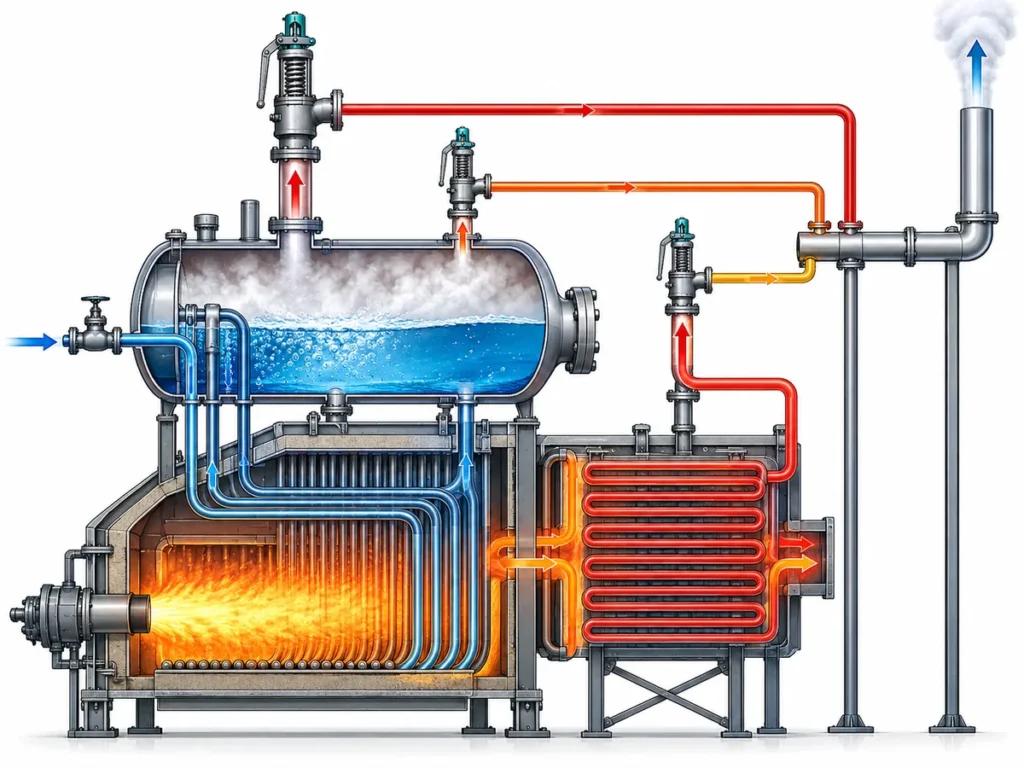
Uma válvula de alívio por expansão térmica é, ela própria, um dispositivo de alívio de pressão. A diferença útil está no cenário de alívio: o que está causando o aumento de pressão, qual seção está sendo protegida, qual estado do fluido chega ao dispositivo e qual carga o dispositivo deve aliviar.
CGA PS-28
descreve uma válvula de alívio por expansão térmica como um dispositivo de alívio de pressão usado em sistemas de tubulação para evitar sobrepressão causada pela expansão térmica de um volume limitado de fluido de processo retido, incluindo casos envolvendo líquidos criogênicos ou gases frios retidos entre válvulas ou outros dispositivos.
Essa definição é restrita e útil: ela identifica um mecanismo específico de sobrepressão, e não uma classe universal de válvula.
Uma sequência de engenharia confiável é, portanto: definir a seção protegida → identificar o mecanismo crível de aumento de pressão → estabelecer a capacidade de alívio requerida → verificar a válvula e o caminho de alívio instalado.
Pressão de ajuste, sobrepressão, acumulação, blowdown, capacidade de alívio e contrapressão são termos relacionados, mas não são intercambiáveis. Suas relações admissíveis dependem do código aplicável, do equipamento protegido e da configuração da válvula, portanto este artigo não aplica um percentual ou limite universal.
Um líquido bloqueado que se aquece dentro de uma seção de tubulação isolada pode criar uma demanda de alívio térmico. Outro sistema pode, em vez disso, ter um caso crível de sobrepressão por fluxo bloqueado, relacionado a bomba, geração de vapor, incêndio ou outro. Esses casos não devem ser reduzidos a uma única escolha de produto “TRV versus PSV”.
API 521
aborda sistemas de alívio de pressão e despressurização para instalações, incluindo terminais de LNG, enquanto a estrutura de sistemas de alívio de pressão da API separa a identificação de causas, a taxa de alívio requerida e a revisão do sistema de descarte a jusante.
O nome da válvula é, portanto, um ponto de partida — não a especificação de engenharia.
Alívio térmico vs. segurança e alívio de pressão: qual é a diferença real?
A diferença real está em primeiro a função, depois o hardware.
Existe uma função de alívio por expansão térmica porque um fluido confinado muda de condição e gera pressão à medida que aquece. O dispositivo de proteção continua respondendo à pressão.
“Térmico” descreve a causa da sobrepressão; não transforma o dispositivo em uma válvula operada por temperatura. A CGA PS-28 deixa essa distinção especialmente clara ao classificar a válvula de alívio por expansão térmica como um dispositivo de alívio de pressão.
“PSV”, “PRV”, “válvula de segurança” e “válvula de alívio” também não devem ser tratados como classes de produto universalmente intercambiáveis.
ISO 4126-1, por exemplo, especifica requisitos gerais de produto para válvulas de segurança e declara explicitamente que é uma norma de produto, e não uma norma de aplicação.
ASME BPVC Seção XIII
fornece separadamente regras de proteção contra sobrepressão que abrangem dispositivos de alívio de pressão, certificação de capacidade, instalação e requisitos relacionados. Portanto, a norma do projeto aplicável, a folha de dados e a documentação da válvula importam mais do que a sigla isolada.
Na análise prática, mantenha quatro termos de pressão separados. Pressão de ajuste é o ajuste da válvula usado como referência de abertura sob condições especificadas de teste ou serviço. Sobrepressão é o aumento de pressão acima da pressão de ajuste durante o alívio. Acúmulo refere-se ao aumento de pressão do sistema protegido acima de sua base admissível aplicável durante um evento de sobrepressão. Blowdown é a diferença de pressão entre o comportamento de abertura e de reassentamento. A documentação de proteção contra sobrepressão da API 520 e da ASME trata esses parâmetros como distintos de projeto ou desempenho; os limites exatos dependem do código e da aplicação.
| Ponto de comparação | Serviço de alívio por expansão térmica | Outro serviço de alívio de pressão |
|---|---|---|
| Pergunta principal | Um volume de fluido confinado pode gerar pressão à medida que suas condições mudam? | Que outro mecanismo crível pode causar sobrepressão no sistema protegido? |
| Primeiro item a definir | Seção protegida isolada e inventário confinado | Sistema protegido e cenário de sobrepressão |
| A designação da válvula estabelece a capacidade? | Não | Não |
| O diâmetro da tubulação estabelece a capacidade requerida? | Não | Não |
| A pressão de ajuste correta comprova proteção adequada? | Não; o dispositivo também deve ter capacidade de alívio adequada e estar conectado ao volume protegido correto. | Não; a capacidade, o estado de alívio e as condições de instalação ainda precisam ser verificados. |
| O que determina a seleção em última análise? | A demanda requerida somada às condições reais de serviço e de instalação | A demanda requerida somada às condições reais de serviço e de instalação |
Para uma comparação mais ampla de terminologia, consulte o
Guia PRV vs PSV vs válvula de segurança vs válvula de alívio.
Este artigo utiliza apenas a terminologia necessária para a tomada de decisão em tubulações de LNG/LPG.
Quando uma tubulação de LNG ou LPG se torna um caso de alívio térmico?
Comece pelo limite de pressão, não pelo catálogo de válvulas. Um caso de alívio térmico se torna um candidato credível quando um volume finito de fluido pode ficar isolado e o aquecimento, a expansão térmica ou uma mudança de fase criogênica aplicável pode aumentar a pressão enquanto essa seção permanece bloqueada.
- Defina a seção protegida. Identifique as válvulas, equipamentos ou outros limites que a isolam.
- Confirme se o fluido pode realmente ficar retido. Uma linha de LNG ou LPG não se torna um caso de alívio térmico simplesmente porque o meio é gás liquefeito.
- Estabeleça o fluido retido e o estado. Líquido, gás frio e uma fase potencialmente variável não devem ser considerados intercambiáveis.
- Identify the pressure-rise mechanism. Determine whether warming or thermal expansion is actually the credible cause.
- Only then establish the thermal-relief duty and required capacity.
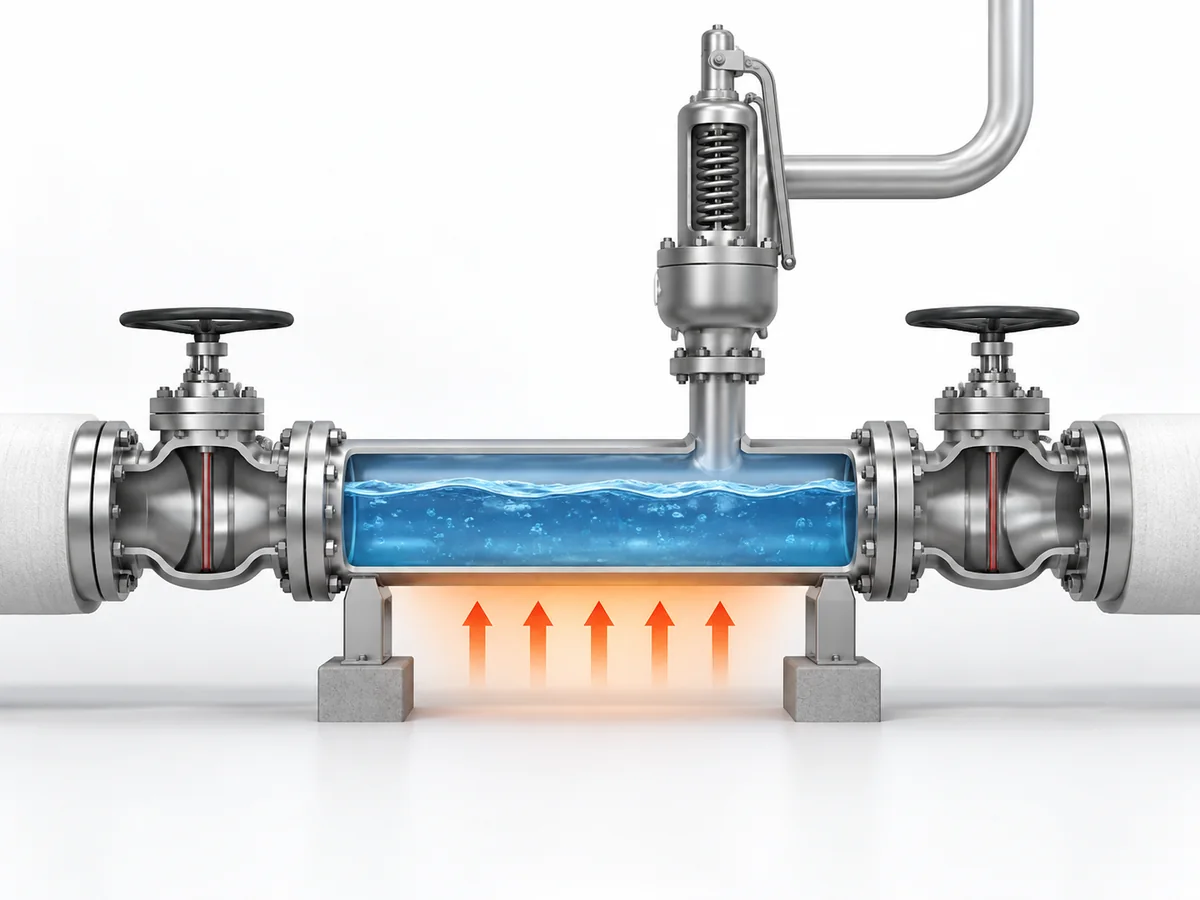
Within its specific scope for LNG road-vehicle fuelling stations,
ISO 16924:2026
defines a thermal relief valve around protection against excess pressure caused by cryogenic liquid vaporization or by warming of cold gas trapped in an isolated pipeline section or other small component.
That definition is useful for understanding the LNG thermal-relief mechanism, but the standard’s fuelling-station scope should not be expanded into a universal rule for every LNG terminal or process plant.
A typical isolated section between two shutoff boundaries is easy to visualize, but it is not the only possible configuration. What matters is whether the proposed relief device has an unobstructed pressure connection to the actual trapped volume throughout the operating and isolation states that create the case.
Cenário de engenharia ilustrativo: a transfer line is isolated at both ends after LNG or LPG movement stops. A small trapped liquid inventory remains in the line and subsequently warms from ambient heat leak. No pump has to be running for the pressure to rise. The engineering response is not to choose a “thermal valve” by connection size; it is to define the trapped volume, establish the thermal-relief load, verify the pressure basis, and confirm that the selected device protects that exact section.
Identifying a thermal-expansion case also does não complete the valve selection. Set-pressure basis, required relieving capacity, phase, temperature, inlet and outlet conditions, back pressure and discharge destination remain separate verification items. The fact that thermal-relief loads are often smaller than major process-upset loads does not justify assuming that any small valve will be adequate.
When Is a Thermal-Relief Valve Not Enough?
A thermal-only assumption is no longer sufficient when another credible pressure-rise mechanism exists—or when the actual relieving condition has not yet been established.
API 521 addresses pressure-relieving and depressuring systems rather than treating pressure relief as a catalogue-selection exercise. Depending on the protected system, further review may be required when there is another process pressure source, a blocked outlet or continuing inflow, a pump-related overpressure condition, vapor generation or another significant phase change, external heat exposure where applicable, an undefined protected boundary, an unknown required relieving rate, or an uncertain liquid, vapor or two-phase relieving state.
The point is not to build a long list of every possible relief scenario. It is to recognize when the thermal-expansion model no longer describes the complete problem.
Two-phase uncertainty is particularly important.
ISO 4126-10:2024
provides a dedicated sizing framework for gas/liquid two-phase flow in pressurized systems including piping. An unresolved LNG/LPG relieving condition therefore should not be silently forced into a single-phase assumption.
| If this is unresolved | Por que é importante |
|---|---|
| Protected section | You do not yet know what the valve actually protects. |
| Credible relief cause | The required duty cannot be defined reliably. |
| Capacidade de alívio requerida | Connection size cannot substitute for sizing. |
| Fase de alívio | Liquid, vapor and two-phase assumptions are not interchangeable. |
| Inlet piping condition | Pressure loss or restrictions between the protected system and the device can affect opening stability and available inlet pressure. |
| Downstream conditions | Outlet resistance and built-up back pressure can change installed valve behavior. |
API 520 Parte II
is specifically the installation part of the API 520 pressure-relieving-device standard. That is why inlet and outlet piping cannot be treated as accessories to the valve-selection calculation. The exact allowable inlet-loss and back-pressure limits depend on the governing standard, valve design and service; they should be checked against the project basis and manufacturer documentation rather than copied from a generic percentage.
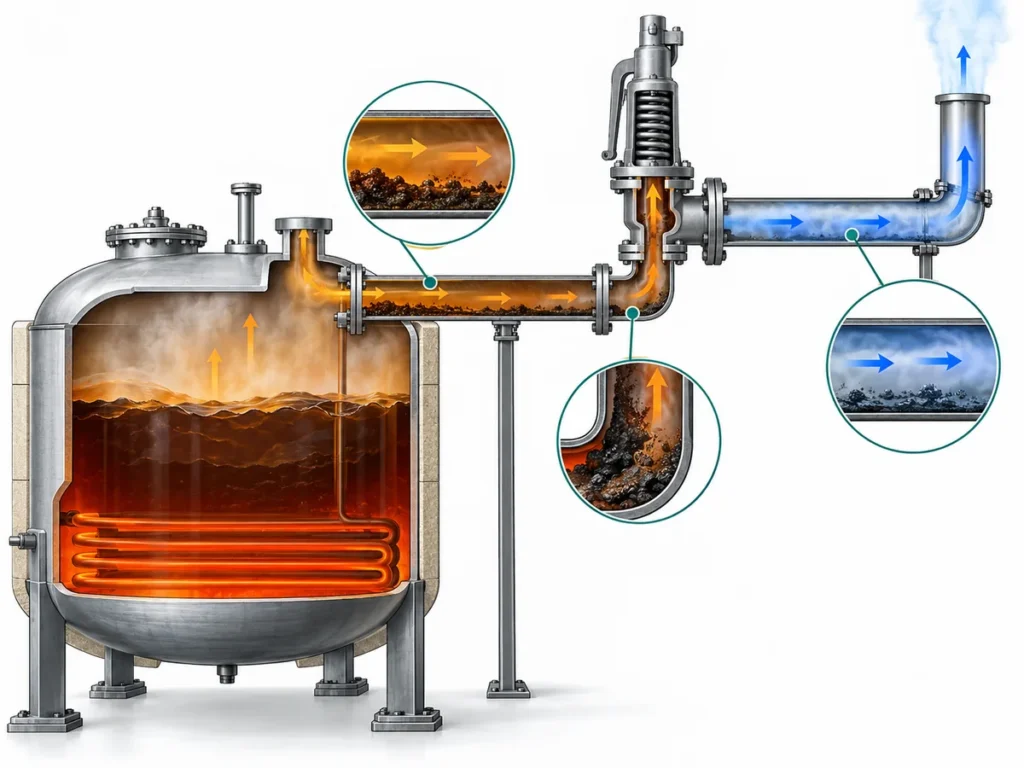
Cenário de engenharia ilustrativo: a spring-loaded relief valve was originally reviewed against one discharge arrangement, but the plant later ties its outlet into a common header. The new header can increase built-up or variable back pressure during relieving. Even if the valve’s set pressure has not changed, its opening/reclosing behavior and effective capacity can require re-evaluation. The prevention step is to recheck the outlet hydraulic case whenever the disposal system changes, not just when the valve itself is replaced.
For the complete capacity calculation and certified-capacity workflow, use the
Guia de dimensionamento e capacidade de alívio certificada de válvulas de segurança
rather than expanding this page into a sizing manual.
Can One Relief Device Cover Both Thermal Expansion and Other Overpressure Cases?
Possibly—but only after the relevant cases are checked independently.
Neither “the main PSV is larger, so it automatically covers thermal expansion” nor “thermal expansion always requires a physically separate valve” is a reliable selection rule.
API 520 Parte I
aborda o dimensionamento e a seleção de dispositivos de alívio de pressão, enquanto
API 520 Parte II
addresses installation. The engineering review therefore needs to consider both the required duty and the installed system.
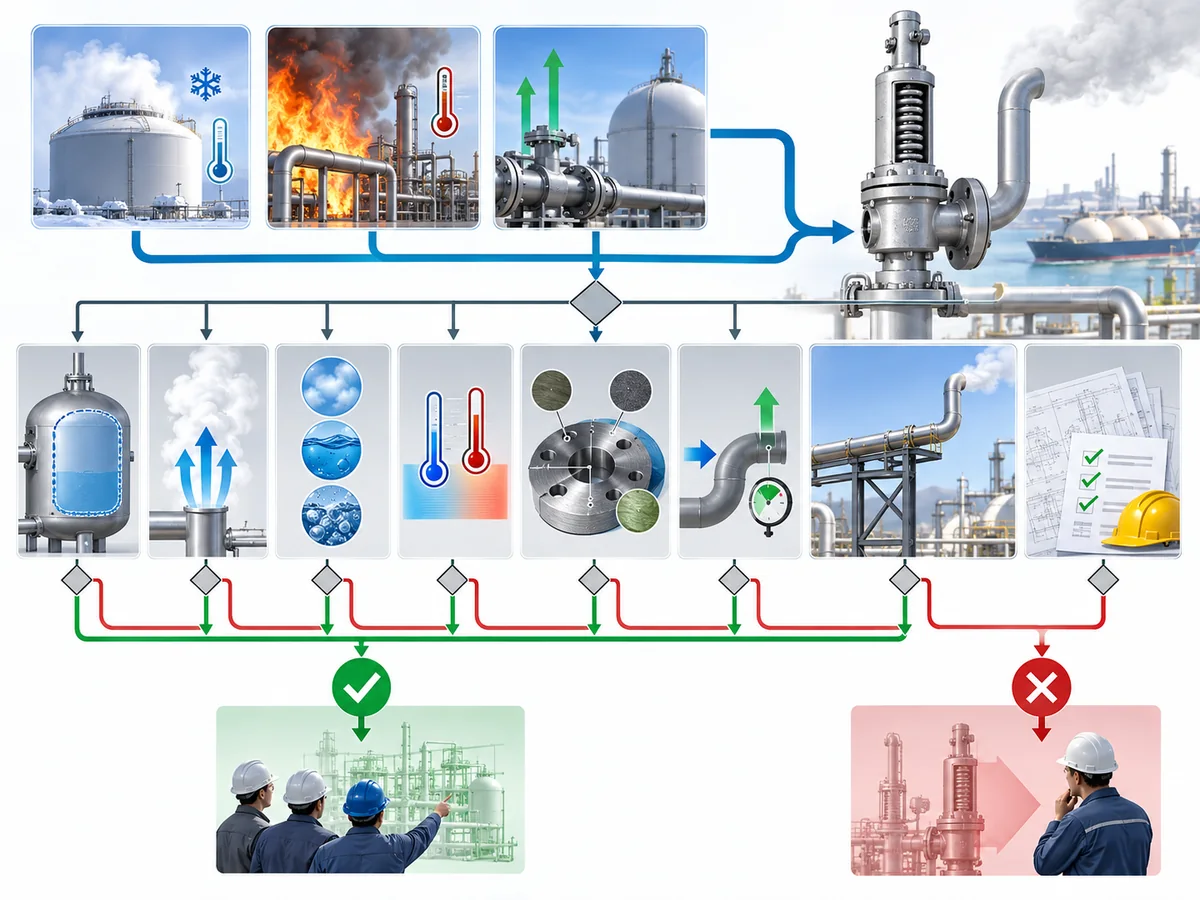
| Pergunta de verificação | Why it can change the decision |
|---|---|
| Does the device protect the required boundary for each case? | A valve elsewhere in the system may not protect an isolated section. |
| Have the relevant relief causes been identified? | An omitted case cannot be covered by assumption. |
| Is the required relieving duty established for each applicable case? | Valve label and connection size do not establish load. |
| Does the candidate have appropriate capacity evidence? | Available capacity has to be compared with the required duty. |
| Is the relieving phase known? | A liquid case does not prove suitability for vapor or two-phase relief. |
| Is the set-pressure basis compatible with the protected system? | A pressão de abertura não pode ser analisada independentemente do limite de pressão. |
| As temperaturas de operação e de alívio estão dentro dos limites documentados? | A adequação a uma temperatura não comprova a adequação a outra. |
| Os arranjos de corpo, trim, mola, guia, sede e vedação são suportados para o serviço? | A adequação dos componentes é específica da configuração e pode afetar a resistência à corrosão, o atrito, a vedação e o movimento estável. |
| As condições de contrapressão são suportadas? | A pressão de saída pode afetar a abertura, a elevação, a capacidade e o comportamento de reassentamento, dependendo do projeto da válvula. |
| O caminho de descarga é aceitável? | A válvula é apenas uma parte do caminho de alívio completo. |
| Os requisitos de documentação do projeto são atendidos? | A capacidade técnica não é o mesmo que a aceitação do projeto. |
O que importa aqui é que dominância de capacidade não é o mesmo que adequação completa. Um candidato com capacidade suficiente para um cenário de maior vazão ainda pode precisar de verificação separada para um caso térmico de menor vazão se esse caso envolver uma seção protegida, fase, temperatura, limitação de componente, contrapressão ou rota de descarga diferente.
A evidência de capacidade também importa mais do que o tamanho da conexão. Para dispositivos de alívio de pressão abrangidos por código, a ASME Section XIII inclui certificação de capacidade e resistência ao escoamento em seu escopo de proteção contra sobrepressão, e o National Board
NB-18 do National Board
fornece informações de certificação de fabricante/dispositivo e recursos de capacidade de alívio certificada. Uma flange correspondente não demonstra que o candidato pode escoar a carga de alívio requerida.
Cenário de engenharia ilustrativo: uma válvula pode ser ajustada para a pressão de abertura pretendida e ainda assim ser um dispositivo de proteção inadequado se sua capacidade de alívio verificada estiver abaixo do caso requerido. A correção não é “aumentar” a pressão de abertura ou escolher uma conexão maior pela aparência; é comparar a taxa de alívio requerida do cenário com a base de capacidade certificada aplicável do candidato ou outra base de capacidade aceita pelo projeto.
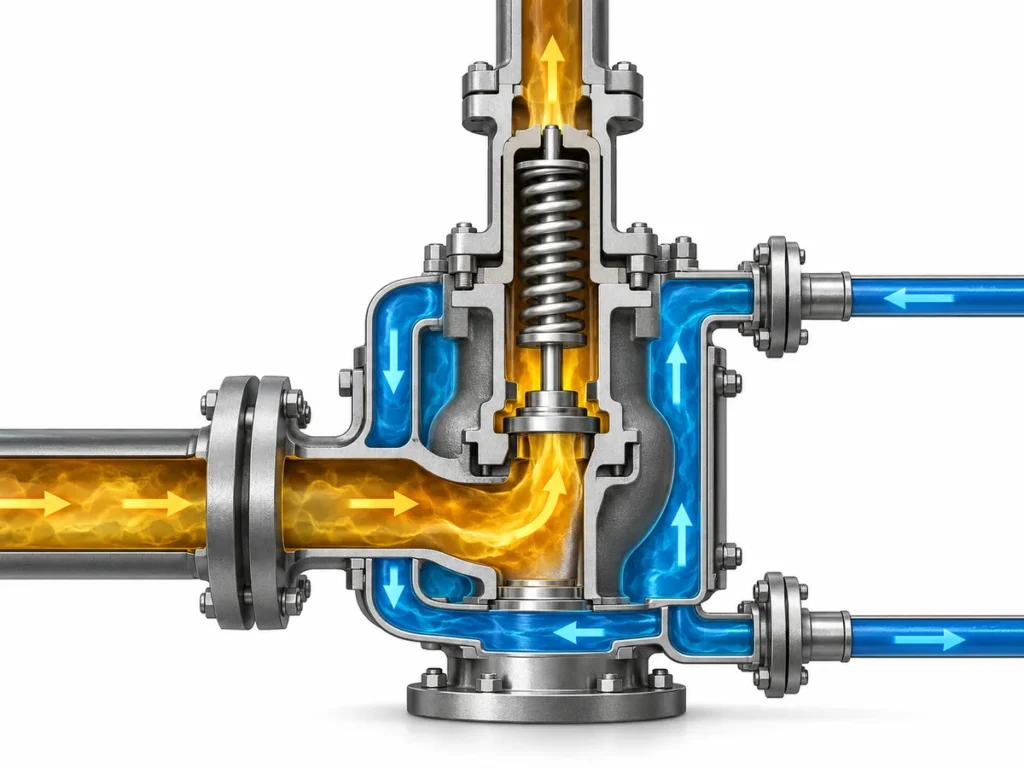
Válvulas de alívio de pressão com mola e pilotadas também não devem ser tratadas como upgrades intercambiáveis. Contrapressão, margem de operação, limpeza do serviço, configuração de sensoriamento/piloto, temperatura e estratégia de manutenção podem influenciar a escolha da arquitetura. A orientação técnica da Baker Hughes sobre válvulas de segurança e alívio pilotadas observa que serviços severamente sujos podem exigir recursos de filtragem ou isolamento e que o entupimento da tubulação de interligação pode tornar um projeto pilotado inadequado em alguns serviços.
Revise a nota técnica da SRV pilotada.
Da mesma forma, nada nesta comparação significa que a expansão térmica sempre exige um dispositivo fisicamente separado. Se um único dispositivo pode atender a múltiplas funções é uma conclusão de engenharia baseada no sistema completo, não uma regra que decorre dos nomes “TRV” ou “PSV”. Este é um princípio de triagem de candidatos, não uma afirmação de que uma válvula já recebeu aprovação de projeto, código ou regulatória.
O que muda entre o serviço de alívio de LNG e LPG?
LNG e LPG podem usar a mesma estrutura de decisão, mas não devem herdar as mesmas premissas de serviço.
The shared questions are straightforward: What is protected? What causes the pressure rise? What fluid and phase reach the valve? What capacity is required? What temperature applies? What back pressure exists? Where does the relieved fluid go? What component and documentation evidence supports the candidate?
| Review variable | GNL | GLP |
|---|---|---|
| Temperatura | Cryogenic exposure can become a primary suitability boundary. | Use actual operating and relieving temperatures; do not inherit LNG assumptions. |
| Estado do fluido | Establish the actual LNG state at the protected section and during relief. | Establish actual LPG state rather than assuming liquid or vapor from the medium name. |
| Flashing / two-phase | Review when process conditions make it credible. | Review when process conditions make it credible. |
| Materiais | Verify the configured valve for the required low-temperature duty. | Verify compatibility and actual temperature requirements. |
| Sede / selo | Low-temperature performance may become a model-level constraint. | Fluid, temperature and leakage requirements still control. |
| Contrapressão | Check the installed outlet system and valve architecture. | Check the installed outlet system and valve architecture. |
| Destino da descarga | Define it for the actual project. | Define it for the actual project. |
Cryogenic pressure-relief equipment deserves model-level verification rather than a generic statement such as “stainless steel is suitable for LNG.”
Baker Hughes technical guidance on cryogenic pressure-relief valves
identifies construction materials, trim design, anti-galling measures and sealing features as cryogenic design considerations. That evidence supports the need to verify the configured product; it does not establish that any specific ZOBAI model has the same construction or service capability.
Material review should therefore cover the full moving and sealing system, not only the pressure-retaining body: nozzle and disc surfaces, guides, spring environment, trim interfaces and seat/seal materials can all affect corrosion, galling, leakage or stable movement under the actual temperature and medium. For LNG service, differential contraction and low-temperature suitability must be confirmed from the product documentation rather than inferred from a generic alloy name.
Seat tightness is a separate purchase and test question from set pressure and certified capacity. API’s current catalog lists API Standard 527, Seat Tightness of Pressure Relief Valves; the standard covers test methods for metal- and soft-seated PRVs. If the project has a leakage requirement, state the required test basis and acceptance criteria in the purchase specification instead of assuming that “soft seat” or “metal seat” alone predicts field tightness.
Cenário de engenharia ilustrativo: a valve can fit the line mechanically and meet the intended set-pressure basis, yet still be a poor LNG candidate if its trim, guide or sealing materials are not supported for the actual low-temperature condition. The prevention step is to review the documented temperature/material configuration as a complete assembly, not to infer cryogenic suitability from body material alone.
For the broader application context, see
LNG and LPG pressure-relief applications.
For deeper component-level selection, see the
Guia de Seleção de Materiais para Válvulas de Segurança.
For engineering review, the same questions can be used for LNG and LPG, but the answers should be verified separately for the actual service.
What Should You Confirm Before Selecting a Valve or Sending an RFQ?
Do not send only “Need a thermal relief valve, LNG, DNxx.” That does not define the protection duty.
A useful engineering enquiry should describe the system first and let the supplier verify the candidate second.
Define the protected system
- equipment or piping section being protected;
- isolation arrangement or system boundaries;
- credible overpressure scenario or scenarios;
- process reason pressure can rise.
If one relief device is expected to cover more than one case, identify every credited protected section and scenario instead of supplying only the “largest” case. A lower-flow thermal case can still have a different isolation boundary or different relieving state.
Provide the process and relief basis
- medium and relevant composition;
- normal fluid phase;
- fase de alívio esperada;
- pressão de operação;
- design or allowable pressure basis;
- required set-pressure basis;
- temperatura de operação;
- minimum relevant service temperature;
- expected relieving temperature;
- required relieving rate or the approved calculation basis.
If the phase is uncertain or two-phase relief is credible, state that uncertainty rather than assuming liquid-only or vapor-only sizing. If the governing code or owner specification limits set pressure, overpressure, accumulation or blowdown, provide that basis rather than asking the supplier to infer it from normal operating pressure.
Define the installed outlet conditions
- destino da descarga;
- downstream system or header;
- expected superimposed and built-up back pressure where applicable;
- relevant outlet piping restrictions;
- flare, vent, process-return or other project-defined destination where applicable.
Back pressure is not merely a piping detail. Depending on valve architecture, it can affect opening pressure, lift, capacity and reseating behavior. Changes to a shared disposal header should trigger a valve/application review even when the protected equipment and set pressure are unchanged.
State the mechanical and material requirements
- requisitos de conexão de entrada e saída;
- pressure class;
- spring-loaded, balanced or pilot-operated architecture if already fixed by the project;
- project material requirements for body, trim, nozzle, disc, spring/guide environment and seat/seal;
- medium compatibility requirements;
- leakage or seat-tightness test requirements;
- installation constraints, including orientation or accessibility where relevant.
Ask the supplier to confirm the candidate evidence
- modelo e configuração exatos;
- pressure and temperature limits;
- construction materials;
- seat and seal arrangement;
- applicable relieving-capacity evidence;
- supported fluid / phase basis;
- back-pressure limitations;
- connection details;
- set-pressure and blowdown adjustment/test basis where applicable;
- seat-tightness test basis where required;
- test, traceability and documentation package;
- conformity or certification only where it actually applies.
For inspection and repair planning, API RP 576 is the API recommended-practice framework for inspection of pressure-relieving devices in the oil and petrochemical industries. If the governing jurisdiction or owner specification requires National Board repair or test accreditation, verify the actual organization and scope in the
National Board Manufacturer and Repair Directory;
do not assume a VR or T/O requirement applies globally.
The buyer or process engineer defines the protected system and required duty; the supplier confirms what a specific valve configuration can support.
For the broader selection workflow, see the
Guia de seleção de válvulas de segurança.
Classify the relief scenario before classifying the valve.
Once the protected boundary, relief cause, capacity, phase, temperature and installed conditions are defined, “thermal relief valve versus PSV” stops being a terminology debate and becomes a traceable engineering review.
Perguntas Frequentes
Is a thermal relief valve the same as a pressure safety valve?
A thermal-expansion relief valve is a pressure-relief device, but “thermal relief” describes a specific overpressure duty rather than proving a universally separate hardware class. The exact device terminology and configuration depend on the governing standard, service and project specification.
Can one pressure safety valve cover thermal expansion and another relief case?
It can be evaluated as a candidate for multiple cases, but capacity alone is not enough. The review must confirm that the device protects the required boundary and that set-pressure basis, required relieving rate, phase, temperature, materials, back pressure and discharge path are acceptable for each credited case.
How does back pressure affect a relief valve in LNG or LPG piping?
Back pressure can change opening, lift, capacity and reseating behavior depending on valve design. Built-up back pressure comes from outlet-system resistance during discharge; superimposed back pressure already exists at the valve outlet. The acceptable limits and the choice between conventional, balanced or pilot-operated designs must come from the governing standard and the specific valve documentation rather than a universal percentage.
Por que a capacidade de alívio certificada é mais importante que o tamanho da conexão?
Connection size tells you how the valve connects to the piping; it does not prove how much mass or volume the valve can discharge under the required relieving conditions. The required relief load must be compared with applicable capacity evidence for the actual fluid, pressure, temperature and valve configuration.
Qual a diferença entre pressão de ajuste, sobrepressão, acúmulo e blowdown?
Set pressure is the valve’s opening reference under specified conditions. Overpressure is the rise above set pressure during relieving. Accumulation refers to the protected system’s pressure rise above its governing allowable basis during the event. Blowdown is the pressure reduction between opening and reseating behavior. Do not apply generic limits without the applicable code and project basis.
How often should an LNG or LPG pressure-relief valve be inspected or recertified?
There is no single interval that is correct for every service. Inspection and test frequency should follow the applicable jurisdiction, code, owner mechanical-integrity program, service severity and device history. API RP 576 and the relevant National Board/NBIC requirements can be part of that framework where they apply; project-specific requirements should control the published maintenance interval.