Hydrogen safety valve selection does not end when the required relief duty is defined. At that point, the task changes from determining the duty to verifying the proposed valve candidate. The remaining questions are whether the seat-tightness evidence matches the applicable acceptance basis, whether the relevant components have evidence appropriate to the actual hydrogen service, …
Hydrogen safety valve selection does not end when the required relief duty is defined. At that point, the task changes from determining the duty to verifying the proposed valve candidate. The remaining questions are whether the seat-tightness evidence matches the applicable acceptance basis, whether the relevant components have evidence appropriate to the actual hydrogen service, whether the valve is compatible with the defined downstream discharge interface, and whether the supplier evidence applies to the configuration being offered.
These checks remain independent. Seat-tightness evidence is not relieving-capacity evidence. A body-material designation does not establish compatibility of the complete valve assembly. Accepting the valve as a component does not close the installed discharge system or ignition-risk assessment. A test report, material record, capacity record or conformity document should support only the engineering question within its stated scope.
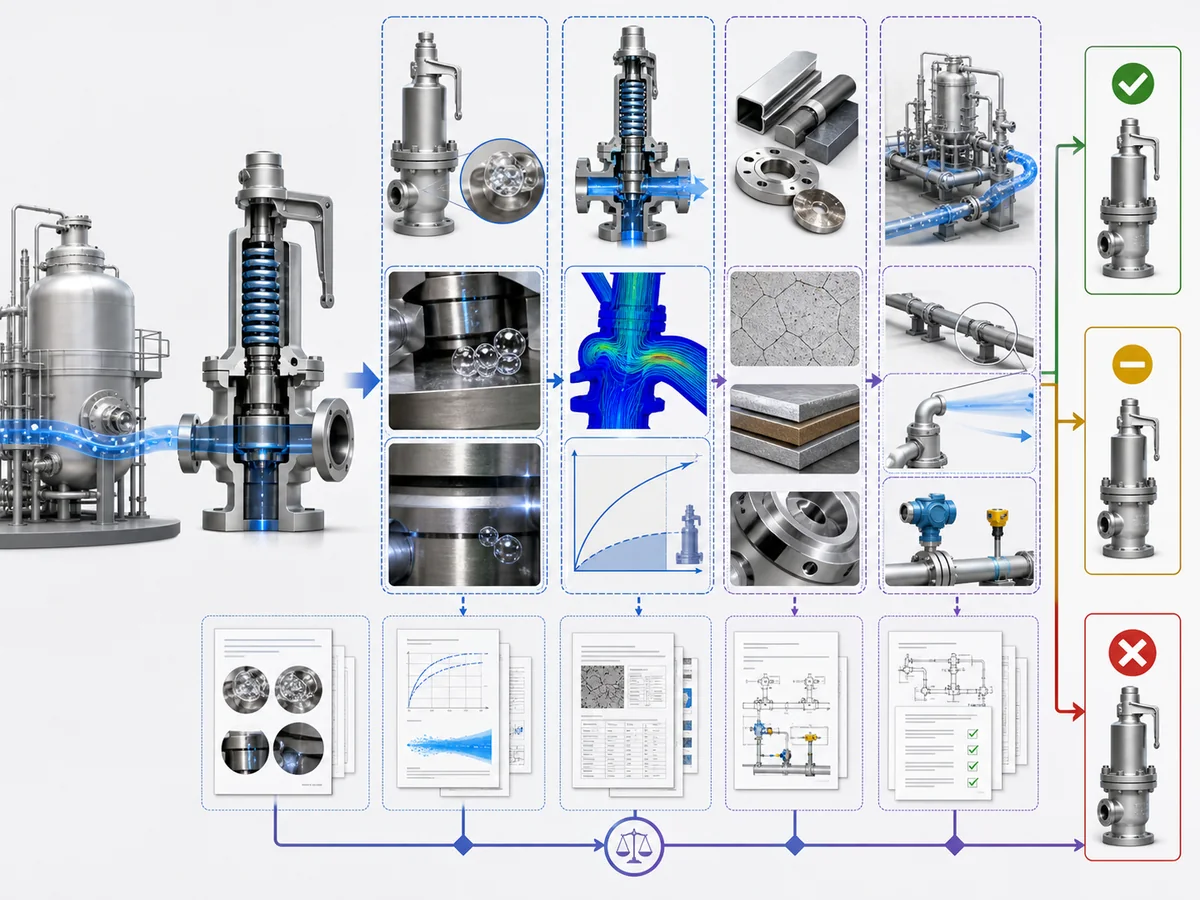
The review therefore follows an evidence-gated sequence: confirm readiness, close the relevant leakage and material questions, verify the valve-to-discharge-system interface, check evidence traceability, and then assign a bounded disposition of PROCEED, HOLD or REJECT.

Confirm the Candidate Is Ready for Hydrogen Verification
The first check is whether the project file contains enough information to make a candidate-level decision. If the required relief duty is still unresolved, the review has started too early and should return to the relief-duty or sizing owner rather than using candidate selection to fill that gap.
H2Tools guidance treats hydrogen relief-device suitability as dependent on the actual service and relevant operating conditions. Once the duty is established, the hydrogen phase or state, proposed valve configuration, seat-tightness acceptance basis and relevant downstream context determine how later evidence should be interpreted.
| Readiness question | If resolved | If unresolved |
|---|---|---|
| Is the required relief duty already defined? | Continue with candidate verification. | Return to relief-duty or sizing work. |
| Is the relevant hydrogen phase or state and service basis known? | Use that basis for leakage, material and configuration review. | HOLD until the service basis is sufficiently defined. |
| Is the proposed valve configuration identified? | Trace evidence to the actual candidate. | HOLD if the available family or generic evidence does not clearly include the proposed configuration within its stated scope. |
| Is the applicable seat-tightness acceptance basis known? | Review the seat evidence against the correct project requirement. | HOLD; the result cannot close the project seat-acceptance decision until the applicable basis is defined. |
| Is the relevant downstream or discharge interface defined? | Check the candidate against the intended installed-system conditions. | HOLD for the proposed installation until the interface is sufficiently defined. |
Missing information and a known mismatch are different decision states. Missing information produces HOLD because the judgment cannot yet be supported. REJECT requires evidence of an actual conflict with the established service or project basis.
The same logic prevents capacity evidence from becoming a shortcut for complete hydrogen suitability. Matching the defined relief duty closes the duty-related question only; seat tightness, materials and the discharge interface remain separate gates.
Before comparing valve features, confirm that the candidate, service basis and acceptance criteria are defined well enough for the next technical checks to be meaningful. If they are not, stop at HOLD instead of continuing with assumptions.
Separate Seat-Tightness Evidence from Capacity and Other Leakage Questions
Seat-tightness evidence answers a specific question: whether leakage past the closed valve seat meets the applicable test and acceptance basis for the candidate being reviewed. It does not independently establish relieving capacity, whole-valve leakage performance, hydrogen material compatibility or installed-system suitability.
API treats pressure-relief sizing or selection and seat tightness as separate technical subjects within their respective scopes. That distinction matters because a valid seat-tightness result should not be asked to prove relieving performance, material suitability or another leakage path that the test did not address.

| 工程问题 | Evidence required | What remains separate |
|---|---|---|
| Does the closed seat meet the applicable leakage acceptance basis? | Seat-tightness evidence traceable to the proposed configuration and relevant test basis. | Capacity, other leakage paths, materials and discharge-interface verification. |
| Can the device support the already-defined relief duty? | Applicable duty or relieving-capacity evidence. | Seat tightness and hydrogen material compatibility. |
| Have other relevant leakage paths been addressed? | Evidence specific to the pressure boundary, joint, seal or other path being reviewed. | Seat leakage unless the seat is separately covered. |
| Are the relevant components suitable for hydrogen service? | Component-level material evidence matched to the service basis. | Leakage performance and capacity. |
The word leakage should therefore not be treated as one interchangeable test category. If the concern is leakage past the closed seat, review the seat-tightness evidence. If the concern is another pressure-boundary, joint or sealing path, the supporting evidence must address that path directly.
- Identify the leakage path being evaluated.
- Confirm that the evidence applies to the actual candidate and configuration.
- Confirm that the applicable acceptance basis is known.
- Close only the leakage question that the evidence actually addresses.
- Keep capacity, materials and the discharge interface open until their own evidence is reviewed.
This changes how supplier documentation should be read. The useful questions are: What was tested? Which configuration was tested? Which acceptance basis applies? Which verification gate does the result close?
A passing seat result should not be rewritten as “zero leakage,” “leak-free” or universal hydrogen acceptance. The relevant decision is whether the seat-tightness evidence satisfies the applicable project basis for the proposed candidate.
Architecture should appear only when it changes the seating arrangement, leakage path or evidence required for the proposed valve. No general claim is made that one pressure-relief-valve architecture or seat construction is inherently the best choice for hydrogen.
Missing, untraceable or mismatched seat evidence produces HOLD. Evidence showing that the applicable seat requirement is not met supports REJECT on that criterion. A passing result closes only the seat-tightness gate.
Verify Hydrogen Compatibility Component by Component
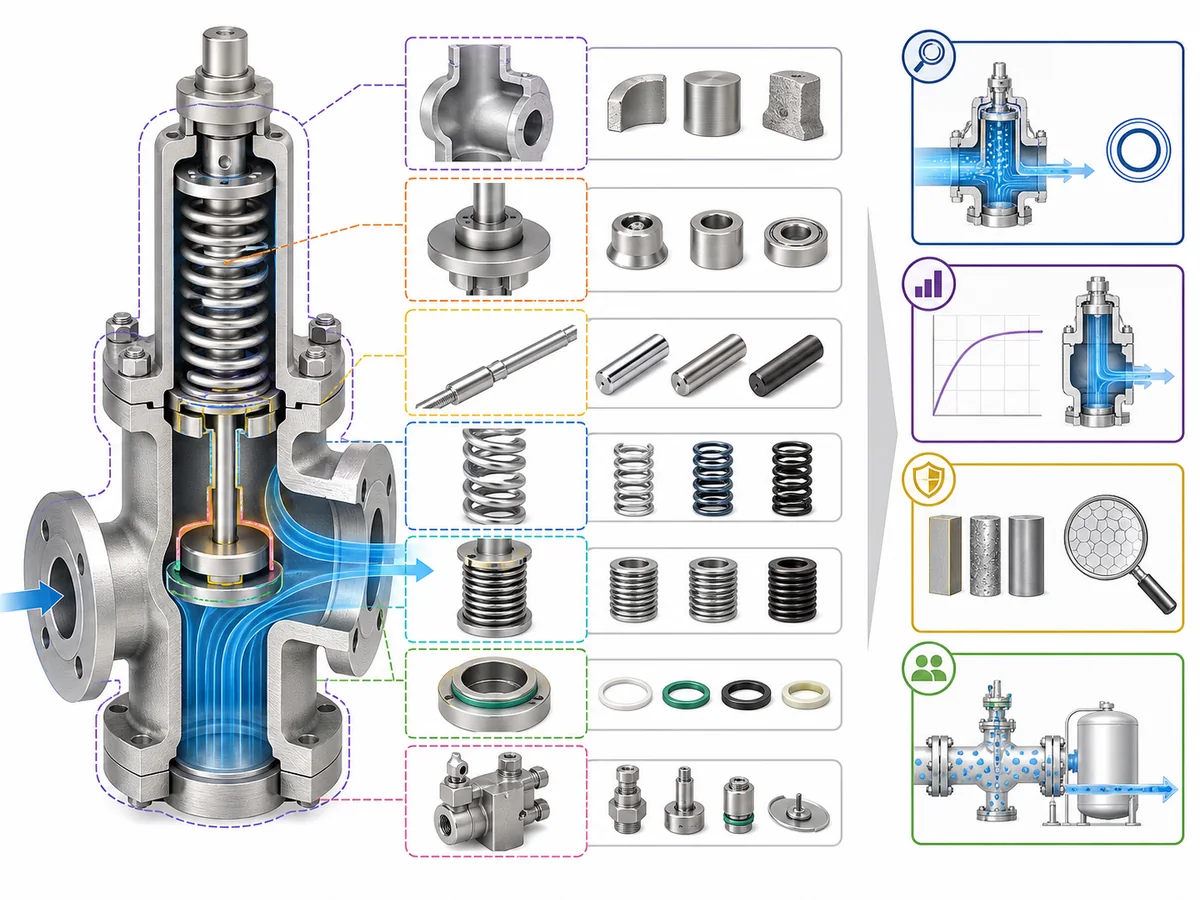
Hydrogen material compatibility should be verified against the actual valve assembly, not inferred from one generic material description. H2Tools notes that hydrogen relief devices can contain multiple materials and that internal components can differ from the body. A familiar body-material designation therefore does not establish suitability of the complete candidate.

The review should be configuration-led. First identify which components are present. Then determine which are exposed to hydrogen or important to the safety function. Only after that should the corresponding materials evidence be compared with the actual service basis.
| Review step | 工程问题 | Decision effect |
|---|---|---|
| Component identification | Which relevant components are actually present in this configuration? | Unknown construction prevents complete material review. |
| Material identification | Is the material of each relevant component identified rather than inferred from the body? | Incomplete identification keeps the candidate on HOLD. |
| Hydrogen-service relevance | Does the material evidence address hydrogen service within an applicable scope? | Generic material data may not be sufficient for candidate acceptance. |
| Service-basis match | Does the evidence correspond sufficiently to the service being reviewed? | Scope mismatch requires further verification. |
| Configuration traceability | Does the material record correspond to the candidate actually being proposed? | Evidence from another configuration does not automatically transfer. |
Depending on the actual construction, relevant review categories can include the pressure boundary, nozzle and disc, trim, stem or spindle, spring, bellows where present, pilot components where present, and seats, seals, gaskets or other nonmetallic elements. These are conditional review categories, not a claim that every safety valve contains every listed component.
Sandia National Laboratories’ hydrogen-materials work supports a service- and material-specific review rather than a context-free “best material” table. The stronger engineering question is: Does the available evidence support this component, in this candidate, for this hydrogen service?
Sandia also distinguishes multiple forms of hydrogen-assisted material degradation rather than treating every hydrogen-related material issue as one identical mechanism. Unless a specific mechanism is supported, broader language such as hydrogen material compatibility or hydrogen-assisted material degradation is more accurate than using “hydrogen embrittlement” as a universal explanation.
Hydrogen permeation should not be confused with leakage past a valve seat. They are different physical questions and require different evidence.
The practical sequence is component identity → material identity → hydrogen-service evidence → service-scope match → configuration traceability. Missing evidence produces HOLD. A verified conflict with the established project material basis can support REJECT.
Even technically credible material data has limited decision value if it cannot be traced to the actual component in the proposed configuration. Material evidence and configuration traceability must close together.
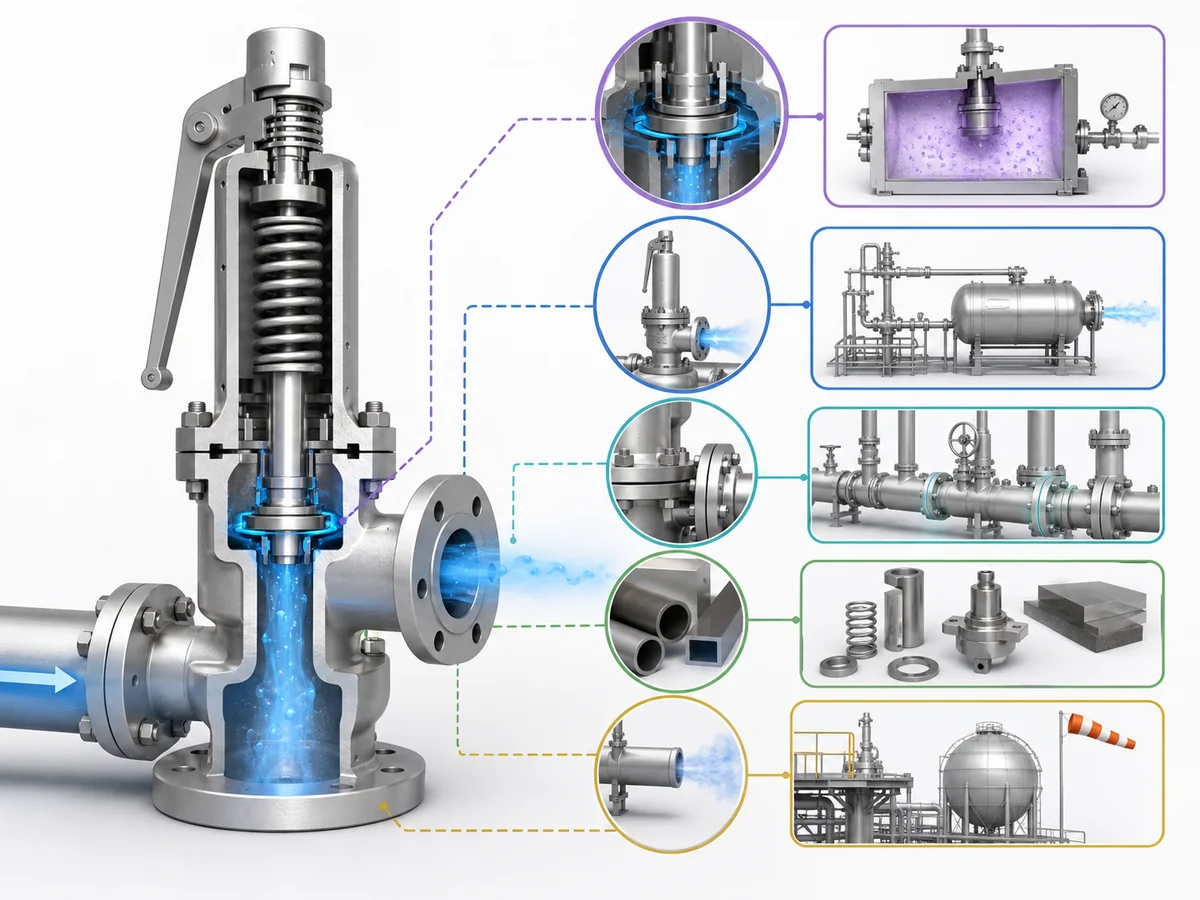
Check the Discharge Interface Before Treating Ignition Risk as Closed
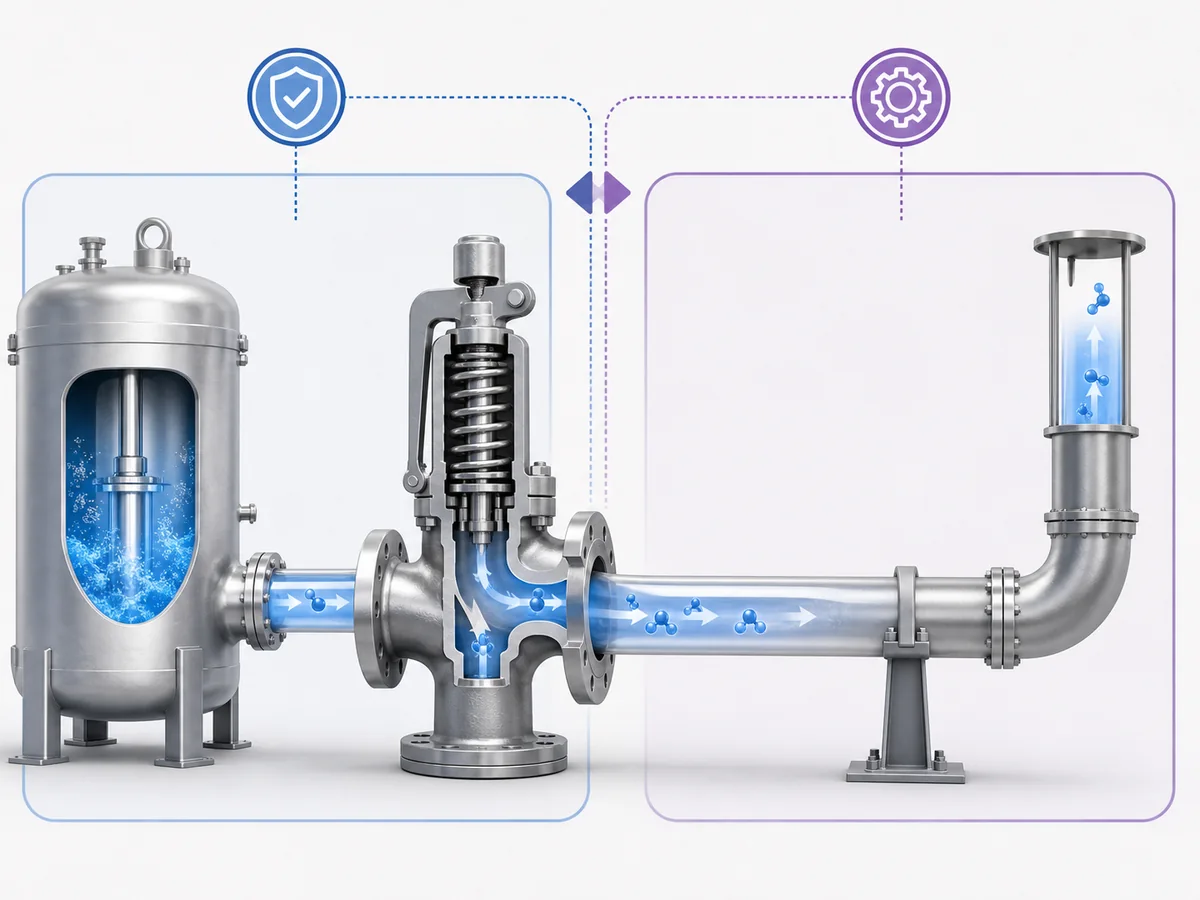
A hydrogen safety valve is one component in an installed relief path. A candidate can pass its own leakage and material checks while the downstream discharge interface remains unresolved.
U.S. Department of Energy hydrogen-safety guidance treats hydrogen release and ignition-risk control as system-level safety concerns. H2Tools likewise treats pressure-relief discharge and venting as system responsibilities beyond the valve itself. The candidate-selection task is therefore to verify the valve-to-system interface without turning this article into a vent-system or hazardous-area design guide.

For candidate verification, four questions are enough to define the boundary:
- Destination: Is the intended downstream or discharge destination sufficiently defined by the project to evaluate the candidate?
- Downstream condition: Can the expected downstream condition affect the proposed relief-device configuration, and has that condition been considered in the candidate’s technical basis?
- Traceability: Do the supplier assumptions correspond to the proposed installation rather than another arrangement?
- Ownership: Are broader ignition-control, ventilation, hazardous-area or discharge-system design tasks still open and owned by the responsible system discipline?
Downstream pressure and restrictions illustrate why the interface matters. H2Tools guidance recognizes that downstream conditions can affect pressure-relief-device operation. That supports checking the candidate against its applicable downstream basis; it does not establish one universal downstream limit for every valve or project.
- Identify the downstream condition expected by the project.
- Check whether that condition is represented in the candidate’s technical basis.
- Determine whether the proposed architecture introduces a relevant sensitivity to the downstream condition.
- If the downstream basis is undefined, place the candidate on HOLD.
- If a known downstream condition conflicts with the candidate’s verified basis, REJECT the candidate for that proposed configuration.
- If the interface closes, continue without claiming that vent-system or ignition-risk design has been approved.
Candidate-level closure and system-level closure are therefore separate decisions. A valve can be technically acceptable as a component while remaining unusable in a proposed installation until the downstream interface is resolved. A downstream system problem should likewise not be mislabeled as a valve defect.
Match Each Candidate Claim to the Evidence That Actually Proves It
A useful supplier file is not the one containing the largest number of documents. It is the one in which each important candidate claim can be traced to evidence that directly supports that claim, for the configuration being proposed, within an applicable scope.
API’s separate treatment of capacity-related and seat-tightness questions illustrates why one evidence type should not substitute for another. H2Tools and Sandia support component- and service-specific hydrogen-material verification, while ASME’s hydrogen-piping scope illustrates the broader rule that a standard or technical document should not be interpreted beyond the equipment or subject it actually covers.
| Evidence / decision layer | What it can support | Boundary |
|---|---|---|
| Duty / capacity evidence | Whether the proposed candidate supports the already-defined relieving requirement within the applicable evidence scope. | Does not establish seat tightness, material compatibility or discharge-system acceptance. |
| Seat-tightness evidence | Whether the closed seat satisfies the applicable leakage acceptance basis. | Does not establish capacity, complete material suitability or final project approval. |
| Component-material evidence | Whether relevant candidate materials have hydrogen-service support within the stated scope. | Does not establish whole-candidate suitability if the proposed construction is not traceable to that evidence. |
| Configuration evidence | Whether technical records correspond to the construction actually being offered. | Does not create performance evidence for characteristics the document did not evaluate. |
| Conformity / compliance evidence | The specific requirement covered within the document’s stated scope. | Does not automatically establish universal hydrogen suitability or project acceptance. |
| Project acceptance (decision layer) | The project-specific decision after the required technical and documentation checks have been closed by the responsible process. | Should not be inferred automatically from one preceding evidence category. |
Evidence substitution is not allowed. Capacity evidence cannot replace seat-tightness evidence. Material data cannot prove that the proposed valve was actually built from those materials. A conformity statement does not automatically establish project acceptance.
A practical procurement rule is therefore claim first, document second. Define the engineering question that needs to be closed before requesting or reviewing the supporting document.
- Duty: What evidence supports the already-defined relieving requirement for this candidate?
- Leakage: What seat-tightness evidence applies to this configuration and acceptance basis?
- Materials: Are the relevant component materials identified, and what hydrogen-service evidence supports them?
- Configuration: Can the critical material and test records be traced to the construction being offered?
- Interface: What downstream conditions or assumptions form part of the candidate’s technical basis?
- Conformity: What does each compliance or conformity document actually prove, and what remains subject to project approval?
For every important supplier document, ask three questions: Which claim is this supposed to support? Does it apply to this candidate? Is its scope sufficient for the project question? If any answer remains unclear, the associated gate stays on HOLD.
Evidence quality and evidence applicability are different. A technically credible document can still be insufficient when it refers to another configuration, another service scope or another engineering question.
Close the Review: PROCEED, HOLD, or REJECT
The final disposition should reflect the state of the independent verification gates. A strong result in one area does not compensate for an unresolved or failed gate elsewhere.
PROCEED, HOLD and REJECT are engineering decision labels used in this article. They are not regulatory or standards-defined classifications.
| Disposition | Use it when | Engineering meaning |
|---|---|---|
| PROCEED | The readiness, seat-tightness, material, discharge-interface and evidence-scope questions are sufficiently closed for the current review, with no known mismatch. | Advance to the next engineering, RFQ or project-review step. It is not final system, vent-system or jurisdictional approval. |
| HOLD | One or more decision-critical facts or evidence items remain unresolved. | Pause the decision and obtain the missing input. HOLD does not mean that the valve is defective. |
| REJECT | A known candidate characteristic conflicts with the established service, interface or acceptance basis. | Do not advance that candidate for the proposed basis or configuration. The conclusion should not be generalized automatically to every hydrogen application. |
The distinction between HOLD 和 REJECT is particularly important in technical procurement:
- An incomplete material record is a reason to HOLD; a verified material conflict with the established project basis can support REJECT.
- An undefined downstream condition is a reason to HOLD; a defined downstream condition that conflicts with the candidate’s verified basis can support REJECT for that proposed configuration.
- Untraceable supplier evidence is a reason to HOLD; evidence of a known failure against the applicable acceptance basis can support REJECT.
No unresolved independent gate is cancelled by a passing result elsewhere. Advance only when the evidence needed for the current review is sufficiently closed. Use HOLD where uncertainty remains, and REJECT only where a known mismatch has been established against the defined basis.
When the review stalls, identify the open gate rather than restarting the entire hydrogen safety valve selection process. Return unresolved service inputs to the readiness check, leakage questions to their specific leakage evidence, material questions to component traceability, discharge-interface questions to the responsible system owner, and documentation gaps to the evidence review.
The strongest candidate-selection record is a traceable chain from defined relief duty to actual valve configuration, independent technical evidence gates and a bounded final disposition. That chain makes clear which questions are truly closed and prevents one successful test, generic material description or unrelated document from being mistaken for complete hydrogen suitability.