Learn how to define H2S exposure, review valve materials and components, separate sour-service qualification from relief capacity, and prepare RFQ data.

Safety valves for sour gas and H2S service should not be accepted simply because it has a corrosion-resistant body material, carries a generic “sour service” description, or is associated with a NACE specification. A credible safety-valve selection starts with the actual H2S-containing environment and the governing relief duty, then checks which valve components are exposed, which material requirements apply, whether the valve can perform the required pressure-relief function, how the discharge system affects the configuration, and what evidence supports the exact offered valve.
That distinction matters because sour-service material qualification and pressure-relief adequacy answer different engineering questions. A valve can use materials that are acceptable under an applicable sour-service specification and still be unsuitable for the required relieving capacity, set-pressure basis, back-pressure condition, or discharge arrangement. Conversely, a valve with adequate relieving capacity is not automatically suitable for an H2S environment. Both sides of the decision must be verified.
Safety Valves for Sour Gas: Define H2S Exposure First
“Contains H2S” is not a complete service definition. The material requirements that apply to an H2S-containing system depend on the actual environment and on which sour-service framework or project specification governs the equipment.
For oil and gas production and natural-gas treatment, NACE MR0175 / ISO 15156 is commonly part of the sour-service materials basis. Petroleum refining and related processing may instead reference NACE MR0103 / ISO 17945. Their scopes are not identical, so the word “NACE” should never be treated as a universal specification that means the same thing in every plant. The adopted standard, edition, jurisdiction, owner specification, and service segment must be confirmed for the project.
The process environment also matters. Depending on the governing material basis and material family, the review may need to consider factors such as H2S partial pressure or fugacity, water or aqueous exposure, pH, temperature, environmental composition, chlorides, and other species that influence the relevant cracking or corrosion mechanism. A wet or condensing sour environment should not be assumed to have the same material implications as a dry gas stream simply because both contain H2S.
The relief condition deserves equal attention. Normal operating data alone may not describe what the safety valve sees when it opens. Relieving pressure, relieving temperature, fluid phase, composition during the governing relief case, and the destination of the discharge can differ from normal operating conditions. If those differences change component exposure or material behavior, the sour-service review has to follow the relieving case rather than the normal process condition alone.
A useful starting data set therefore includes the protected equipment, governing relief scenario, process composition and phase, relevant H2S information, operating pressure and temperature, design pressure or MAWP where applicable, set pressure, relieving pressure and temperature, required relieving capacity, and back-pressure or discharge conditions when they affect the valve or its materials.
The objective is not to collect every possible process variable. It is to define the environment well enough to answer a more specific question: what parts of this particular safety-valve configuration are exposed to what conditions, and what material or functional requirements follow from that exposure?
Review Sour-Service Suitability Across the Whole Valve
A sour-service review cannot stop at the body material.
H2S-related cracking mechanisms are affected by more than alloy name. Where the applicable sour-service framework addresses sulfide stress cracking or related mechanisms, susceptibility can depend on the interaction of the environment, tensile stress, material strength or hardness, microstructure, welding or fabrication condition, and the actual component geometry and loading. Hard weld regions or high-strength components can therefore require attention even when the nominal material designation appears acceptable.
That is why the valve should be reviewed as a system of components rather than as a single body casting.
Depending on the design and exposure path, the review may need to include the body, nozzle, disc, guide, spindle or piston, bolting, bellows, pilot components and tubing, and other metallic parts whose degradation could affect pressure containment or basic valve function. Seats, gaskets, seals and other nonmetallic components require their own compatibility basis; metallic sour-service qualification does not automatically prove that an elastomer or sealing material is suitable for the same environment.
The key phrase is depending on the design. Not every listed component is process-wetted in every safety valve. A spring may be isolated from the process in one configuration but exposed to a relevant environment in another. A balanced-bellows design changes the relationship between the process, discharge pressure and spring chamber. A pilot-operated valve adds pilot internals, sensing connections and tubing that do not exist in a conventional direct-acting valve.
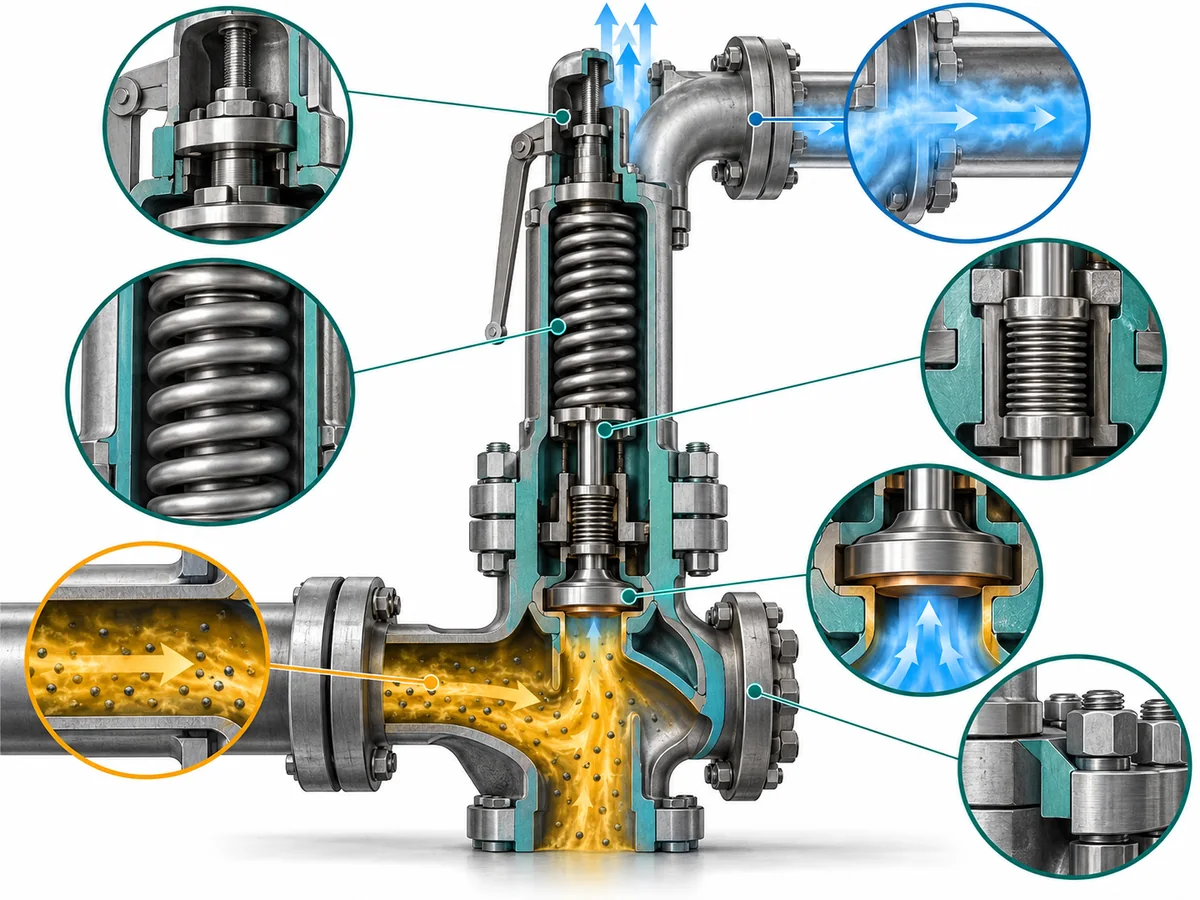
For each important component, the engineer should be able to answer four questions:
- Is the component actually exposed to the process, discharge gas, condensate, or another relevant environment?
- What function would be lost if that component suffered cracking, corrosion or degradation?
- Which material, fabrication or qualification requirement governs that component?
- What document demonstrates that the supplied component meets that requirement?
This approach avoids two common shortcuts: assuming that a corrosion-resistant body alloy makes the entire valve suitable, and assuming that a material name alone proves suitability regardless of hardness, fabrication condition, product form, environment or project requirement.
It also prevents the opposite mistake. If current evidence does not confirm that an offered component meets a sour-service requirement, that does not automatically prove it is unsuitable. It means the requirement remains to be verified against the exact material and selected valve documentation.
Keep Sour-Service Qualification Separate from Relief Capacity and Functional Selection
Material suitability is only one axis of safety-valve acceptance.
The valve must still protect the equipment against the governing overpressure scenario. That means the required relieving load must be established, the selected device must have an appropriate set-pressure basis, and its relieving capacity must be supported by the applicable manufacturer or certification data under the relevant service conditions.
These responsibilities should not be collapsed into one “H2S valve” specification.
| Sour-service qualification asks | Pressure-relief verification asks |
|---|---|
| What H2S-containing environment applies? | What is the governing relief scenario? |
| Which components are exposed? | What relieving rate is required? |
| Which material and fabrication requirements apply? | What set-pressure and relieving-pressure basis applies? |
| Is component material evidence traceable? | What valve/orifice provides sufficient documented capacity? |
| Are relevant seals, bellows or pilot parts compatible? | How do fluid phase, temperature and back pressure affect selection? |
| Does the project accept the material basis? | Does the selected valve satisfy the pressure-protection basis? |
A satisfactory answer in the left column does not prove the right column.
Set pressure, for example, is not relieving capacity. An inlet or outlet connection size does not establish flow area or certified capacity. An orifice designation cannot be transferred between unrelated valve series or certification bases without confirming what that designation represents. Likewise, a valve that uses materials acceptable for the defined sour environment still has to be checked for 所需泄放量, stability, configuration, installation and discharge conditions.
This separation is particularly important during replacement work. An existing valve and a proposed replacement may have the same nominal connections and set pressure while differing in orifice, capacity basis, back-pressure behavior, materials, certification or internal configuration. Appearance or nameplate similarity can help identify a candidate; it cannot establish full interchangeability.
For a sour-service replacement, the verification should therefore carry both tracks to completion: material/service compatibility and pressure-relief performance.
Check Valve Configuration, Back Pressure, and Discharge-System Effects
Sour-service material selection does not remove the need to evaluate how the valve interacts with the relief system.
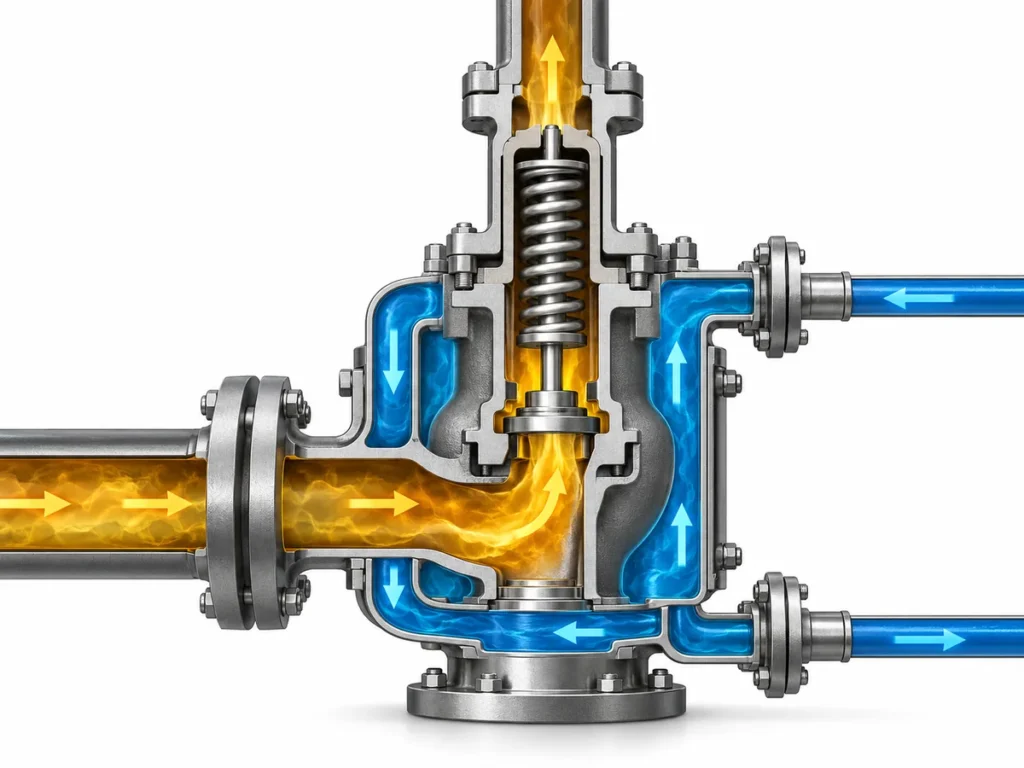
A conventional spring-loaded valve, a balanced-bellows valve and a pilot-operated valve do not respond to 背压 in exactly the same way. That difference can matter when a valve discharges into a closed relief header, flare system or another system where superimposed or built-up back pressure occurs.
A balanced bellows can be used in applications where reducing the influence of back pressure on the spring-loaded valve is important, but the words “balanced bellows” do not mean that every back-pressure problem has been solved. Bellows integrity, the applicable manufacturer’s back-pressure limits, spring-chamber or bonnet venting, materials and the consequences of a bellows failure still belong to the review.
Pilot-operated valves introduce another set of dependencies. Their behavior depends on the design of the pilot, pressure-sensing arrangement, dome or control-pressure relationship, pilot tubing and pilot exhaust arrangement. Where any of those components or connections can be exposed to the sour process or to a pressurized discharge system, the material and system review must include them. A pilot-operated design should therefore not be selected merely because it appears to isolate the main spring from the process.
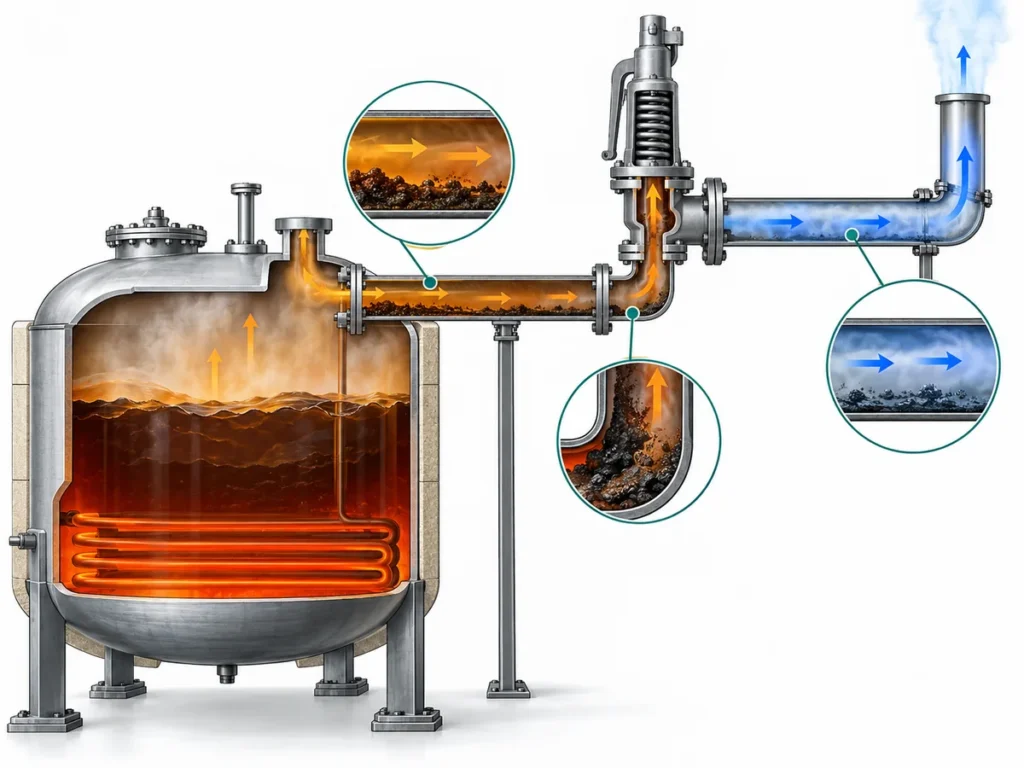
The same principle applies to discharge and venting. H2S is a hazardous toxic gas, so the destination of any process discharge, bonnet vent, bellows vent or pilot exhaust that can contain H2S deserves explicit engineering review. That does not mean every sour-service valve must use the same closed discharge arrangement. The correct routing depends on the valve design, relief system, facility requirements, process hazards and project specification.
Back pressure also remains a functional variable. An engineer should identify whether it is superimposed or built-up, whether it is relatively constant or variable when that distinction affects the valve, and whether the selected configuration has documented limits for the actual condition. Naming a valve type is not a substitute for that verification.
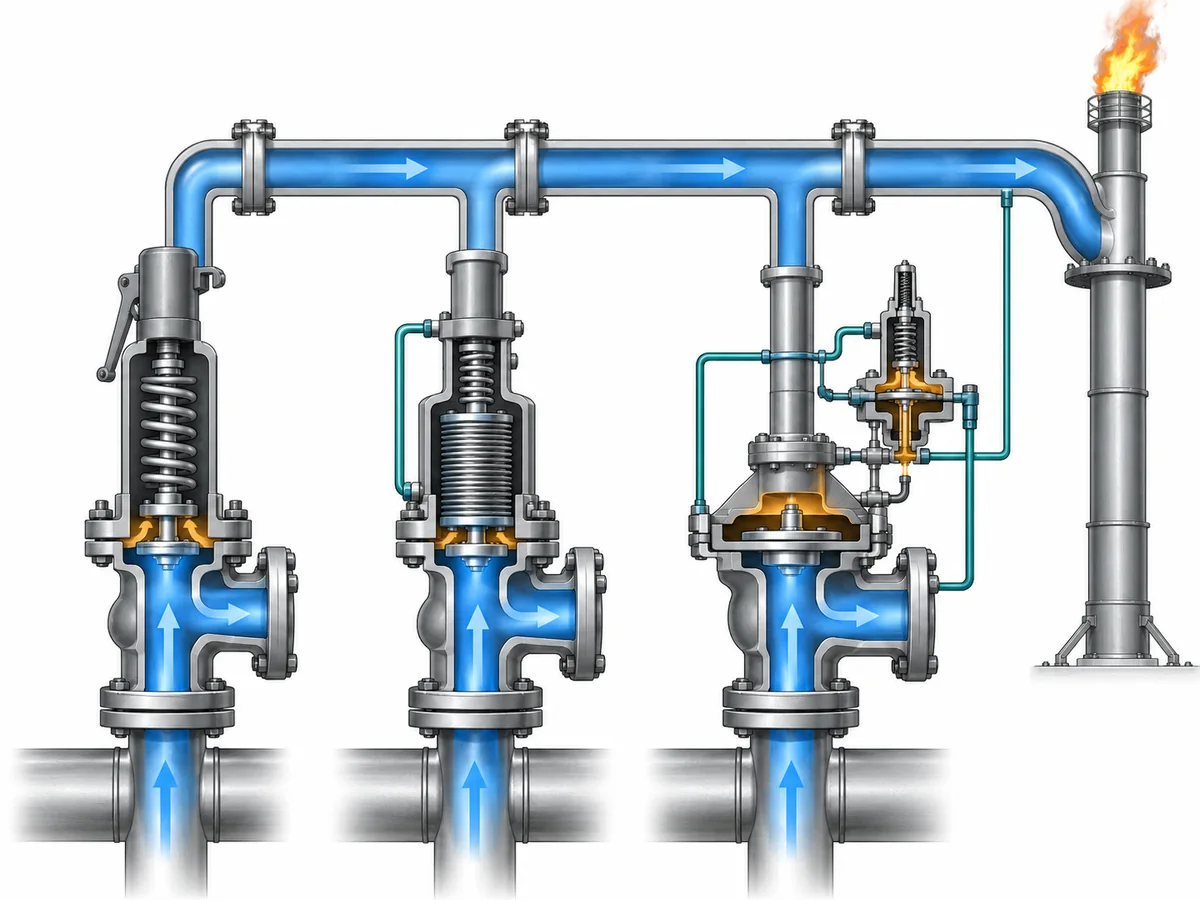
The practical selection sequence is therefore:
service environment → relief duty → component exposure → material requirements → valve configuration → back-pressure/discharge interaction → manufacturer and project verification.
Skipping the system steps can produce a valve that appears acceptable on a material list but does not behave as required in the installed relief system.
Translate Sour-Service and Pressure-Relief Requirements into an Acceptance Basis
Standards are most useful when each one is allowed to prove only what it actually governs.
For sour-service materials, the applicable framework may come from NACE MR0175 / ISO 15156, NACE MR0103 / ISO 17945, an owner specification, or another project-specific requirement. Which one governs depends on the facility, process sector, environment and contractual basis. Current editions and project adoption should be verified before exact requirements are placed in a datasheet or purchase specification.
Pressure-relief standards and codes serve a different purpose. They may define or support pressure-relief sizing, selection, installation, testing, certification, pressure protection or system design. Their existence does not prove that the valve’s materials are suitable for H2S, just as a sour-service material specification does not prove pressure-relief capacity.
A defensible acceptance basis therefore separates four evidence classes:
Service/environment basis.
What process and H2S-containing environment is being specified, and under which operating and relieving conditions?
Material and component basis.
Which metallic and nonmetallic components require service-specific review, and what material, hardness, fabrication, qualification or compatibility evidence applies to them?
Pressure-relief performance basis.
What relief scenario, required capacity, set pressure, relieving conditions, configuration and back-pressure conditions must the selected valve satisfy?
Project and product evidence.
Which exact valve, drawing, datasheet, bill of materials, capacity information, test documentation and traceability records show that the offered configuration meets those requirements?
This structure also prevents a common procurement problem: using a phrase such as “NACE valve” as though it were a complete purchase specification. It is not. The phrase does not by itself identify the applicable standard, edition, environmental limits, component scope, required valve capacity, configuration, test requirements or documentation package.
The supplier’s evidence should therefore be traceable to the actual offered configuration, not merely to a generic product family.
For ZOBAI, model-specific sour-service suitability, exact material packages, standards compliance and certified capacity must be confirmed against the selected valve documentation. General engineering guidance or a refinery-oriented product family does not establish those facts for every model.
Engineering and code boundary: This article provides a selection and verification framework. It does not replace the governing relief calculation, manufacturer capacity data, the project-adopted edition of the applicable code or sour-service specification, or the owner/jurisdiction acceptance process.
What to Send in the RFQ—and What to Verify Before Acceptance
A useful sour-service RFQ should make it possible for the supplier to identify an exact valve configuration rather than respond to a generic request for an “H2S safety valve.”
Provide the information that materially affects the decision:
- protected equipment and governing relief scenario;
- process fluid, phase and relevant composition information;
- H2S service information required by the applicable project basis;
- normal operating pressure and temperature;
- design pressure or MAWP where relevant;
- required set pressure;
- required relieving capacity or the approved calculation basis;
- 泄放压力和温度;;
- superimposed and built-up back pressure where relevant;
- discharge destination and any containment requirements relevant to the valve;
- inlet and outlet connection requirements;
- applicable sour-service material specification and project edition, if already established;
- any project-mandated material, trim, seal, bellows, bolting or pilot requirements;
- inspection, traceability or documentation requirements;
- existing datasheet, nameplate and drawing information for a replacement application.
The return package should then be reviewed against the actual offered valve. Depending on the project requirement, that review may include the valve datasheet and drawing, material identification and traceability for relevant components, required material-condition or hardness evidence, the selected valve’s capacity or sizing basis, and specified calibration, test or inspection records.
The goal is not to demand the largest possible document package. It is to create a traceable chain:
defined service → applicable requirement → affected component or function → selected valve → supporting evidence.
If one link in that chain is missing, the correct response is usually to identify what remains unconfirmed—not to assume either compliance or non-compliance.
That same discipline should be applied to replacement valves. Matching the existing connections, set pressure or external dimensions can narrow the search, but it does not establish the required capacity, internal material condition, back-pressure compatibility, certification basis or sour-service suitability.
For an engineering review, provide the actual operating and relieving conditions, H2S service basis, required capacity, back-pressure and discharge information, applicable project specification, and any existing valve documentation. ZOBAI can then review the requirement against the documentation for the selected model rather than relying on a generic sour-service label.