了解真空安全阀在储罐和工艺工况中的含义、真空保护的工作原理、相关术语的区别,以及工程师需要核实的要点。.
用于储罐和工艺设备 真空安全阀 是一种真空保护
装置,当出现过度真空工况时可开启以吸入空气或其他适宜气体
由于该术语在不同行业中的用法并不完全一致,本文仅在
该储罐/工艺背景下使用它。.
什么是真空安全阀?
在此背景下,该装置为补充气体进入受保护系统提供受控通道。
然而,仅凭装置名称并不能确定完整的工程
职责。.
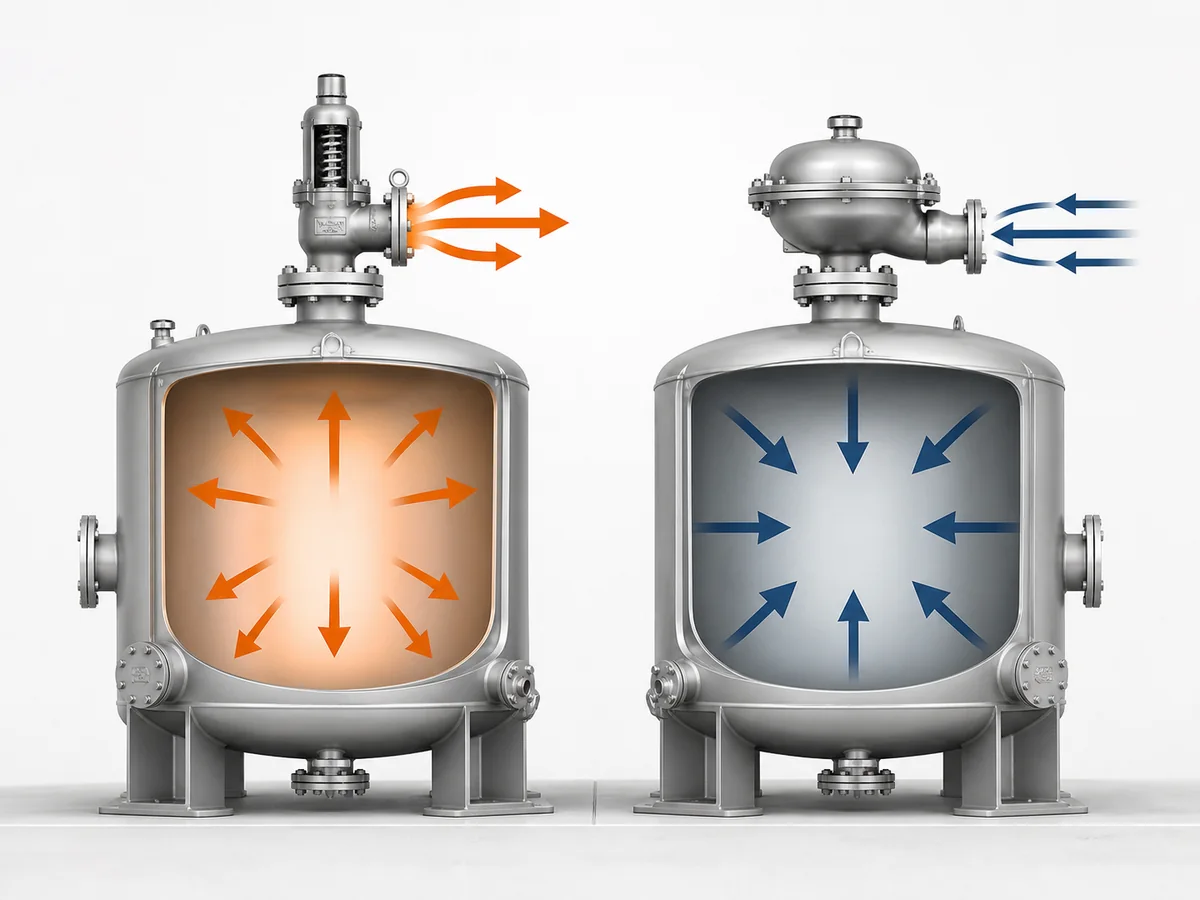
正压泄放装置为流体在系统内部压力过高时离开系统提供通道。
真空保护则沿相反流动方向工作:合适的
补充气体进入受保护设备,以减轻过度真空状态。.
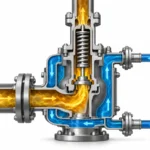
真空安全阀如何保护设备?
真空保护由压差驱动。当受保护设备内部压力
相对于进气侧可用压力下降时,压差
可达到装置的开启条件。随后装置允许补充气体进入并
减轻真空。在受支撑的阀门设计中,当压力条件
恢复时,它会关闭或重新密封。.

当内部压力下降时会发生什么
关键工程问题不仅仅是系统是否被描述为“处于
真空。即压力工况是否已达到指定
真空保护通路需要开启的程度。该边界取决于受保护设备及
项目设计基础,而非适用于所有系统的通用值。.
为何补入气体可缓解过度真空
当液体离开储罐、气体或蒸气冷却收缩,或蒸汽或其他蒸气
冷凝时,蒸气空间可能需要补充气体以维持预期压力
工况。引入置换气体可以抵消这种变化并降低真空度。.
置换气体不一定是大气空气。其适用性取决于
工艺条件,且必须与基本的真空泄放功能分开考虑。.
什么原因会导致储罐或工艺系统产生过度真空?
如果不了解产生真空需求的原因,就无法评估所需的保护措施。
在储罐和工艺应用中,有几种机理具有代表性,但起主导作用的
具体取决于实际设备及操作顺序。.
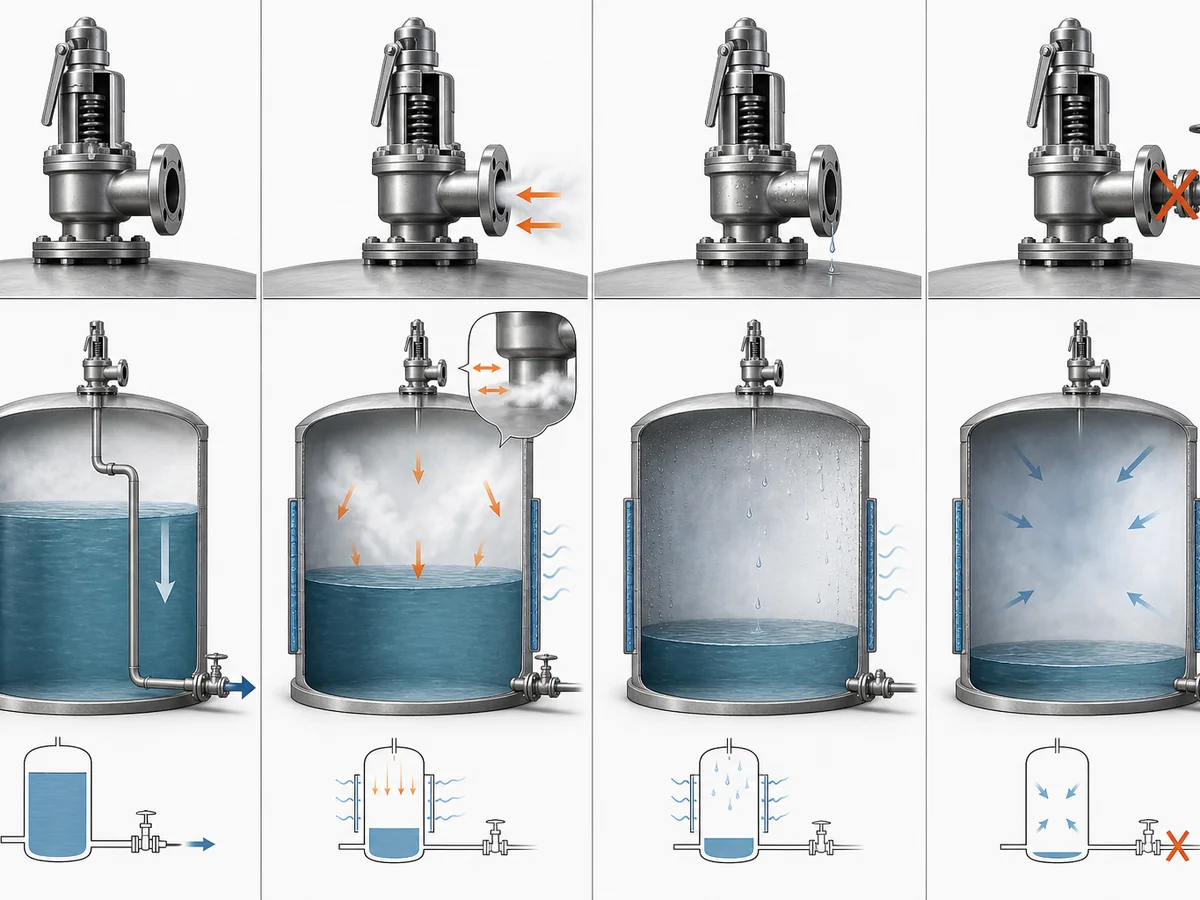
液体抽出
当液体从储罐中抽出时,气相空间需要补充额外的气体体积。如果补充
气体无法快速进入以抵消该变化时,内部压力可能下降并形成真空
状态。.
冷却或蒸气收缩
冷却可降低封闭或受限系统中气体或蒸汽的压力。由此产生的
压力下降可能形成 吸入 需求——即需要
补充气体进入系统——即使没有液体被抽出。.
蒸汽或蒸汽冷凝
冷凝会减少系统中占据空间的蒸汽量。蒸汽系统真空破坏阀
可说明这一机理:蒸汽在冷却过程中冷凝时,压力下降,空气可能被
admitted to break the vacuum.
Restricted replacement-gas flow
Excessive vacuum can also develop when the required make-up gas cannot enter quickly enough to
offset withdrawal, cooling, or condensation. This is best understood as part of the overall
cause chain rather than as a universal standalone failure mode.
For deeper application-specific discussion of vacuum scenarios, see
ZOBAI Vacuum Service.

Vacuum Safety Valve vs Vacuum Relief Valve vs Vacuum Breaker vs PVRV
These terms can overlap, but treating them as universal synonyms can create the wrong
engineering assumption. A more reliable approach is to identify what condition the device
protects against and how it responds.
| Term | Useful Working Meaning | Important Boundary |
|---|---|---|
| Vacuum safety valve |
In this article, a device used to protect tank or process equipment against an excessive vacuum condition. |
The phrase is context-dependent and is not a universal cross-industry definition. |
| Vacuum relief valve |
A valve used to relieve an excessive-vacuum condition, commonly by admitting air or another suitable gas. |
Construction and application vary, so the name alone does not establish suitability. |
| Vacuum breaker |
A functional term for a device that breaks a sub-atmospheric condition by allowing gas to enter. |
The term is used in steam and process service and should not automatically be treated as identical to every vacuum relief valve. |
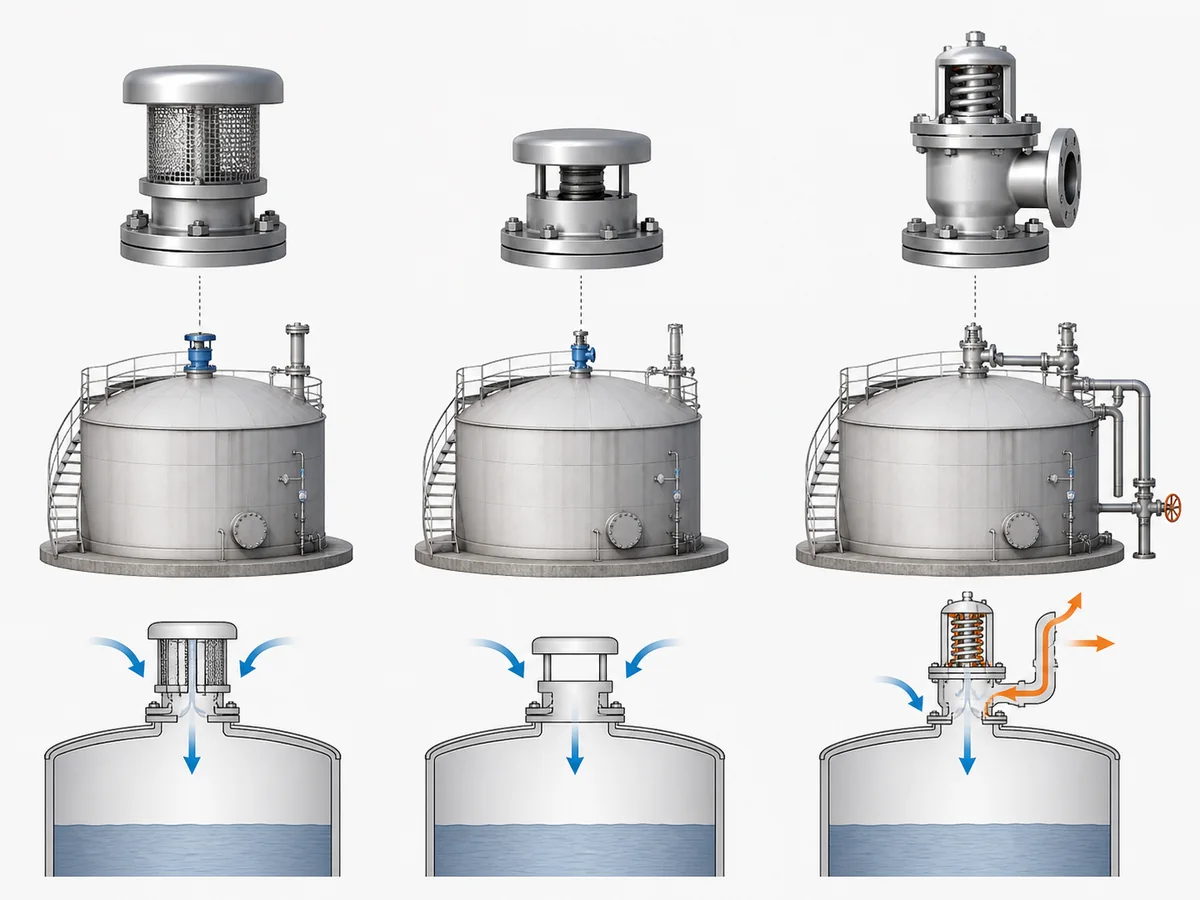
| PVRV / PV valve |
A pressure/vacuum relief configuration that can provide both positive-pressure and vacuum-protection functions. |
A combined pressure/vacuum device is not the generic name for every vacuum-only protection device. |
| Conventional pressure safety or relief valve | A device primarily intended to protect against excessive positive internal pressure. | Positive-pressure relief and vacuum relief operate in different flow directions. |
There is another important terminology boundary. In high-vacuum equipment, the phrase can
carry a different meaning.
VAT Group,
for example, uses 真空安全阀 for a valve that protects an evacuated vessel
against excessive positive internal pressure by releasing pressure outward.
That use is different from the tank/process vacuum-relief meaning used throughout this
article.
When combined pressure and vacuum protection becomes relevant
Some tank applications require both directions of protection: relief of excessive positive
pressure and relief of excessive vacuum. A combined pressure/vacuum relief device can provide
both functions, but whether that arrangement is appropriate remains a project-level
engineering decision.

What Actually Determines the Vacuum-Protection Requirement?
A vacuum-protection device cannot be evaluated simply by matching a connection size. The
required duty comes from the protected equipment and the process conditions that create the
vacuum.
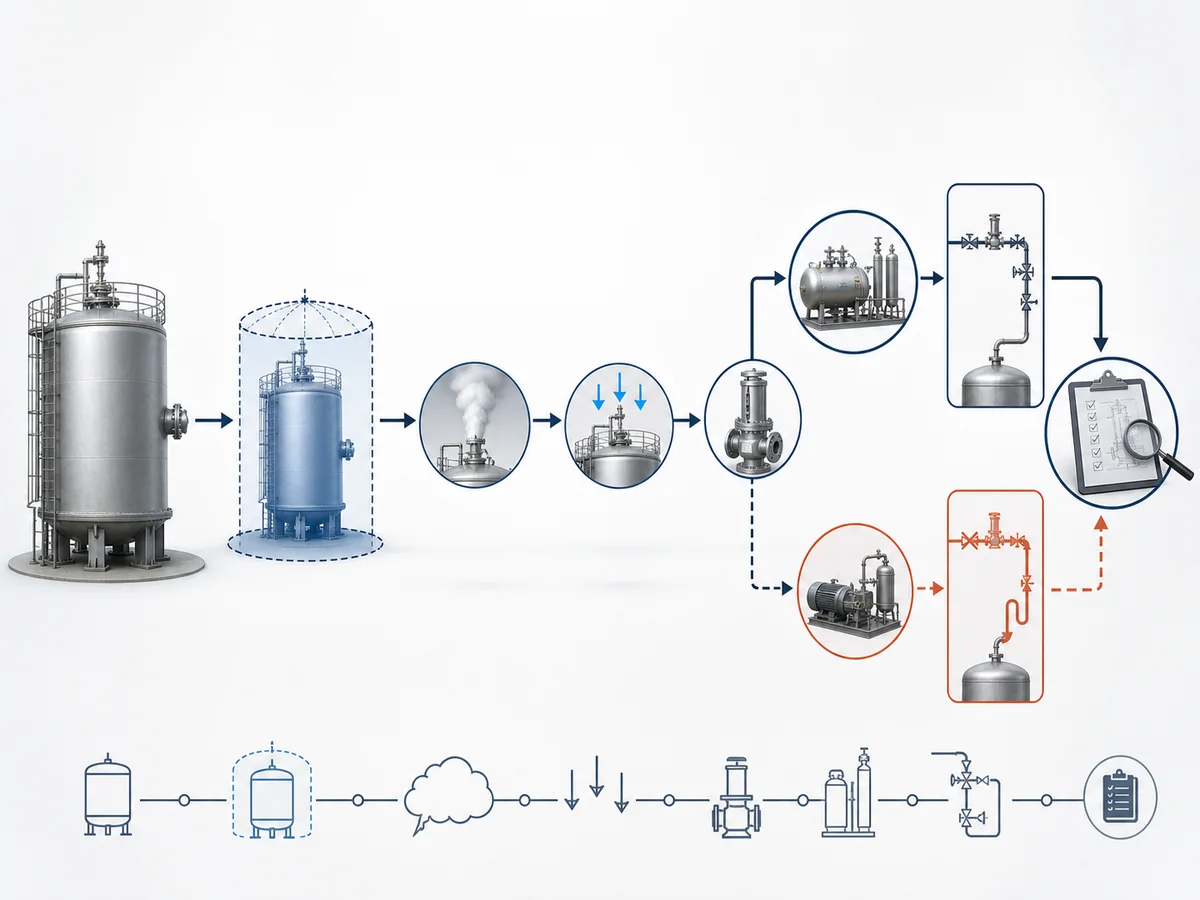
1. What equipment is being protected?
Start with the tank, vessel, or process equipment itself. Its allowable or design vacuum basis
establishes the boundary that the protection system is intended to respect.
2. What vacuum condition can the equipment tolerate?
The relevant vacuum limit is equipment- and project-specific. A generic valve setting cannot
be assumed from the equipment name, connection size, or application category.
3. What event creates the governing vacuum demand?
The engineering review needs to identify the operating event that governs the relevant
inbreathing requirement, such as withdrawal, cooling, or condensation. Different operating
sequences can create different vacuum demands.
4. How much replacement gas may be required?
The device must be evaluated against the required replacement-gas or inbreathing duty for the
governing scenario. Nominal connection size by itself does not establish that the required
flow can be handled.
5. What gas is acceptable to admit?
Atmospheric air may be acceptable in some applications, while other systems may require an
inert or otherwise controlled vapor-space atmosphere. The acceptable make-up gas is therefore
a process-design question as well as a valve-selection question.
6. What restrictions exist in the complete flow path?
The installed venting path can include piping and accessories that add flow resistance.
Components such as flame arresters should therefore be considered as part of the complete flow
path rather than assumed to have no effect on the available pressure drop.

Once these inputs are known, the project can move from general understanding to comparison
with available vacuum-protection solutions. The
ZOBAI Vacuum Safety Valves
page provides the relevant product-family overview.
When Is Atmospheric Air Not a Safe Assumption?
A simplified explanation of vacuum relief often says that the valve “lets air in.” That can
describe many real systems, but it is not a universal design rule.
Some processes are intentionally operated with an inert or otherwise controlled vapor-space
atmosphere. In those cases, unrestricted atmospheric-air admission may conflict with the
process requirement. Relevant concerns can include oxygen exposure, moisture or contamination
control, or a project-specific inerting or blanketing strategy.
This does not mean that every chemical, hygienic, or sanitary tank requires inert-gas
admission. Hygienic vacuum-protection equipment also exists that intentionally admits
atmospheric air within its defined application. The narrower and safer conclusion is that
the permitted make-up gas must be confirmed for the actual process.
Device capability and process suitability are separate questions. A valve may provide a
vacuum-relief function while the proposed admission method is still inappropriate for the
process being protected.
Where Do API 2000 and ISO 28300 Fit?
API 2000 and ISO 28300 belong to the engineering context of venting atmospheric and
low-pressure storage tanks. They should not be treated as universal vacuum-valve standards
for every vessel, vacuum system, or industrial application.
According to
API’s current Digital Catalog,
Standard 2000, Edition 8 is titled
Venting Atmospheric and Low-pressure Storage Tanks. This article uses that verified
information only at the title and scope level. It does not reproduce or claim detailed
Edition 8 sizing rules, formulas, tables, or clause requirements.
ISO’s official listing
identifies ISO 28300:2008 as the published International Standard for
venting atmospheric and low-pressure storage tanks. ISO also lists a
revision under development.
A developing revision should not be presented as though it has already replaced the published
edition.
For a real project, the applicable standard, edition, equipment scope, and contractual
requirements need to be confirmed. Mentioning API 2000 or ISO 28300 does not by itself
establish that a particular manufacturer’s product is certified to, or compliant with, that
standard.
常见问题
Does every storage tank need a vacuum safety valve?
There is no universal yes-or-no answer. The protection method depends on the tank design
basis, operating conditions, venting arrangement, credible vacuum-producing scenarios, and
applicable project requirements. A particular valve configuration should therefore be
evaluated from the actual system rather than assumed from the equipment category alone.
Can a flame arrester or another vent-path restriction affect vacuum-relief performance?
Yes. Flow-path components can introduce resistance, so the installed venting path should be
evaluated as a system. A flame arrester, piping arrangement, or another accessory should not
automatically be assumed to have no effect on the pressure drop available for the required
flow.
Does API 2000 mean a vacuum safety valve is “API certified”?
No. A standard can define or inform engineering requirements for a project without serving as
a certification mark for a particular product. Any product-specific compliance or
certification claim must be supported separately by valid product or manufacturer
documentation.