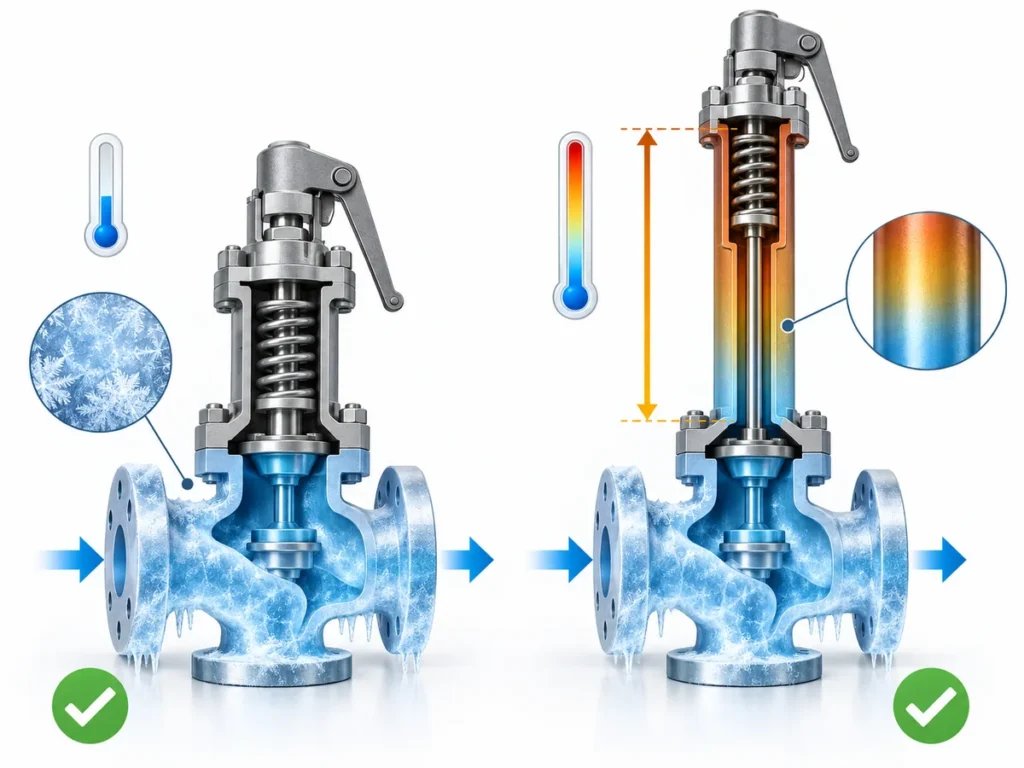
Troubleshoot vacuum relief valve leakage, sticking, reseating and weather exposure. Learn what to inspect and when testing, repair or replacement is needed.

A vacuum relief valve that appears to leak or stick should not be diagnosed from the symptom alone.
On pallet-type vacuum relief and pressure/vacuum relief valves used on atmospheric and low-pressure
tanks, admitting air during a genuine vacuum-relief event can be normal operation. The maintenance
question is whether the device opens under the expected vacuum condition, has a clear flow and movement
path, and reseats correctly afterward.
Weather can complicate that diagnosis. Moisture, condensate, ice, debris or corrosion can matter in some
valve designs, but finding an outdoor valve wet or dirty still does not establish the root cause. Different
P/V vent designs use different drainage, weather-protection and cold-weather measures, so a remedy that is
valid for one model should not be transferred to another without the applicable manufacturer and site procedure.
Полезная последовательность поиска неисправностей:
classify the symptom → preserve the as-found evidence → inspect the relevant flow, seating and movement
paths → identify what remains uncertain → verify function or escalate when necessary.
This article is about diagnosis and maintenance decisions; it is not a generic field-adjustment, lubrication
or overhaul procedure.
Is It Really a Vacuum Relief Valve Leak?
Air moving through a vacuum relief valve is not automatically leakage.
For the pallet-type tank vacuum valves in this article’s scope, the vacuum
element is intended to open when the required vacuum condition is reached,
admit gas into the protected equipment, and reseat as the vacuum condition
условий давления.
ZOBAI’s
vacuum safety valve selection page
explains the broader tank-vacuum protection role. For troubleshooting,
however, the first question is narrower:
when does the observed airflow occur?
| Наблюдение | На что это может указывать | Что это не доказывает |
|---|---|---|
|
Air enters while the tank is experiencing the condition that should call for vacuum relief |
The valve may be performing its intended vacuum-relief function | Повреждение седла |
| Flow continues when the valve would normally be expected to reseat | A reseating or sealing problem requires investigation | The exact cause |
| Air movement occurs when no vacuum-relief event is expected | Valve or system behavior needs further checking | That the seat itself is defective |
| Leakage appears to come from a flange, connection or adjacent piping | Another leak path may exist | Internal valve-seat failure |
What matters is separating opening from reseating. A valve
can open correctly and still have difficulty closing afterward. Conversely,
an observed airflow path may come from outside the valve seat. Capture the
timing and direction of flow before cleaning or dismantling anything; once
the as-found condition is lost, the strongest diagnostic clue may be gone.
Record the process condition before the valve is disturbed:
- what the tank or process was doing;
- whether a vacuum condition was present;
- when the symptom started;
- whether flow was continuous or intermittent;
- whether it stopped when process conditions changed.
Do not convert that field observation into a formal leakage result.
Seat-tightness acceptance depends on the actual device, applicable test
basis and project requirements. API RP 576 includes weight-loaded
pressure/vacuum vents within its inspection-and-repair scope for
pressure-relieving devices, which is one reason an as-found symptom should
be kept separate from a defined inspection or test result.
See API’s publication scope for RP 576
.
Classify the event before diagnosing the valve.
If the investigation points to inadequate tank inbreathing, venting duty
or the overall pressure/vacuum protection basis rather than a mechanical
valve symptom, move to the broader
storage-tank venting application review
instead of expanding this troubleshooting path into a sizing exercise.
What Can Make a Vacuum Relief Valve Stick or Fail to Reseat?
“Sticking” identifies a movement problem. It does not identify its cause.
For pallet-type pressure/vacuum vents, useful troubleshooting separates
several cause categories and asks what physical evidence supports each one.
The same symptom can come from fouling, degraded seating or guide surfaces,
mechanical interference, or weather-related contamination, and those findings
lead to different next actions.
Deposits and process residue
Product build-up or foreign material around seating surfaces, guide holes
or moving interfaces can interfere with free movement or correct seating.
Protectoseal maintenance documentation, for example, calls for inspection
of seating surfaces and guide areas for build-up and corrosion.
Protectoseal P/V vent maintenance instructions
.
Finding deposits makes fouling plausible. It does not establish whether
wear, pitting or another defect is also present. Nor does successful cleaning
demonstrate that the valve opens, reseats or responds at the required setting;
those are separate functional questions.
Corrosion, pitting and physical damage
Corrosion, pitting, scratches, burrs or component wear can affect either
movement or sealing. For maintenance purposes, separate contamination that
can be addressed under an approved procedure from deterioration that
requires further repair evaluation.
Visible corrosion alone is not a universal full-valve replacement
criterion. Record где it occurs. Damage at a seat, guide, stem,
pallet edge, diaphragm or other moving/sealing component can have a different
consequence from superficial corrosion on a non-functional exterior surface.
Material compatibility should therefore be reviewed at component level—not
just by the body alloy—when corrosion or chemical attack is suspected.
Mechanical interference or modification
Moving parts need an unobstructed path. Added hardware, deformation,
incorrect reassembly or unauthorized modification can create physical
interference.
A documented UK Health and Safety Executive incident involved a
pressure/vacuum relief valve whose unauthorized modification interfered
with stem movement and left its vacuum-relief element stuck open. The
incident concerned road-tanker equipment, so it should not be generalized
into a universal failure mechanism; it does demonstrate why a modification
near moving parts is relevant evidence.
HSE pressure/vacuum relief valve safety alert
.
HSE also reported that the vacuum-protection function on the affected valves
was not being routinely tested before refitting. The engineering lesson is
broader than the tanker application: after work that can affect movement,
seating or setting, do not assume that correct appearance proves correct
function.
Moisture, condensate and ice
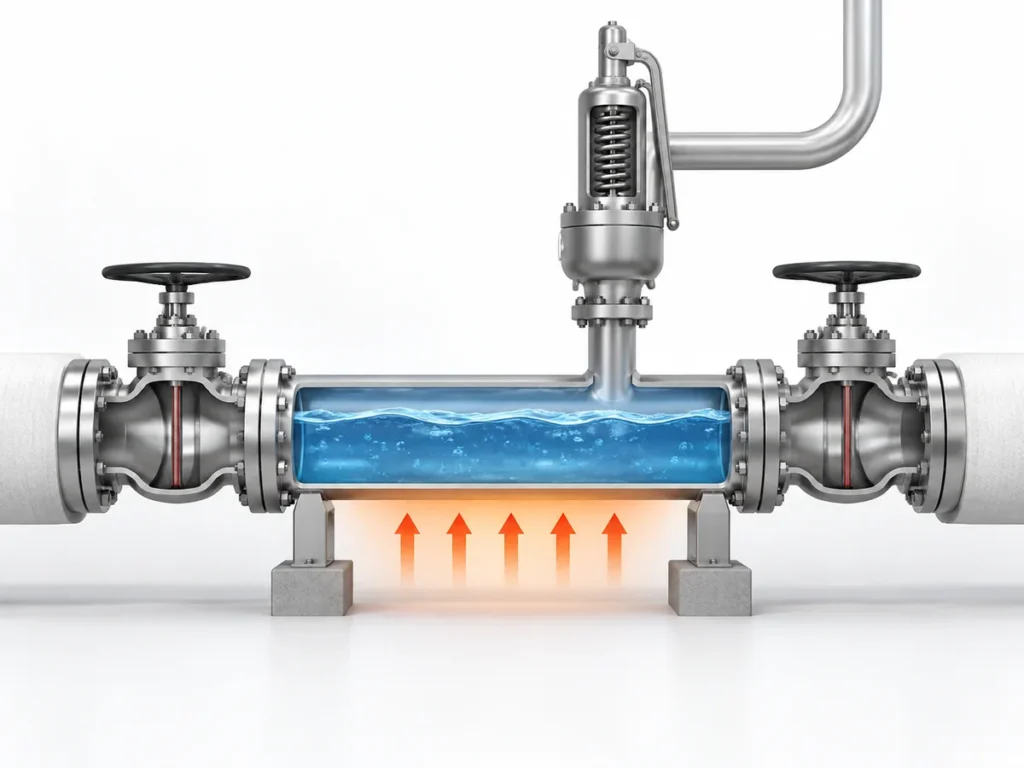
Outdoor moisture and cold conditions can also become relevant, depending
on the design. Some manufacturers use drainage, drip rings or specific
seating arrangements on particular products to address condensate,
freezing or atmospheric-moisture sticking. Groth, for example, describes
self-draining construction and seating features on specific P/V vent models
for condensate, freezing and atmospheric-moisture service.
That evidence supports moisture and freezing as legitimate troubleshooting
variables; it does not prove that weather caused a particular failure.
| Evidence found | More plausible issue | What still remains unknown |
|---|---|---|
| Residue around a seat or guide | Fouling or product build-up | Whether component damage also exists |
| Pitting, wear or corrosion | Degraded movement or sealing surfaces | Whether repair or full replacement is required |
| Added or distorted hardware in the movement path | Механическое заедание | Whether additional faults exist |
| Ice or recurring condensate at relevant components | Weather-related interference | Whether weather is the only cause |
| Damaged moving or sealing component | Component deterioration | Whether the valve can be repaired and verified |
This evidence-to-cause relationship is more useful than a generic list of
“common valve problems.” It also prevents a common maintenance error:
repeating the same cleaning action when the evidence is actually pointing
to corrosion, interference or an unsuitable service condition.
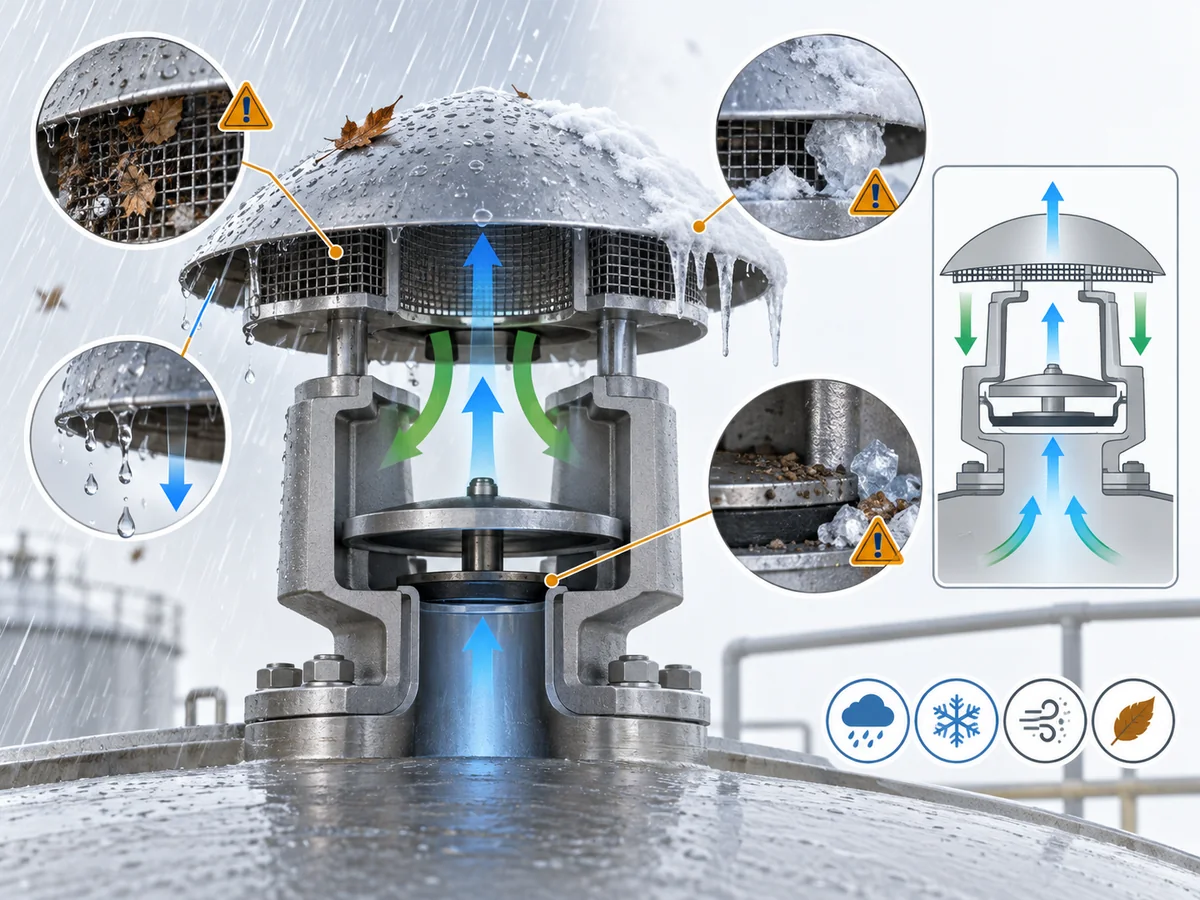
How Weather Exposure Can Contribute to Vacuum Relief Valve Problems
Weather protection is part of the valve’s operating environment, not
simply an outer cover. Rain, atmospheric moisture, condensate, freezing
conditions and outdoor debris can matter when they reach flow paths,
guides, seats or moving components. The mechanism—and the appropriate
response—depends on the valve construction.
Moisture and condensate
Water or condensate becomes relevant when there is evidence that it reaches
an area where it can contribute to contamination, corrosion or restricted
movement. The useful question is not simply “is the valve outdoors?” but
“is there a credible path from the observed weather exposure to the seat,
guide, pallet or vent path involved in the symptom?”
Useful evidence includes:
- repeated condensate in the same location;
- corrosion or residue where moving components operate;
- obstructed drainage;
- moisture accumulation around a seat or guide.
Merely knowing that a valve is installed outside is much weaker evidence.
A dry, freely moving valve can still have a process or setting problem; a
wet valve can still have an unrelated seat or reassembly problem.
Freezing conditions
Moisture can become more consequential when it freezes. Different
manufacturers address this differently. Emerson documentation for its
specific 5910C design, for example, includes model-specific
freezing-weather maintenance.
Emerson 5910C instruction manual
.
Other designs use drainage or different seating arrangements. Groth
documentation for particular P/V valve configurations describes
self-draining construction intended to manage condensate and freezing.
Groth pressure/vacuum relief valve documentation
.
The practical implication is that
cold-weather mitigation must follow the actual valve design and its
approved maintenance guidance.
A lubricant or winter procedure specified for one product should not be
transferred automatically to another.
Hoods, screens and exposed openings
A weather hood or screen may reduce exposure to precipitation, debris or
animals. Emerson’s 5910C instructions, for example, describe a weatherhood
and mesh screen protecting pressure-side components from weather and
contamination. Protectoseal’s current P/V vent maintenance guidance also
requires guide areas associated with weatherhood or vacuum-cover components
to remain free of product build-up.
Protectoseal P/V vent maintenance guidance
.
Those examples are design-specific, but they support a broader inspection
point: protective components still belong to the installed flow and
movement environment and may themselves require inspection. If a valve has
a flame arrester, bird screen, pipe-away connection or other attached flow
component, record its condition as part of the system review rather than
assuming every restriction is inside the valve.
Weather remains a cause pathway to verify, not a diagnosis.
What Should You Inspect Before Adjusting, Repairing or Replacing the Valve?
Initial inspection should reduce uncertainty without changing the valve’s
protective function. API RP 576’s scope includes weight-loaded
pressure/vacuum vents within the inspection and repair discipline for
pressure-relieving devices. Actual model-specific work still depends on
the valve manufacturer, owner/operator procedure, process hazards and
installed service.
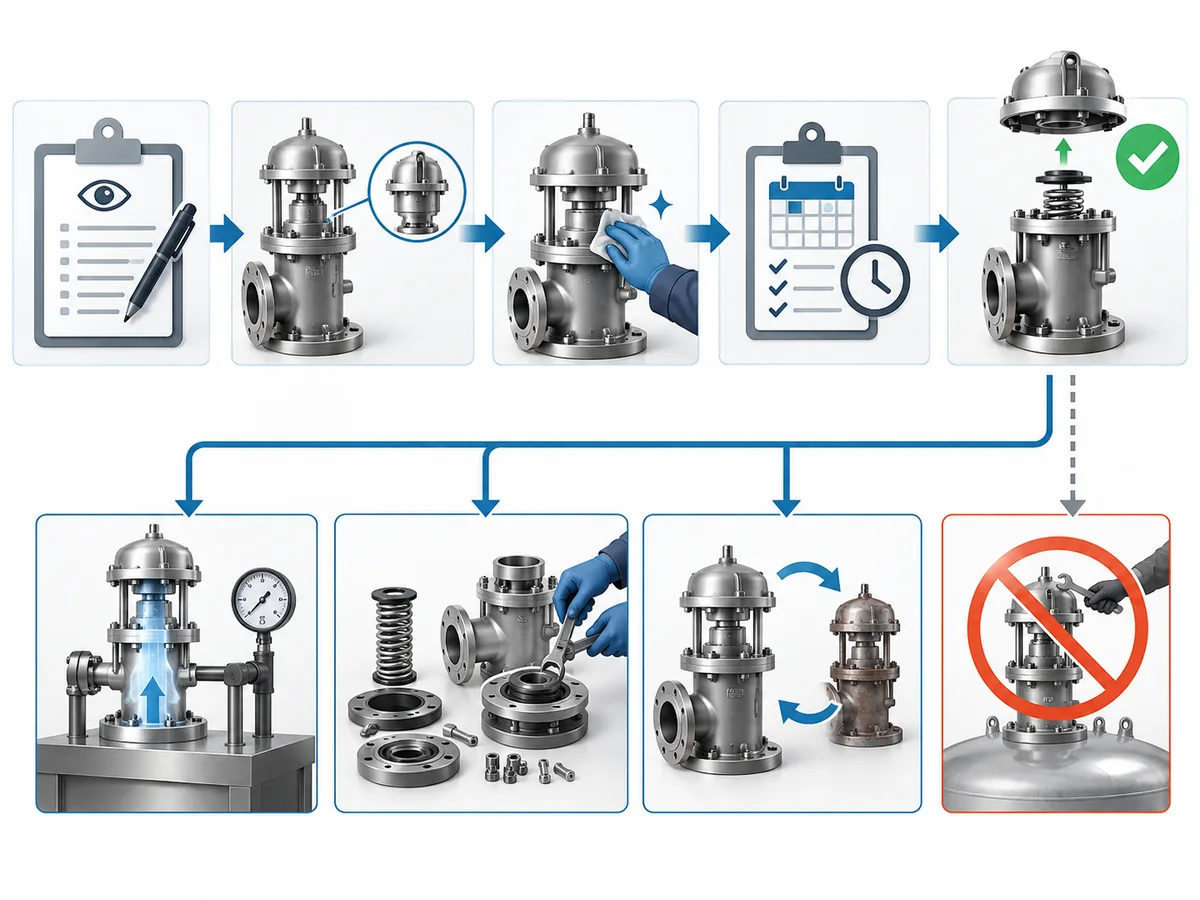
1. Preserve the as-found symptom
Before cleaning, dismantling or modifying anything, record:
- when the leakage or sticking appears;
- whether vacuum was present;
- whether airflow is continuous or event-related;
- whether the problem began after maintenance, abnormal weather or a process change;
- whether the symptom involves the valve itself or an attached flange, screen, arrester, piping connection or vent path.
Otherwise, the strongest diagnostic evidence may disappear during the
first intervention. Photographs of the as-found condition, nameplate and
visible deposits or modification can be more valuable than a cleaned valve
with no record of what was changed.
2. Identify the device
Record the:
- manufacturer;
- model;
- serial/nameplate information;
- known pressure or vacuum settings;
- installed accessories, where identifiable.
The correct servicing and verification route can depend on the exact
design. A weight-loaded atmospheric-tank vent should not be maintained as
though it were a conventional high-pressure spring-loaded PSV merely because
both are pressure-relieving devices.
3. Check the external installation
Look for observable conditions such as:
- debris or obstruction;
- corrosion or physical damage;
- moisture, condensate or ice;
- blocked or damaged screen or weather-protection components;
- drainage problems;
- added covers, brackets or modifications;
- fouling or restriction in an attached flame arrester or pipe-away path, if fitted;
- installation changes that could affect the required movement or flow path.
If the fault followed modification or reassembly, record that relationship.
If an attached component is restricted, the tank may experience a venting
problem even when the pallet itself is mechanically free.
4. Review service history
Determine whether the valve has recently been:
- removed;
- cleaned;
- disassembled;
- repaired;
- adjusted;
- modified;
- exposed to abnormal process conditions.
A newly developed problem after intervention deserves a different
investigation from progressive process fouling. Do not copy a maintenance
interval from another manufacturer or model: service severity, stored
product, weather exposure and inspection history can all change the useful
interval, and manufacturer instructions differ by design.
5. Inspect internal components only within the approved maintenance scope
Where the actual valve procedure allows it, useful evidence can include:
- deposits;
- foreign material;
- corrosion;
- pitting;
- damaged sealing components;
- guide interference;
- components that do not move or rest as intended.
Manufacturer maintenance documents commonly inspect these kinds of
conditions, but dismantling, lapping, component replacement and setting
procedures remain model-specific. Internal work also introduces process-
contamination and stored-energy hazards that must be handled under the
site’s isolation and safety procedure.
6. Stop before troubleshooting becomes unauthorized adjustment
Do not use a general troubleshooting article as authority to change a
valve’s loading, setting, lubricant or cleaning method. Those actions,
where applicable, depend on the exact valve design and the approved
manufacturer and site procedure.
For example, Protectoseal’s current P/V vent instructions tell end users
not to change pressure or vacuum settings by adding or removing weights,
while Emerson publishes model-specific cold-weather lubrication guidance
for its 5910C series. The two examples illustrate the same boundary:
maintenance and adjustment practices are not automatically transferable
between valve designs.
Protectoseal P/V vent maintenance instructions
.
Unless the exact approved procedure establishes otherwise, do not improvise
by changing loading weights, springs or settings, selecting an arbitrary
lubricant or cleaner, altering a hood or screen, or bypassing a special
servicing requirement.
Escalate when the next step requires changing the protective setting,
repairing damaged parts, deeper disassembly or demonstrating the valve’s
function under controlled conditions.
When Should the Valve Be Tested, Repaired or Replaced?
Inspection identifies evidence. It does not necessarily prove that the
valve is ready to return to service. The next decision depends on both
what has been found и what remains uncertain.
| Состояние до ремонта | Next decision |
|---|---|
|
A removable contaminant is identified and the applicable maintenance procedure covers it |
Complete the approved maintenance path and the verification required by the applicable procedure |
| Opening, reseating or setting remains uncertain | Move to controlled functional or setting verification |
|
Moving or sealing parts show wear, corrosion or damage beyond routine maintenance |
Obtain qualified repair evaluation |
| Mechanical interference or unauthorized modification is found |
Stop treating the issue as ordinary fouling and escalate through the appropriate service route |
| Leakage or sticking recurs after repeated cleaning | Reassess the failure mechanism, service compatibility and installed configuration |
| Function cannot be restored or demonstrated | Evaluate replacement or reselection |
Testing answers a different question from inspection
A clean valve is not automatically a verified valve. Visual inspection may
reveal residue, corrosion or mechanical interference. Controlled testing
addresses whether the device actually performs the function required by
the project, governing basis or manufacturer.
That matters most when work has affected moving, sealing or
setting-related components. HSE’s tanker investigation is a documented
example of why this distinction matters: the valve had been serviced and
modified, but its vacuum-protection function was not being routinely tested
before refitting.
Repair is its own decision
When parts are worn, damaged, badly corroded or modified, the issue may
move outside routine maintenance. Depending on the design, repair can
require specialized tooling, controlled setting work and functional
verification. A general article should not replace those model-specific
procedures.
Do not assume that every low-pressure tank P/V vent repair falls under the
same repair-stamp or jurisdictional program used for conventional code
pressure-relief valves. The applicable repair, test and documentation route
depends on the device classification, original construction basis, owner
requirements and local jurisdiction.
Replacement is not automatically triggered by one event
The authorities reviewed for this article do not establish a universal
rule requiring complete replacement of this equipment class after a single
leakage or sticking event.
Replacement or reselection deserves consideration when, for example:
- required components cannot be restored through the approved repair path;
- the condition prevents reliable function from being demonstrated;
- the installed valve is found to be mismatched to the actual service;
- suitable repair parts or technical support are unavailable;
- recurring failure indicates that the original configuration should be reviewed.
If the investigation identifies a specification problem rather than simple
damage, review the
vacuum safety valve selection criteria
rather than automatically ordering a like-for-like replacement.
What Information Should You Record Before Escalating the Problem?
A technically useful service request says more than “the vacuum valve is
leaking.” Record known information and leave unknown values explicitly
unknown. The goal is to let the next engineer distinguish a sealing problem,
a movement problem, an environmental problem and a venting-duty problem
without reconstructing the entire event from memory.
Valve identity
- manufacturer and model;
- serial or nameplate information;
- size and connection, where relevant;
- documented pressure and/or vacuum setting.
Наблюдаемый симптом
- what was seen or heard;
- when it happens;
- whether it is continuous or intermittent;
- whether it occurs during or after a vacuum event;
- whether the device appears to reseat;
- whether the same symptom returns after cleaning or maintenance.
Состояние до ремонта
- deposits or product residue;
- corrosion, wear or physical damage;
- moisture, ice or condensate;
- blocked or damaged hood, screen or drainage component, if fitted;
- condition of any attached flame arrester or pipe-away path, if fitted;
- evidence of modification;
- recent maintenance or adjustment;
- inspection or test results already available.
Service information
If repair or replacement review is likely, also capture the relevant:
- process fluid;
- рабочая температура;
- operating/design pressure and vacuum information;
- connection and material information;
- flame arrester, screen or other installed accessories;
- environmental exposure;
- required inbreathing or venting duty and its design basis, if the problem is moving into reselection.
Do not fill gaps with assumptions. An accurate неизвестно is
more useful than a guessed setting, material, capacity or failure mode.
Frequently Asked Questions About Vacuum Relief Valve Leakage and Sticking
Why can a vacuum relief valve appear to leak even when it is functioning?
A pallet-type vacuum vent is supposed to admit air when the tank reaches the valve’s vacuum setting.
Airflow during that event can therefore be normal. The fault investigation starts when airflow occurs at an
unexpected condition, continues after the device should have reseated, or comes from another flange, connection
or vent-path component.
Can cold weather make a pressure/vacuum vent stick?
It can be a contributing mechanism in some designs when condensate, atmospheric moisture or ice reaches a guide,
seat, drainage path or other moving area. The observation still needs to be verified against the actual valve
construction. Cold-weather maintenance is model-specific; a lubricant or procedure from another manufacturer
should not be copied across designs.
Should I lubricate a sticking vacuum relief valve?
Not on the basis of a generic troubleshooting article. Some manufacturers publish lubricant instructions for
specific products and conditions, while other designs use different materials, drainage features or maintenance
methods. Follow the exact manufacturer and site procedure for the installed model.
How often should a vacuum relief valve be inspected?
There is no single interval that can safely be applied to every P/V vent. Manufacturer instructions, stored
product, contamination tendency, weather exposure, operating history and the site inspection program all matter.
If inspection history shows faster fouling or weather-related problems, the program may need to be adjusted rather
than copied from another valve family.
When should a leaking or sticking vacuum relief valve be replaced?
One event does not automatically require complete replacement. Replacement or reselection becomes a stronger
candidate when damage cannot be restored through the approved repair route, function cannot be demonstrated,
required parts or support are unavailable, or recurring problems indicate that the existing configuration is
unsuitable for the service.
Is API 527 the seat-leakage standard for every vacuum relief valve?
No. API 527 addresses seat tightness of pressure relief valves, while API separately maintains standards and
recommended practices for low-pressure tank venting and inspection of pressure-relieving devices. The applicable
leakage or tightness basis has to match the actual device and project requirements; do not transfer API 527 limits
to a weight-loaded tank P/V vent without an applicability review.
API pressure-relieving systems standards list
.