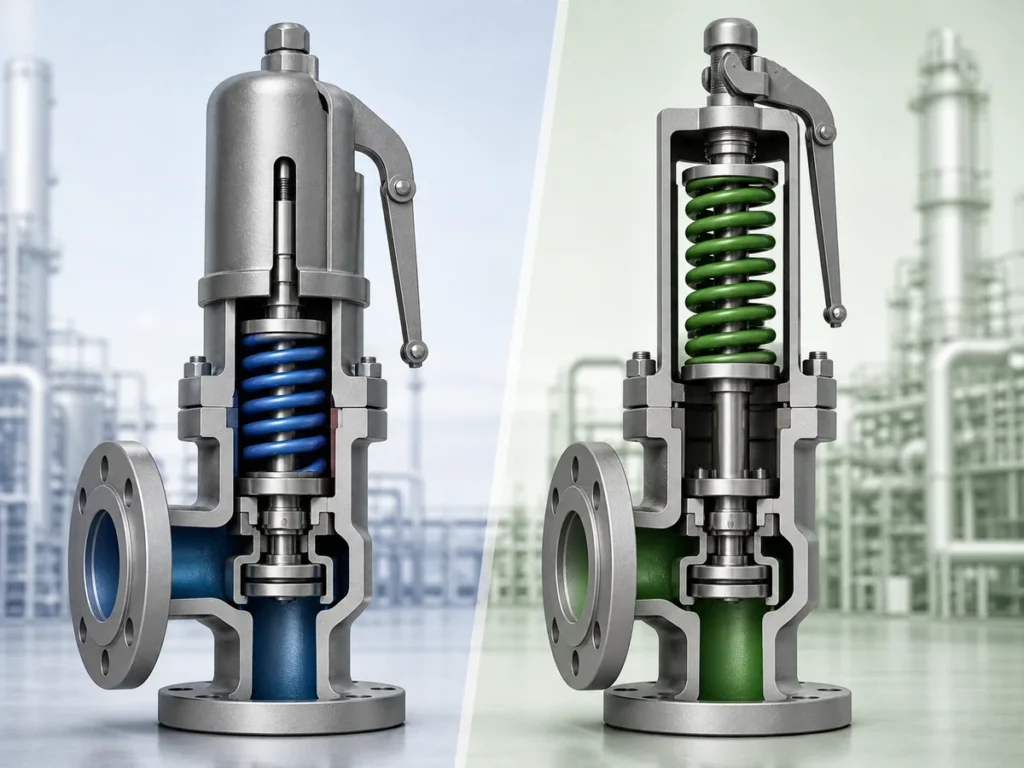
An external-fire relief review for pressurized LPG storage should be treated as an acceptance chain, not as a valve-only check. The reviewer first confirms the protected equipment and applicable fire scenario, then verifies that the project fire basis and relieving condition are defined, that a required relieving duty exists independently of the valve, that relevant …

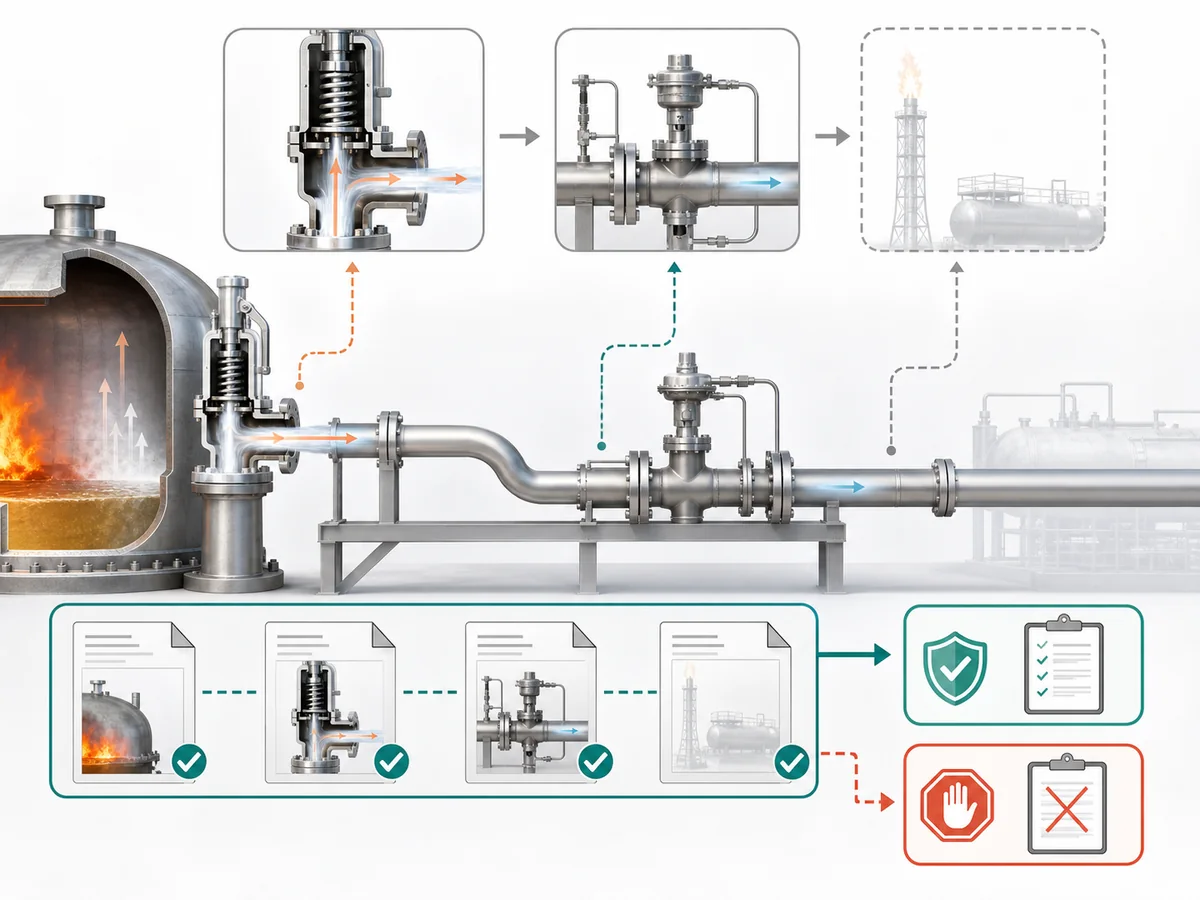
An external-fire relief review for pressurized LPG storage should be treated as an acceptance chain, not as a valve-only check. The reviewer first confirms the protected equipment and applicable fire scenario, then verifies that the project fire basis and relieving condition are defined, that a required relieving duty exists independently of the valve, that relevant valve-capacity evidence can be matched to that duty, and that the installed discharge and back-pressure basis does not leave the device assessment unresolved.
Each step depends on the one before it. A downstream document cannot repair a missing upstream basis. If the protected boundary, fire basis, relieving condition, required capacity, valve-capacity evidence, or outlet-system basis is unresolved, the correct result is a documented hold rather than an assumed acceptance.
Confirm the External-Fire Case and Protected Equipment Boundary
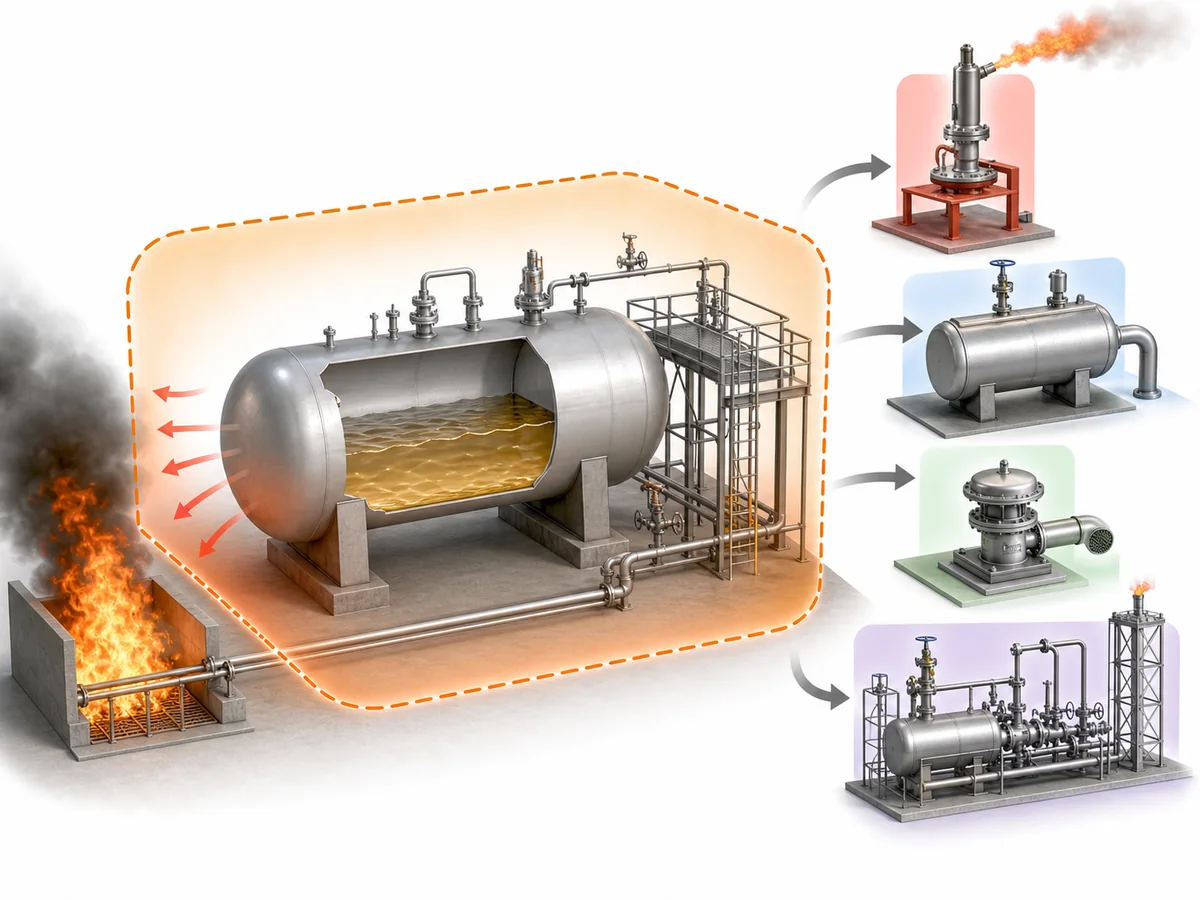
Capacity assessment starts only after two questions have been answered: what pressure-containing equipment is being protected, and whether external fire belongs to the relief basis for that equipment.
Starting with a safety valve and then trying to infer the protected case from the valve creates the wrong sequence. The protected pressure boundary and applicable overpressure scenario come first; the relief device is checked against that established basis later.
What equipment is actually being protected?
“LPG storage” is not a sufficiently precise engineering boundary on its own. The assessment should identify the pressurized equipment boundary associated with the relief device and the part of that boundary to which the external-fire case applies.
This first check prevents information from one protected boundary from being transferred to another simply because both involve LPG. Capacity evidence, project assumptions, and downstream conditions need to remain attached to the equipment and case for which they were established.
Connected piping requires the same discipline. The presence of LPG in a connected line does not make every heating-related overpressure case part of the storage-vessel fire assessment.
Is external fire a defined relief scenario for this equipment?
The UK Health and Safety Executive (HSE) recognizes external fire as a potential source of pressure rise in LPG storage. That general engineering point does not establish a project-specific fire case by itself.
The project relief basis must identify the external-fire scenario being assessed for the protected equipment.
A successful pressure-relief assessment should also remain within its own scope. It addresses the overpressure function defined by the relief case; it does not establish complete fire protection or the overall behavior of the installation during a severe fire.
What belongs to another protection or relief owner?
Several adjacent LPG duties should be routed away from this acceptance chain rather than folded into it.
- A blocked-in liquid section that warms and expands belongs to trapped-liquid thermal relief.
- Pressure/vacuum protection for a different tank or operating regime belongs to the PVRV/vacuum owner.
- The broader decision about which LPG valve configuration to select belongs to generic LPG valve selection.
- Detailed hydraulic design of a flare or disposal network belongs to flare-system design.
Freeze the Project-Specific Fire Inputs Before Reviewing Capacity
Once applicability is established, the next requirement is a traceable project fire basis. The reviewer should be able to distinguish between information that belongs to the project relief analysis and information that merely appears in public guidance, a worked example, or valve literature.
Public guidance may explain the engineering framework. It does not supply the project-specific inputs needed to establish the actual relief case.
Which fire-case inputs must come from the project basis?
The project basis should contain the information needed to characterize the defined fire exposure and the protected equipment under that scenario. Depending on the project, this can include equipment configuration, the applicable exposure basis, protection assumptions, the material held in the equipment, and other conditions needed by the upstream relief analysis.
The practical requirement is traceability: each material input relied upon by the fire case should have a project source rather than being reconstructed during valve assessment.
Why generic worked examples cannot establish this case
A worked example may illustrate a method, but it does not demonstrate that its equipment configuration, fire assumptions, protection assumptions, fluid condition, or other inputs apply to another installation.
The useful question is therefore not whether the project resembles an example. It is whether the inputs used for the protected equipment can be traced to the applicable project basis.
- Confirm that the protected equipment and fire scenario are identified.
- Confirm that the material fire-case inputs are supplied by the project basis.
- Confirm that the valve assessment is receiving those inputs rather than creating replacements.
- Hold the assessment when a missing upstream input materially prevents the required relief case from being established.
What missing fire-basis information stops the review
Capacity acceptance should not begin if the fire duty is not defined well enough for the upstream analysis to establish the required relieving case.
An uncertain equipment boundary, unclear fire-scenario basis, or missing project information that materially affects the relief analysis leaves the acceptance chain incomplete.
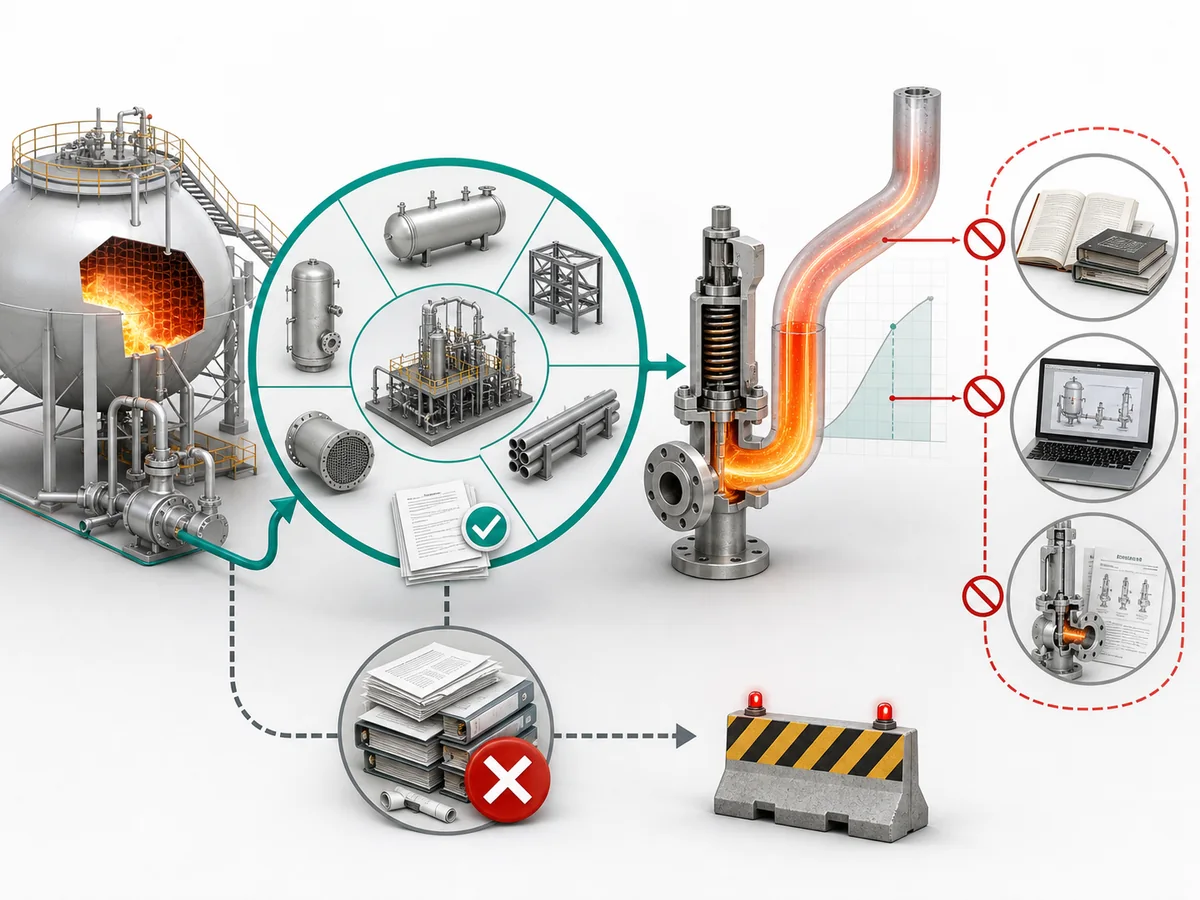
Establish the Relieving Condition and Required Capacity as Upstream Inputs
The next handoff separates what the protected system requires from what the proposed relief device can demonstrate.
Before valve capacity is evaluated, the relieving condition and required relieving capacity must already exist as outputs of the applicable relief-case analysis.
What relieving condition must already be defined?
The normal storage description of LPG does not, by itself, establish the fluid condition used in the relief case.
The relevant state or phase for the fire-case assessment must come from the upstream relief analysis because that condition forms part of the basis used to establish the required duty and judge the applicability of device-capacity evidence.
This article does not determine that condition. The acceptance check is simply whether the condition has been established and carried consistently into the device assessment.
Why required relieving capacity is not a valve attribute
Required relieving capacity represents the duty that the protected system requires for the defined case. Valve capacity represents what the proposed device can demonstrate under an applicable basis and condition.
American Petroleum Institute (API) pressure-relief guidance separates the relieving requirement from device selection and capacity assessment. The required duty therefore belongs upstream; the device assessment tests whether the proposed relief valve has evidence supporting that duty.
Nominal size, apparent physical size, or inclusion in an LPG product family cannot establish the required relieving duty.
- The project relief analysis defines the relieving condition.
- The upstream analysis establishes the required relieving duty.
- The proposed relief device is identified separately.
- Applicable device-capacity evidence is checked against the established requirement.
When the capacity review cannot proceed
The device-capacity assessment cannot be completed when the relieving condition or required relieving capacity is still unresolved. In either case, there is no stable upstream requirement against which the device evidence can be judged.
A catalogue, product page, generic application description, or nominal connection cannot fill that gap.
Check the Valve Capacity Evidence Against the Defined Fire Duty
Only after the relieving condition and required duty are established should attention turn to the proposed relief device.
The acceptance question is whether the available capacity evidence can be connected to the defined fire duty under the relevant relieving basis. A general LPG description is not enough.
What does valve-capacity evidence need to demonstrate?
The reviewer should be able to identify the proposed device, identify the capacity evidence being relied upon, and establish that the evidence applies to the relieving condition and duty used in the fire-case assessment.
Manufacturer or project documentation may form part of that evidence chain, but the presence of a product name, nominal size, or generic capacity table does not by itself establish that the evidence is applicable to this case.
| Review point | What must be demonstrated | Hold condition |
|---|---|---|
| Required duty | An upstream relieving requirement exists for the defined fire case. | The required duty is missing or unresolved. |
| Relieving basis | The condition used to judge the device evidence is defined. | The relieving condition is unclear or inconsistent with the evidence basis. |
| Device identity | The evidence can be tied to the proposed relief device. | The supporting documentation cannot be connected to the device being assessed. |
| Подтверждение производительности | The evidence being relied upon is applicable to the defined requirement. | The evidence is generic, incomplete, or cannot be matched to the duty. |
| Installed outlet basis | The downstream condition required for the device assessment is established. | The outlet or back-pressure condition is still unresolved. |
Why nominal valve size or product-family membership is not enough
Nominal size is a mechanical or identification attribute. It does not by itself demonstrate the relieving capacity applicable to the defined fire duty.
The same boundary applies to broad product-family descriptions. Calling a device an LPG safety valve neither establishes the project’s required capacity nor proves that the proposed device has the evidence needed for the case under assessment.
The practical sequence is therefore requirement first, evidence second—not product identity first and inferred capacity second.
Which missing device evidence requires a hold
The device assessment should remain open whenever the reviewer cannot trace the proposed device, applicable capacity evidence, relieving condition, required duty, and downstream basis into one consistent comparison.
This includes situations where only nominal product information is available or where the outlet conditions needed to interpret the device evidence have not yet been established.
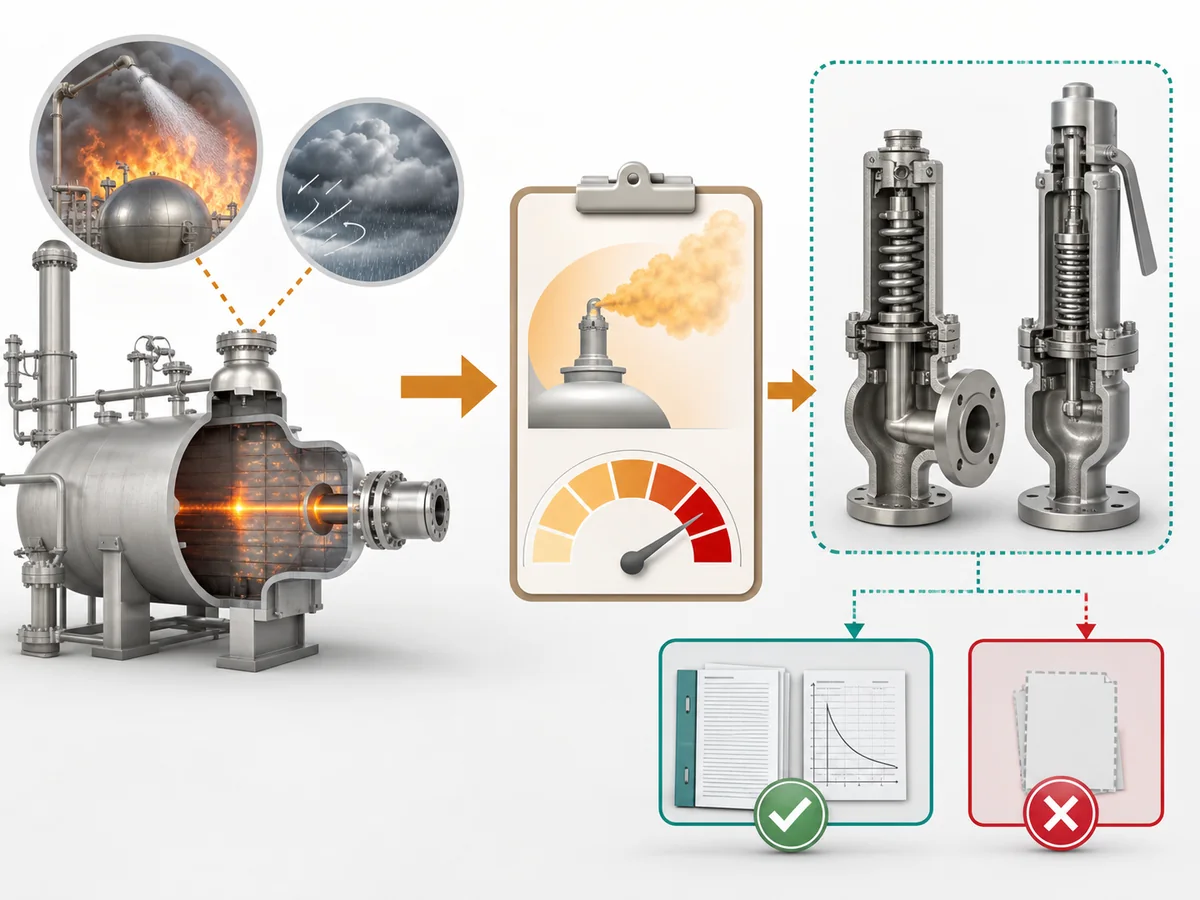
Review Discharge, Back Pressure and System Interaction
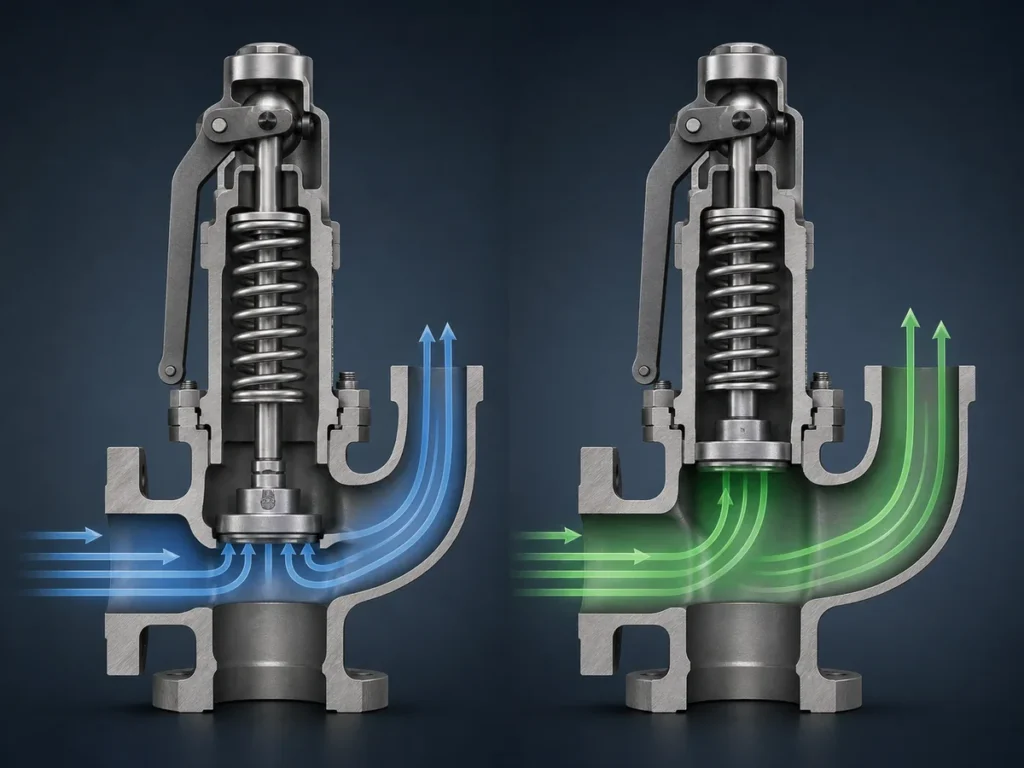
Device-capacity evidence does not close the fire-case assessment on its own. The proposed valve operates within an installed relief path, so the outlet condition used in the device assessment must be consistent with the actual downstream arrangement.
This is where valve-level acceptance and system-level acceptance need to remain distinct. API pressure-relief system guidance treats downstream disposal conditions as part of the broader relief-system context rather than as a valve-only property.
What installed outlet conditions belong in the review?
The reviewer should establish where the valve discharges, whether its outlet is independent or connected to a shared system, and whether the downstream path can create an outlet condition that matters to the device evidence being used.
Where the applicable project or installed-system documentation identifies outlet restrictions or possible liquid or condensate accumulation as relevant to the relief path, those items should be checked as part of the discharge basis. This is an installation-specific check, not a universal requirement for every LPG system.
For U.S. LP-Gas installations within the scope of the Occupational Safety and Health Administration (OSHA), OSHA also addresses discharge arrangements. Those jurisdiction-specific requirements are not generalized here beyond their applicable scope.
The task here is not to redesign the downstream piping. It is to determine whether the outlet and back-pressure information needed for device acceptance exists and is documented.
When a shared discharge arrangement becomes a system-level issue
The existence of a shared outlet does not automatically require this article to perform a network calculation.
The trigger is whether the outlet condition applicable to the valve depends on unresolved interaction with other contributors or on the hydraulics of the interconnected discharge system.
If the applicable outlet condition can be established from existing project evidence, it can be carried into the device assessment. If it cannot, the unresolved condition belongs to the downstream-system owner.
Where this review stops before flare-system design begins
This article may verify whether the discharge destination is defined, whether the relevant outlet and back-pressure information is available, whether a shared system changes that condition, and whether the device evidence can be evaluated against the established downstream condition.
It does not design the flare or disposal system, establish full network hydraulics, determine a complete set of simultaneous contributors, or approve the downstream disposal facility.
Close the Documentation Chain—or Stop the Review
The final acceptance step is a traceability check. Another qualified reviewer should be able to follow the engineering logic from the protected equipment and fire scenario through the upstream relief requirement, the proposed device evidence, and the installed discharge basis without having to infer a missing link.
Documents that appear reasonable individually do not create a defensible acceptance chain if they cannot be connected to one another.
What evidence must connect the relief basis to the installed valve
| Этап подтверждения | What must be traceable | What breaks the chain |
|---|---|---|
| Protected equipment and external-fire scenario | The pressure boundary and the fire case being assessed. | The equipment or scenario is ambiguous. |
| Project fire basis | The project-specific information used by the upstream relief analysis. | Material fire inputs cannot be traced to the project basis. |
| Relieving condition and required capacity | The engineering requirement passed into the device assessment. | The relieving basis or required duty is unresolved. |
| Proposed relief device and capacity evidence | The evidence used to judge the proposed device against the defined duty. | The evidence is missing, generic, or mismatched to the assessment basis. |
| Installed discharge and back-pressure basis | The downstream condition relevant to the device assessment. | The outlet condition depends on unresolved system interaction. |
| Review decision | The documented acceptance, hold, or request for additional engineering evidence. | The conclusion relies on an assumption inserted to bridge an unresolved link. |
Explicit stop conditions before an acceptance decision
| STOP condition | Why the review cannot close | Требуемое следующее действие |
|---|---|---|
| Protected boundary unclear | The reviewer cannot identify exactly what equipment the fire case protects. | Resolve the protected equipment and pressure boundary. |
| External-fire applicability unresolved | The project basis does not establish the scenario being assessed. | Return to the applicable project relief basis. |
| Project fire basis incomplete | Material fire-case inputs cannot be traced to the project analysis. | Obtain the missing project basis rather than substituting generic inputs. |
| Relieving condition unresolved | The fluid condition used to establish or verify capacity is not defined adequately. | Resolve the relieving-state basis upstream. |
| Required relieving capacity unavailable | There is no established upstream duty against which the device can be checked. | Return the gap to the relief analysis. |
| Valve-capacity evidence incomplete or mismatched | The supporting evidence cannot be connected confidently to the proposed device and relieving basis. | Obtain applicable device evidence before making an acceptance conclusion. |
| Outlet or back-pressure condition unresolved | The downstream condition relevant to device acceptance has not been established. | Establish the installed outlet basis. |
| Shared-system interaction requires separate analysis | The applicable outlet condition depends on unresolved interconnected-system behavior. | Route the issue to the appropriate downstream-system analysis. |
These STOP conditions do not prove that the installation fails. They identify the point at which the available evidence no longer supports an acceptance conclusion.
What information should move forward to the next engineering or RFQ step
The handoff should preserve what has already been established and make unresolved fields explicit.
- the protected equipment and applicable relief scenario;
- the available project fire basis;
- the relieving condition;
- the required relieving capacity;
- the proposed relief-device documentation;
- the applicable valve-capacity evidence;
- the installed discharge and back-pressure basis;
- any unresolved shared-system question.
This gives engineering, procurement, or a supplier a defined technical question instead of an underspecified request for an LPG safety valve for fire service.